
CPA-REGULATION Online Practice Questions and Answers
In which of the following situations may taxpayers file as married filing jointly?
A. Taxpayers who were married but lived apart during the year.
B. Taxpayers who were married but lived under a legal separation agreement at the end of the year.
C. Taxpayers who were divorced during the year.
D. Taxpayers who were legally separated but lived together for the entire year.
In evaluating the hierarchy of authority in tax law, which of the following carries the greatest authoritative value for tax planning of transactions?
A. Internal Revenue Code.
B. IRS regulations.
C. Tax court decisions.
D. IRS agents' reports.
Adams owns a second residence that is used for both personal and rental purposes. During 2001, Adams used the second residence for 50 days and rented the residence for 200 days. Which of the following statements is correct?
A. Depreciation may not be deducted on the property under any circumstances.
B. A rental loss may be deducted if rental-related expenses exceed rental income.
C. Utilities and maintenance on the property must be divided between personal and rental use.
D. All mortgage interest and taxes on the property will be deducted to determine the property's net income or loss.
On December 1, 1992, Michaels, a self-employed cash basis taxpayer, borrowed $100,000 to use in her business. The loan was to be repaid on November 30, 1993. Michaels paid the entire interest of $12,000 on December 1, 1992. What amount of interest was deductible on Michaels' 1993 income tax return?
A. $12,000
B. $11,000
C. $1,000
D. $0
In the current year Jensen had the following items:
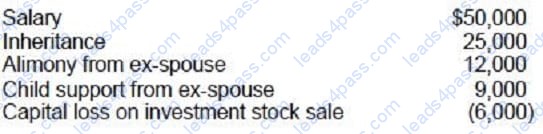
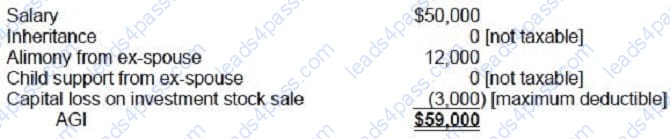
What is Jensen's AGI for the current year?
A. $44,000
B. $59,000
C. $62,000
D. $84,000
Farr made a gift of stock to her child, Pat. At the date of gift, Farr's stock basis was $10,000 and the stock's fair market value was $15,000. No gift taxes were paid. What is Pat's basis in the stock for computing gain?
A. $0
B. $5,000
C. $10,000
D. $15,000
Clark bought Series EE U.S. Savings Bonds after 1989. Redemption proceeds will be used for payment of college tuition for Clark's dependent child. One of the conditions that must be met for tax exemption of accumulated interest on these bonds is that the:
A. Purchaser of the bonds must be the sole owner of the bonds (or joint owner with his or her spouse).
B. Bonds must be bought by a parent (or both parents) and put in the name of the dependent child.
C. Bonds must be bought by the owner of the bonds before the owner reaches the age of 24.
D. Bonds must be transferred to the college for redemption by the college rather than by the owner of the bonds.
For a cash basis taxpayer, gain or loss on a year-end sale of listed stock arises on the:
A. Trade date.
B. Settlement date.
C. Date of receipt of cash proceeds.
D. Date of delivery of stock certificate.
The uniform capitalization method must be used by:
I. Manufacturers of tangible personal property.
II.
Retailers of personal property with $2 million dollars in average annual gross receipts for the 3 preceding years.
A.
I only.
B.
II only.
C.
Both I and II.
D.
Neither I nor II.
Tom and Joan Moore, both CPAs, filed a joint 1994 federal income tax return showing $70,000 in taxable income. During 1994, Tom's daughter Laura, age 16, resided with Tom. Laura had no income of her own and was Tom's dependent. Determine the amount of income or loss, if any that should be included on page one of the Moores' 1994 Form 1040. In 1992, Joan received an acre of land as an inter-vivos gift from her grandfather. At the time of the gift, the land had a fair market value of $50,000. The grandfather's adjusted basis was $60,000. Joan sold the land in 1994 to an unrelated third party for $56,000.
A. $0
B. $500
C. $900
D. $1,000
E. $1,250
F. $1,300
G. $1,500
H. $2,000
I. $2,500
J. $3,000
K. $10,000
L. $25,000
M. $50,000
N. $55,000
O. $75,000





All rights are reserved by
leads4pass.com. Any changes, copy or trademarks abuse will be
regarded as infringement.
leads4pass.com will reserve the right to pursue accountability.
Copyright © 2004-
2026 leads4pass.com.