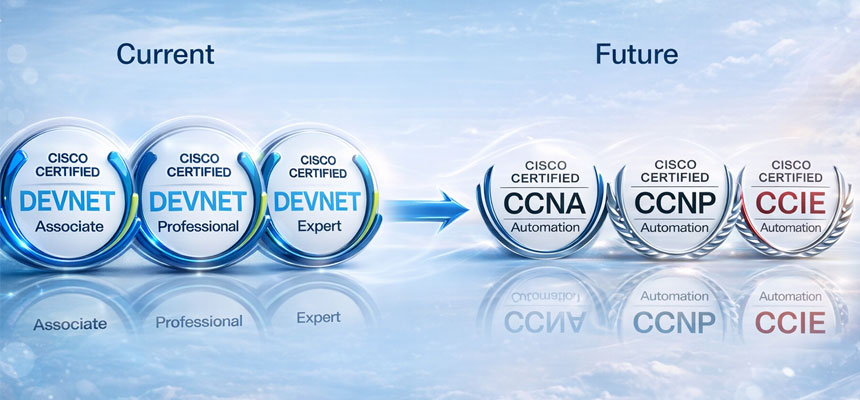
On February 3, 2026, Cisco will implement one of the most significant updates to its certification portfolio in over a decade:
The DevNet track will be rebranded as Cisco Automation and fully integrated into the familiar CCNA, CCNP, and CCIE structure.
This is more than a name change—it reflects the industry shift where automation and programmability are now core skills for network engineers.
As someone who has tracked Cisco certifications for years, I see this as a major benefit for current DevNet holders (automatic migration, no retesting) and a clear opportunity for anyone entering automation.
Below is a mobile-friendly breakdown based on Cisco’s official January 2026 tables, with practical insights and recommendations.
Key Changes Summary
Cisco has explicitly stated that all active DevNet certifications will automatically migrate to the corresponding Automation certifications on February 3, 2026—no additional exams required. This is the strongest possible protection for current certificate holders.
| Level | Original Exam/Certification | New Exam/Certification | Version & Changes | Key Dates | Notes |
|---|---|---|---|---|---|
| Associate | 200-901 DEVASC | 200-901 CCNAAUTO | v1.1 (name change only) | Effective Feb 3, 2026 | No topic changes |
| Professional Core | 350-901 DEVCOR | 350-901 AUTOCOR | v2.0 (blueprint update) | Effective Feb 3, 2026; last date for old version Feb 2, 2026 | Enhanced focus on automation design, deployment, and management |
| Concentration (select) | 300-435 ENAUTO 300-635 DCNAUTO 300-735 SAUTO 300-835 CLAUTO 300-910 DEVOPS | Same numbers, v2.0 or v1.1 | Blueprint updates or retirement | Most effective Feb 3, 2026; some last test date Feb 2, 2026 | Four concentrations (including DEVOPS) fully retired |
| Expert | DevNet Expert | CCIE Automation | Current lab topics and hardware/software lists unchanged | Automatic migration Feb 3, 2026 | Future blueprints expected to gradually incorporate AI/IaC |
Critical reminders:
- If you’re preparing for DEVCOR or one of the retiring concentration exams (e.g., SAUTO, CLAUTO, DEVOPS), aim to complete it before February 2, 2026; otherwise you’ll need to follow the new blueprint.
- The Associate level is the most seamless: only a name change, making it ideal for newcomers to start directly with the new version.
Why This Matters Now
By folding DevNet into the mainstream rather than keeping it separate, Cisco is sending three clear messages:
1.Automation is now mandatory
Gartner forecasts that by 2027, 75% of enterprise network operations will be automated. Manual configuration is rapidly giving way to Infrastructure as Code (IaC), Ansible, Terraform, and Python scripting. Elevating automation to the same level as routing/switching and security is Cisco’s direct acknowledgment of this reality.
2.Improved employer recognition
The old “DevNet” label was often misunderstood as a pure developer credential, causing it to be sidelined in hiring decisions. The new CCNA/CCNP/CCIE Automation naming aligns perfectly with traditional tracks, making its value immediately obvious to recruiters. Recent 2025 LinkedIn data shows roles requiring network automation skills command 15–25% higher average salaries than traditional CCNP positions (U.S. market).
3.Preparation for AI and multi-vendor programmability
While the current CCIE Automation lab remains largely unchanged, Cisco has hinted at future blueprint enhancements emphasizing AI-driven automation, model deployment, and cross-platform programmability—aligning with the evolution of DNA Center, Meraki, and SD-WAN.
My take: This is a rare career reset window. Traditional network engineers who skip automation risk falling behind in 3–5 years. Early adopters will gain strong advantages across security, cloud, and DevOps.
Who This Affects & What to Do
Current DevNet certificate holders
- No action required—new certificates will be issued automatically on February 3, 2026 (including updated digital badges).
- Recommendation: Update LinkedIn and resumes to highlight the new “CCIE Automation” title and actively seek AI/automation projects to stay current.
Candidates currently preparing for DevNet exams
- Associate: Continue studying 200-901—the transition is painless.
- Professional: Assess your progress. If close to passing, sprint to finish the legacy DEVCOR; if not, pivot to AUTOCOR v2.0 (blueprint released mid-2025).
- Concentration: Prioritize retained exams (ENAUTO, DCNAUTO) and avoid those scheduled for retirement.
Traditional CCNP/CCIE engineers considering automation
- Recommended path: Start with CCNA Automation (200-901) → AUTOCOR core → choose ENAUTO or DCNAUTO concentration → pursue CCIE Automation.
- Resources: Cisco U. free courses (DEVNAE, PRNE), Leads4Pass, Packet Pushers community, official Learning Matrix.
Newcomers or career switchers
- Go straight for CCNA Automation—the entry barrier is comparable to traditional CCNA, but the long-term payoff is significantly higher.
Final Takeaway
Cisco’s 2026 certification changes are not disruptive—they are evolutionary, offering the smoothest possible transition (automatic migration + clear timelines) for the entire community to move toward an automation-first era.
For network engineers, this is the ideal moment to audit your skills, map out your 2026 learning plan, and take decisive action. The industry won’t wait. Whether you rush the final legacy exam window or fully embrace the new blueprints, positioning yourself in automation now will give you a measurable head start in the career race ahead.
(This article is based on Cisco’s official January 2026 announcement tables and publicly available industry data. It is for informational purposes only—always refer to the Cisco Learning Network for the authoritative source.)