
642-242 Online Practice Questions and Answers
In the Cisco Unified Contact Center Enterprise solution, the same object is configured in multiple components.
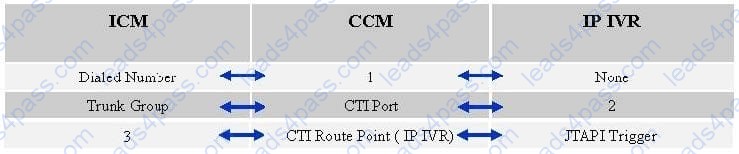
Choose the correct set of matching terms that fill in the missing object names in each component.
A. 1 = CTI route point 2 = JTAPI call control group 3 = DNIS (temporary label)
B. 1 = CTI route point 2 = None 3 = DNIS (temporary label)
C. 1 = CTI port 2 = JTAPI call control group 3 = CTI route point
D. 1 = CTI route point 2 = JTAPI call control group 3 = None
In the Cisco Unified Contact Center Enterprise solution, if a Cisco Unified Communications Manager subscriber in the Redundancy Group for the Cisco voice gateway is down, how will incoming calls be treated?
A. The voice gateway will play a "fast busy" and drop the call.
B. The voice gateway will reroute the call to a secondary CTI route point on the alternative/backup subscriber in the cluster.
C. The voice gateway will use the alternative/backup subscriber in the cluster.
D. The voice gateway will route around the subscriber to an IP IVR port on the alternative/backup subscriber in the cluster.
A default label can be configured for a dialed number in the Cisco Unified ICM Configuration Manager.
This default label is used under which two circumstances? (Choose two.)
A. It is the default and is used in all situations.
B. If a target cannot be determined within the timeout threshold of the routing client.
C. If an ICM routing script reaches an End node without having produced a target.
D. If a RONA event occurs when attempting to deliver a call to an agent.
E. If an agent call fails due to call admission control.
In a Cisco Unified ICM routing script, what is the best way to assign a sales call a higher priority in the system?
A. At the beginning of the Sales routing script, use the Queue Priority node to set the priority of all calls hitting that script to 1.
B. In the Queue to Skill Group node, set the call priority to 1 for any Sales skill group queue nodes.
C. In the Queue to Skill Group node, set the call priority to 10 for any Sales skill group queue nodes.
D. Use a Queue Priority node for support and other non-sales calls with priority 1.
In which two ways are Cisco Unified Communications Manager CTI route ports typically used in the Cisco Unified Contact Center Enterprise solution? (Choose two.)
A. to accept media for callers in the Cisco Unified IP IVR under control of the Cisco Unified Contact Center Enterprise system
B. to manage incoming call signaling from the PSTN as Dialed Numbers for the Cisco Unified Contact Center Enterprise system
C. to play media to callers for busy or disconnect tones from Cisco Unified Communications Manager
D. to provide a call-signaling transfer point as part of a Translation Route to VRU node in the Cisco Unified Contact Center Enterprise call routing script
E. to provide conference bridge resources to allow supervisors to barge into calls with agents in the Cisco Unified Contact Center Enterprise system
The Cisco Unified Contact Center Enterprise solution supports SIP-based trunks and services for inbound calls. In a SIP trunk deployment, which statement is true?
A. All inbound SIP calls must be delivered as G.711 with no compression.
B. Cisco requires the Cisco Unified Border Element to act as a Session Border Controller between the carrier SIP trunk and the customer voice network.
C. Cisco Unified IP IVR requires additional MTP resources in a SIP deployment.
D. Cisco Unified IP phones must use the SIP protocol, not SCCP, when used with SIP trunk services.
In a typical Cisco Unified Contact Center Enterprise parent/child call flow, when a call is routed by the parent ICM to the child site and an agent is no longer available at that child, what are two options that the call may do? (Choose two.)
A. be queued at the child for the next available agent
B. be automatically routed to an error message at the child
C. receive RONA treatment in the child
D. be queued at the parent for an agent at any child site
E. be terminated
In the Cisco Unified Contact Center Enterprise, using the CTI OS Desktop there is a standard button for "Supervisor Assist," which will find the team supervisor and bring them into the call.
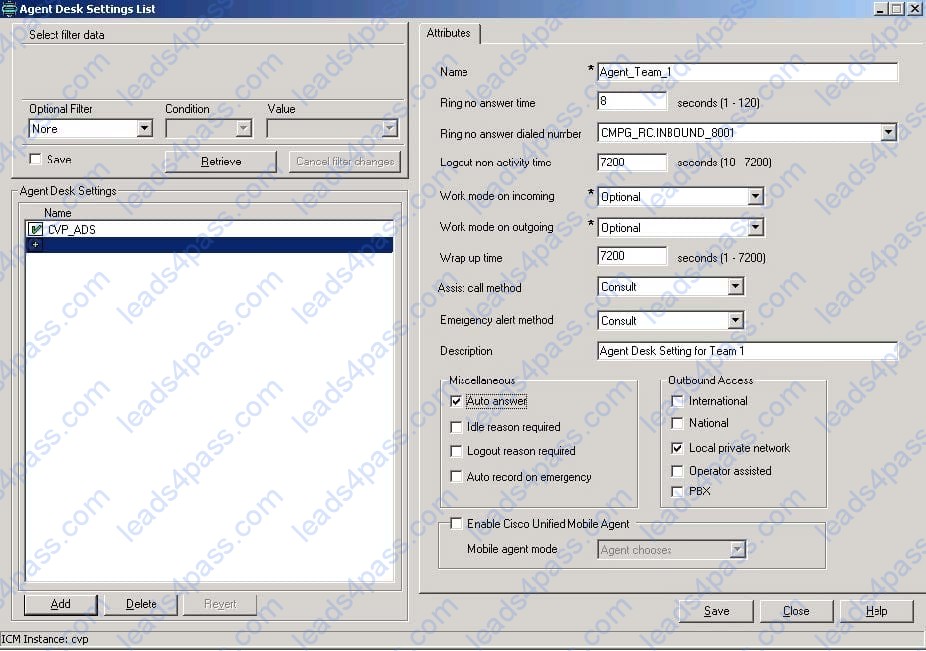
Using the Agent Desk Settings above, how is the supervisor brought into the call?
A. The supervisor will get a conference call from the agent, with just the agent first, then they can join the caller.
B. The supervisor will be joined into a conference with the agent and caller automatically.
C. The supervisor will be joined to a conference with the caller and the agent will be dropped from the call once the supervisor is connected.
D. The agent will have to manually consult the supervisor on their second line of the Cisco IP Phone.
During the system functional test of a Cisco Unified Contact Center Enterprise solution, it was found that a few calls are failing on a translation route to VRU node. When you use the call tracer tool there are no failures.
Which two configuration items should be checked? (Choose two.)
A. Check to be sure that the initial CTI route point for the ICM dialed number is associated to the IP IVR JTAPI user.
B. Check to be sure that the CTI route point for the initial ICM dialed number is not associated to the IP IVR JTAPI user.
C. Check to be sure that the Translation Route CTI route points and CTI ports for IP IVR are associated to the PG JTAPI user.
D. Check to be sure that the Translation Route CTI route points and CTI ports for IP IVR are not associated to the PG JTAPI user.
In the Cisco Unified Contact Center Enterprise solution, how are CTI route points and CTI ports created in the Unified IP IVR 4.0(x)?
A. CTI route points and CTI ports are created and associated to the IP IVR user in Cisco Unified Communications Manager Administration prior to configuring the CTI route points in the IP IVR in the CRS Administration menu.
B. CTI route points and CTI ports are created from the CRS Administration menu. The CRS Administration will automatically create and associate the CTI route points and CTI ports in Unified Communications Manager.
C. CTI route points and CTI ports are created from the CRS Administration first and then the CTI route points and CTI ports are associated to the correct user using Unified Communications Manager Administration manually.
D. CTI route points and CTI ports can either be created from the CRS Administration menu or from the Cisco Unified Communications Manager Administration as long as the CTI route points and CTI ports are associated to the correct IP IVR user profile.





All rights are reserved by
leads4pass.com. Any changes, copy or trademarks abuse will be
regarded as infringement.
leads4pass.com will reserve the right to pursue accountability.
Copyright © 2004-
2026 leads4pass.com.