
030-333 Online Practice Questions and Answers
A client with type 1 diabetes mellitus checks her fasting morning glucose level on her whole-blood glucose meter (fingerstick method), and the result of 253 mgldL (14 mmol/L). A urine test is positive for ketones before her exercise session. What action should you take?
A. Allow her to exercise as long as her glucose is not greater than 300 mgldL (17 mmol/L).
B. Not allow her to exercise this session, and notify her physician of the findings.
C. Give her an extra carbohydrate snack, and wait 5 minutes before beginning exercise.
D. Readjust her insulin regimen for the remainder of the day to compensate for the high morning glucose level.
Which the following statements regarding intensity of resistance training is FALSE?
A. The number of repetitions to volitional fatigue will vary inversely with resistance.
B. It is necessary to determine the 1- RM to establish training intensity.
C. Exercise to volitional fatigue is not dangerous from a musculoskeletal standpoint provided that good exercise form is maintained.
D. Exercise intensity should be similar for males and females.
To lose one pound (=0.5 kg) of body fat, how much of an energy deficit must be created by diet and or physical activity?
A. 2,000 kcal.
B. 2,500 kcal.
C. 3,000 kcal.
D. 3,500 kcal.
Which of the following statements about injury reporting is NOT correct?
A. A process for injury reporting, backed up with a form, should be developed.
B. The process to be used and the accompanying forms must be part of the PandP manual.
C. Injury reporting forms must be kept under lock and key, just like data records.
D. A physician should sign every injury report form that is filed.
A 143-pound woman regularly exercises on a treadmill at a speed of 5.5 mph and a 2% elevation. What is her caloric expenditure?
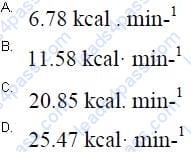
A. B. C. D.
Which of the following conditions can prolong the QT interval?
A. Hypokalemia and hypercalcemia.
B. Hyperkalemia and hypercalcemia.
C. Hypocalcemia and hypokalemia.
D. Hypocalcemia and hyperkalemia.
Tall, positive T waves may be caused to all of the following EXCEPT:
A. Hyperacute phase of MI.
B. LVH.
C. Acute pericarditis.
D. Hypocalcemia.
Right-axis deviation may be caused by:
A. Acute pericarditis.
B. Right atrial enlargement.
C. Chronic obstructive pulmonary disease.
D. Cardiomyopathy.
Myocardial cells can be excited in response to all of the following stimuli EXCEPT:
A. Electrical
B. Chemical
C. Mechanical
D. Emotional
The P wave on the ECG can be:
A. Negative
B. Positive
C. Isoelectric
D. Either positive or negative





All rights are reserved by
leads4pass.com. Any changes, copy or trademarks abuse will be
regarded as infringement.
leads4pass.com will reserve the right to pursue accountability.
Copyright © 2004-
2026 leads4pass.com.