
USMLE-STEP-3 Online Practice Questions and Answers
A 65-year-old man presents to your office for evaluation of abdominal pain. The patient states that he has epigastric pain that radiates to his back. The pain is worse with eating and improves with fasting. The pain has been present for 6 months and is gradually worsening. The patient has lost 15 lbs but feels his oral intake has been adequate. He complains of greasy stools and frequent thirst and urination. Examination reveals a thin male with temporal wasting and oderate abdominal pain with palpation. The patient consumes approximately 1015 beers per day and smokes a pack of cigarettes per day for the past 20 years. What would be the best initial test to do in this patient?
A. spot fecal fat collection
B. 72-hour fecal fat collection
C. CT scan of the abdomen
D. ERCP
E. upper endoscopy
A 60-year-old woman arrives at your office for a routine physical examination. During the course of her examination she asks you about osteoporosis. She is concerned about her risk for osteoporosis, as her mother suffered from multiple vertebral compression fractures at the age of 60. Your patient reports that she still smokes cigarettes ("although I know they are bad for me") and has one alcoholic beverage a week. She reports having had menopause 5 years ago and experiencing a deep venous thrombosis approximately 20 years ago. She is proud of the fact that she regularly exercises at the local fitness center. She has been taking 1500 mg of calcium with 800 IU of vitamin D every day. You suspect that she is at risk for osteoporosis. After a thorough discussion with your patient, you determine that pharmacologic intervention would be beneficial given the severity of her osteoporosis. Which of the following is most appropriate for your patient?
A. estrogen replacement therapy
B. combined HRT with estrogen and progestin
C. alendronate
D. calcitonin intranasal spray
E. raloxifene
An 18-year-old female presents for follow-up of a rash. She states that she has been using OTC antifungal preparations without success. She used OTC cortisone cream with mild improvement, but the lesions never disappeared. Her condition also recurred with full severity once the cortisone cream was discontinued. Her family history reveals a first degree relative with similar rash. The rash is over the elbows, trunk, and scalp .
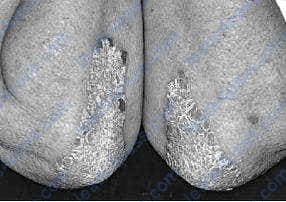
Which of the following tests is most likely to confirm your clinical suspicion?
A. ESR and ANA
B. KOH prep and microscopic analysis of scraping from rash
C. biopsy of the involved area
D. capillary microscopy
E. Lyme titers
A 25-year-old woman with acute myelocytic leukemia is undergoing induction chemotherapy and presents to the Emergency Center complaining of a 1-day history of fever to 102º F with no other symptoms. Other than having a fever, her vital signs and physical examination are normal. Laboratory evaluation reveals pancytopenia, with a WBC count of 0.3 k/L, hemoglobin concentration of 9.2 mg/dL, and platelet count of 23,000/L. What is the most appropriate initial management?
A. Obtain blood cultures, urine culture, a chest x-ray, and discharge patient to home with follow-up in 12 days to review culture results.
B. Obtain blood cultures, urine culture, a chest x-ray, and admit the patient to the hospital for observation with plan to institute antibiotics if any culture becomes positive.
C. Obtain blood culture, urine culture, a chest x-ray, and admit the patient to the hospital for empiric broad-spectrum antibiotics with Gram-negative coverage.
D. Obtain blood culture, urine culture, a chest x-ray, and admit the patient to the hospital for empiric antibiotics with Gram-positive coverage.
E. Forego cultures and admit the patient to the hospital for empiric antibiotics with both Gram-positive and Gram-negative coverage.
A patient presents to the ED complaining of abdominal pain out of proportion to her examination. Initial vital signs are: BP 70/30, HR 120. The patient does report a prior history of abdominal pain after eating. Which of the following statements regarding this condition is most accurate?
A. A CT scan which shows superior mesenteric artery (SMA) thrombosis or bowel wall thickening requires an immediate operation.
B. The most common site of embolic event is the SMA.
C. Nonocclusive mesenteric ischemia is treated with arterial bypass.
D. Patients with cardiac arrhythmias arenot at increased risk.
E. After volume resuscitation, the initial diagnostic study for this patient is esophagogastroduodenoscopy (EGD).
You are called to see a newborn in the nursery because the nurse is concerned that the baby may have Down syndrome.
Which of the following signs is associated with Down syndrome?
A. café au lait spots
B. high arched palate
C. ambiguous genitalia
D. hypotonia
E. club feet
A mother brings her 15-year-old son in for a preparticipation sports physical examination. She feels that her son has not yet undergone pubertal changes and that makes her concerned.
Which of the following is a true statement regarding puberty delay?
A. The onset of puberty in males is earlier than that in females.
B. A puberty delay is not considered pathologic unless accompanied by short stature.
C. Hypothyroidism can be a cause of pubertal delay.
D. Males do not have a true adrenarche as females do.
E. The most common cause for pubertal delay is pan-hypopituitarism.
A35-year-old woman with two prior term pregnancies presents for her first prenatal visit at 12 weeks' gestation. She recalls having had hypertension near the end of her first pregnancy. She believes her blood pressure has been normal since, but admits that she rarely seeks preventive health care visits, and that her last examination by a physician was more than 2 years ago. Today, you find her blood pressure to be 160/100.
Which of the following antihypertensive agents would be contraindicated for management of her hypertension during pregnancy?
A. labetalol
B. alpha-methyldopa
C. enalapril
D. nifedipine
E. hydralazine
A 30-year-old woman with a prior history of depression is attending her postpartum followup appointment after the birth of her first child. She has no physical complaints and her examination demonstrates no significant problems. She appears anxious. When asked, she describes intrusive thoughts of wanting to harm her baby but quickly states, "I'm not like that. I would never do anything to hurt him."
Which of the following is the most appropriate next step in her management?
A. assess further for symptoms of psychosis and support system
B. begin immediate treatment with an antidepressant
C. call child protective services in order to have the child removed
D. hospitalize the woman immediately for further evaluation
E. reassure her that these thoughts are normal
A54-year-old Asian female with no significant medical history presents with frontal headache, eye pain, nausea, and vomiting. Her abdominal examination shows mild diffuse tenderness but no rebound or guarding. Her mucous membranes are dry. Her vision is blurry in both eyes, her eyes are injected but her extraocular muscles are intact. Her pupils are mid-dilated and fixed.
Which of the following is most likely to provide a diagnosis?
A. abdominal ultrasound
B. emergency exploratory laparoscopy
C. MRI of the brain
D. arterial blood gas
E. ocular tonometry





All rights are reserved by
leads4pass.com. Any changes, copy or trademarks abuse will be
regarded as infringement.
leads4pass.com will reserve the right to pursue accountability.
Copyright © 2004-
2026 leads4pass.com.