
SBAC Online Practice Questions and Answers
FILL BLANK
Mike earns $6.50 per hour plus 4% of his sales.
Enter an equation for Mike's total earnings, E, when he works x hours and has a total of y sales, in dollars.
A.
See explanation below.
FILL BLANK
Student Directions
Mandatory Financial Literacy Classes Argumentative Performance Task
Task:
In your economics class, you are discussing the importance of making smart financial decisions. Your teacher tells you that, in some school districts, students are required to take a financial literacy class before graduating. Your school board
is hosting a meeting to decide whether to offer such a course for graduation, and wants students to contribute their perspectives. As part of your initial research, you have found four sources about financial literacy classes.
After you have reviewed these sources, you will answer some questions about them. Briefly scan the sources and the three questions that follow. Then, go back and read the sources carefully so you will have the information you will need to
answer the questions and finalize your research. You may click on the Global Notes button to take notes on the information you find in the sources as you read. You may also use scratch paper to take notes.
In Part 2, you will write an argumentative essay on a topic related to the sources.
Directions for Beginning:
You will now examine several sources. You can re-examine any of the sources as often as you like.
Research Questions:
After looking at the sources, use the rest of the time in Part 1 to answer three questions about them. Your answers to these questions will be scored. Also, your answers will help you think about the information you have read and looked at,
which should help you write your argumentative essay.
You may click on the Global Notes button or refer back to your scratch paper to look at your notes when you think it would be helpful. Answer the questions in the spaces below the items.
Both the Global Notes on the computer and your written notes on scratch paper will be available to you in Part 1 and Part 2 of the performance task.
Part 1
Sources for Performance Task:
Source #1
This article, from April 9, 2010, is from the New York Times, and is about the potential benefits of financial literacy courses.
Working Financial Literacy in With the Three R's
by Tara Siegel Bernard
Most Americans aren't fluent in the language of money. Yet we're expected to make big financial decisions as early as our teens– Should I take on thousands of dollars of student debt? Should I buy a car? – even though most of us received
no formal instruction on financial matters until it was too late.
While no course in personal finance could have prevented many Americans from getting caught up in the housing bubble1, it's clear that most of us need some help, preferably starting when we're still in school. And I'm not just talking about
learning to balance your checkbook. Its understanding concepts like the time value of money, risk and reward, and, yes, the importance of savings.
All of this raises the question: What's happening inside our classrooms? And how many schools even broach the topic? As it turns out, for a country that prizes personal responsibility, we're doing very little.
"We need to teach the basics of economics and finances so people can make financial decisions in a changing world," said Annamaria Lusardi, economics professor at Dartmouth College and a research associate at the National Bureau of
Economic Research. "It's the compounding of interest2, the problem of inflation3. These are the principles. And these are really scientific topics.”
While more states are beginning to require some sort of personal finance instruction, there aren't enough that do, financial literacy experts say, and there is little consistency in the quality of the education. Just 13 states require students to take
a personal finance course or include the subject in an economics course before they graduate from high school, up from seven states in 2007, according to the Council for Economic Education. Meanwhile, 34 states (including those 13) have
personal finance within their curriculum guidelines, up from 28 states in 2007…
But that hasn't stopped enterprising teachers like Mathew Frost, who teaches 11th and 12th graders American history and economics at Sunset High School in Dallas, from working the topic into his student's school day. The Texas economics
curriculum carves out time for personal finance, but it doesn't test students on the material. Mr. Frost says it's just too important to ignore. So he tries to bring the lesson to life for his students by pairing them up as married couples and giving them a couple of children. The students must then create a budget based on the average income range for their neighborhood, or about $21,000 to $40,000 a year. As in the board game “Life," the students are dealt real-world circumstances. Mr. Frost has them randomly pick "chance cards" from a bag, which might tell them they need new brakes for their car, broke an arm, suffered a death in the family, or found $20.
"I try to make it as realistic as possible," he said. "We talk about building budgets, expenses, investing money," he added, as well as "how to use credit wisely, insurance and careers."
One of his students later wrote about the experience. The 11th grader, who simulated life with a wife and two children on $21,000 a year, told of balancing needs versus wants, trying to find an apartment in a safe neighborhood that fit the
family budget, and the effect of an unexpected rent increase on their savings.
"I first learned that real life isn't going to be as nice as this game," he said. "I also learned that good budgeting has to be maintained throughout a person's life no matter the income, no matter the living conditions."
Research shows that this type of financial education tends to resonate with the students later.
Michael S. Gutter, an assistant professor of family financial management at the University of Florida, studied the issue in 2009, after he surveyed 15,700 students at 15 universities who came from states with different (or nonexistent) personal
finance schooling requirements. The study was financed by the National Endowment for Financial Education, a nonprofit organization in Denver that provides financial education curriculums.
"College students who came from states where there was a course required were more likely to budget, were more likely to be saving, and were less likely to have maxed out their credit cards in the last year and were more likely to be paying
off their credit cards fully," Professor Gutter said. But his research also suggested that "social learning is also very powerful as well," he said. "What your parents tell you matters.”
"It's hard because there is no silver bullet to get this into every school," said Matthew Yale, deputy chief of staff to Education Secretary Arne Duncan. "It's not as simple as saying, ‘We're going to institute this in the 100,000 public schools in
America.’ But our plan for reauthorization does make room for financial literacy in schools, which is a really big, big deal." Mr. Yale was referring to the Obama administration's plan to revise the Elementary and Secondary Education Act,
commonly known as No Child Left Behind. He said the Department of Education's next step is to work with districts and teachers and help them find the money they need, whether it's through the many literacy-minded nonprofits or the private sector. Mr.Yale also said that department officials were working on competitive grant programs, which would allow schools to compete for money to pay for the financial literacy programs. As a joint effort with the Treasury Department, the Education Department is currently running the National Financial Capability Challenge, an online exam for high school students that measures financial know-how and recognizes outstanding performers, to help raise awareness.
President Bush created the first Advisory Council on Financial Literacy in 2008, and President Obama plans to assemble his own team. In its annual report, the first council recommended that Congress or state legislatures mandate financial education in all schools for students in kindergarten through 12th grade. But the new administration follows through with that recommendation? Mr. Yale said education officials were "not interested in introducing unfunded mandates."
So what can we do? According to Scott Truelove, who teaches personal finance as part of a work-study program for seniors at Chesterton High School in Indiana, "It will take a parent movement."
Mr. Truelove has already seen the power of financial education in his school's hallways, where a student told him and another personal finance teacher that she set up a Roth 1.R.A.* given what she learned in class.
"That, to me, is huge," Mr. Truelove said.
1ousing bubble: when housing prices rapidly increase to unsustainable levels and then collapse
2compound interest: interest paid on both the original amount of money invested and on the interest it has already earned
3inflation: a general increase in prices that decrease the purchasing power of money
4“Roth I.R.A.: a type of individual retirement account
Bernard Siegal, Tara. (2010, April 9). Working Financial Literacy in With the Three R's. The New York Times. Retrieved from http://www.nytimes.com/2010/04/10/your-money/10money.html
Source #2
In this article from February 6, 2009, the Chicago Tribune discusses problems with financial literacy education. Financial Education Leaving Americans Behind by Greg Burns
With so many personal finance decisions turning into disasters, a chorus of voices is singing the praises of financial-literacy education.
Make every American a financial whiz, the thinking goes, and credit bubbles never will bedevil us again.
Trouble is, growing evidence suggests that financial-literacy courses don't work. Worse, they may actually hurt, in part by making their graduates overconfident about limited skills.
Few want to hear that message, according to Lauren Willis, a professor at Loyola Law School in Los Angeles, whose recent paper, "Against Financial Literacy
Education,” shook up all sorts of vested interests. . . .
Plenty of people make a living off these courses, and lawmakers love them, since they give the impression that something is being done about the intractable problem of financial ignorance.
Utah, Missouri, and Tennessee require students to take a semester-long personal-finance class before graduating from high school. Illinois and 16 other states incorporate financial education into other subjects–by decree, of course.
The Indiana Senate this month approved a bill that would require "personal financial responsibility" to be taught from kindergarten through high school. Its sponsor described it as an appropriate response to "difficult times." Other states are
mulling expanded mandates
These measures don't affect only youth. Adults face similar obligatory instruction when they seek bankruptcy protection or, in some cases, apply for loans.
Academics have known for years about the scant evidence in support of the programs, but few are willing to go as far as Willis in bluntly denouncing them as a counterproductive racket."
She cites examples, such as the high school students who took a semester-long personal finance course and tested worse than those who didn't. Or the graduates of retirement-planning classes who thought their literacy had increased, when
their financial test scores had not.
Now comes a study from Harvard Business School raising more doubts. Using rigorous methodology, it concluded that programs in widespread use during the past two decades were no use at all.
"They weren't effective in changing people's financial decisions," said Shawn Cole, one of two professors behind the report, titled "If You Are So Smart, Why Aren't You Rich?"
"We find no effect," he said. "My gut feeling is that teaching math or statistics would be more useful."
Still, Cole believes it may be possible to design an effective program. That's a common theme among those who favor financial education: Just because no one has proven these courses work is no reason to give up searching for the right
formula.
Willis has other ideas. She wants to forget about making Americans capable of handling their credit and investment needs – most will never get there, especially given the fast-moving, complicated nature of financial services.
She favors pro-consumer regulation and one-on-one counseling with unbiased advisers. Sure, those could be tough to come by. But no one said saving Americans from themselves would be easy.
1racket: a dishonest scheme or business activity
Burns, Greg. (2009, February 6). Financial Education Leaving Americans Behind. Chicago Tribune. Retrieved from http://articles.chicagotribune.com/2009-02-16/news/0902150143_1_financial-literacy-financial-literacy-education-financial
ignorance.
Source #3 This October 6, 2013 article from the New York Times is about the drawbacks of financial literacy courses, and what the research shows about teaching financial literacy skills. Financial Literacy, Beyond the Classroom
by Richard H. Thaler
Even if we grade on a very generous curve, many Americans flunk when it comes to financial literacy. Consider this three-item quiz:
Suppose you had $100 in a savings account and the interest rate was 2 percent a year. After five years, how much do you think you would have if you left the money to grow? More than $102, exactly $102 or less than $102?
Imagine that the interest rate on your savings account was 1 percent a year and that inflation was 2 percent. After one year, would you be able to buy more than, the same as, or less than you could today with the money?
Do you think this statement is true or false: "Buying a single company stock usually provides a safer return than a stock mutual fund"?
Anyone with even a basic understanding of compound interest, inflation and the answers to these questions are "than" and "false." Yet in a survey of Americans over age 50 conducted by the economists Annamaria Lusardi of George
Washington University and Olivia S Mitchell of the Wharton School of the University of Pennsylvania, only a third could answer all three questions correctly.
This is particularly troubling given the inherent complexity of our modern economy. Whether in taking out a student loan, buying a house, or saving for retirement, people are being asked to make decisions that are difficult even if they have
graduate training in finance and economics. Throwing the financially illiterate into that maelstrom is like taking students currently enrolled in driver's education and asking them to compete in the Indianapolis 500.
A popular approach to this problem is to work harder to improve financial literacy – for example, by including household finance in the basic high school curriculum. One reason to think this solution will have big payoffs is that people who are
more knowledgeable about financial matters, as measured by a test, perform better at tasks like saving for retirement and staying out of debt. This may seem a straightforward argument in support of financial literacy courses. Unfortunately, it
isn't.
The problem is that measured financial literacy is highly correlated with other factors, most notably higher education in general, so it's hard to sort out causes. (The ability to solve the Sunday crossword puzzle is probably also positively correlated with good financial outcomes.) So to see whether a financial education curriculum is likely to pay dividends, we should review specific efforts to shore up financial skills in those who are deficient, and not just measure what people already know.
A new paper by three business school professors – Daniel Fernandes of Erasmus University in the Netherlands and the Catholic University of Portugal, John G. Lynch Jr. of the University of Colorado, and Richard Netemeyer of the University of Virginia – presents a discouraging assessment of attempts to teach people how to deal with money. Their article uses a technique called meta-analysis,” looking at results from 168 scientific studies of efforts to teach people to be financially astute, or at least less clueless.
The authors’ conclusions are clear: over all, financial education is laudable,* but not particularly helpful. Those who receive it do not perform noticeably better when it comes to saving more, for example, or avoiding ruinous debt. . . .
Don't get me wrong. I am all for trying to teach household finance in schools, starting as early as possible. And when it comes to high school, I think learning about compound interest is at least as important as trigonometry or memorizing the
names of all 50 state capitals. If we try enough approaches, and evaluate what works, we may improve such programs' effectiveness. But we shouldn't fool ourselves into thinking that adding a household finance class to a high school
curriculum will in itself create knowledgeable consumers who can understand today's wide array of financial products.
…In the meta-analysis, even the most time-intensive programs – those with more than 24 hours of education and training, almost the length of a college course – had no discernible effects just two years later.
It would be premature to conclude that all efforts at improving financial literacy are futile. But it is a fair conclusion that simply doing more of the training commonly used now will not produce significant results. So what else might we try?
Although no approach offers a panacea,” three types of efforts seem worthy of more attention.
The first is what Professor Lynch, one of the authors of the meta-analysis, calls just-in-time education.
Because learning decays quickly, it's best to provide assistance just before a decision is made. High school seniors should receive help in how to think about a student loan and how to make sure that the education bought with the loan offers
good prospects for repayment. Just-in-time education can be offered at other crucial moments–when taking out a mortgage or figuring out when to retire. But unless such education is compulsory, many of the consumers most in need of help
don't take advantage of it. And we need to be sure not to confuse self-serving marketing5 with objective advice.
Another approach is to offer simple rules of thumb to help people cope. Because few people can calculate how much they need to save for a comfortable retirement, it might help to offer simple guidelines like “invest as much as possible in
your 401(k) plan, H6 “save 15 percent of your income," or "get a 15-year mortgage if you are over 50."
One example comes from a field experiment involving microentrepreneurs7 in the Dominican Republic. Of those who expressed an interest in receiving help, some were offered training in basic accounting principles while others were given
simple rules of thumb. The accounting education did not have apparent effects, but simple rules – like keeping personal money and business money in separate drawers – led to better outcomes. This seemingly trivial concept helped small-
business owners keep better track of how their businesses were faring.
The third approach, and the one I believe offers the best prospects of immediate help, is to make our financial system more user-friendly. You don't need to be a computer scientist to use a smartphone. If we made choosing a suitable
mortgage as easy as checking the weather in Timbuktu, fewer households would find themselves underwater* when real estate markets tumble…
The same principle can be used in other areas, from credit cards to checking accounts. The financial services industry – either on its own or as required by government regulators – needs to find ways to make it easier for people to make
sound decisions. And those financial firms that engage in fraudulent practices should be prosecuted and stopped.
1diversification: investing in different assets in order to minimize risk
2meta-analysis: an analysis of several separate but similar studies to determine if an observed effect is not due to chance alone
3laudable: praiseworthy
4panacea: a solution or remedy for all difficulties or diseases
5self-serving marketing: surveys, top 10 lists, and technical papers that contain seemingly useful consumer information but are being used as a marketing strategy
6401(k) plan: a retirement savings plan in which deductions are automatically made from an employee's paycheck before taxes are deducted and that are sometimes matched by the employer
7microentrepreneur: operator of a microenterprise, or very small business; microenterprises typically employ fewer than ten people and have relatively low start-up costs
8 underwater: when an individual owes more on a loan than the market value of the loan; this term is typically applied to home mortgages
Thaler, Richard H. (2013, October 6). Financial Literacy, Beyond the Classroom. New York Times. Retrieved from http://www.nytimes.com/2013/10/06/business/financial-literacy-beyond-the-classroom.html.
Source #4
This article, from October 15, 2006, is from the Baltimore Sun and is about concerns surrounding mandated financial literacy classes. Finance Course Prompts Debate by Gina Davis
While Carroll County students will be required to take a financial literacy course to graduate starting next year, concerns linger over whether mandating the course is the most effective way to teach money matters to teens.
"The course is likely a good thing, but I am convinced it is not the best thing," school board President Thomas G. Hiltz said last week. "One course is not a panacea and, alone, will not make our students financially literate."
After a lengthy debate about requiring the class, board members voted 4-1 to require students beginning next school year to take the half-credit course. It will cover concepts such as money management, consumer rights and responsibilities,
credit, savings, and investing.
Carroll joins a handful of Maryland school systems – including Harford, St. Mary's, Talbot and Baltimore counties–with a similar requirement.
The financial course was one of several changes to the high school program of studies that the board approved.
During last week's meeting, Hiltz joined Cynthia L. Foley in supporting a motion to amend the proposal that would have eliminated financial literacy as a required course. The motion to amend failed in a 3-2 vote.
Foley was the lone dissenter1 when the original proposal came to a vote. Hiltz said he voted to approve the high school program of studies that included the financial literacy requirement because he supported the overall plan.
“While it did not turn out the way I may have wanted... unless I believe there has been an egregious mistake in judgment, a vote against the entire high school program of studies is, in my view, sour grapes," Hiltz said in an email.
During the meeting, Hiltz suggested the board needed more time to consider alternatives, such as incorporating elements of the course into already required classes or developing a comprehensive “financial literacy program," not a single
course.
Hiltz also said a required course would necessitate about 10 teachers each year and cost the system about $600,000 annually.
"My overwhelming concern is not cost – it is effectiveness," Hiltz said. "The $600,000 is a low cost if the course is effective. An effective course will return that investment. It is a high cost if it is ineffective."
School officials said statistics suggest teens and young adults are assuming too much credit card debt and are not knowledgeable about finances.
About one in five students gets a personal finance course during high school, according to the JumpStart Coalition for Personal Financial Literacy, which surveys high school seniors every other year to gauge financial aptitude.
Of the 5,775 high school seniors in 37 states who participated in that survey this year, students on average scored 52.4 percent on 30 questions, according to the group.
A 2004 poll of college administrators found that excessive credit card debt was the primary reason students dropped out and the secondary reason was low grades, according to the Maryland Coalition for Financial Literacy.
Carroll school officials said last week that in a "pre-test" given to about 30 students taking the
financial literacy elective this semester, the highest score was about 60 percent–with some students scoring much lower.
"Personal finances are not being taught in the home," said Patricia Hummel, a parent who also teaches financial literacy at Winters Mill High as a permanent substitute. "Studies have shown that only 26 percent of 13- to 21-year-olds reported
that their parents actively taught them how to manage money.”
Hummel supported a required financial literacy course because, "unless this class is mandated, students will not take advantage of the class."
Hiltz said that while the district has piloted [tested] a financial literacy course, no local data has been collected on its effectiveness.
"We all agree that financial literacy is essential," he said. "The lack of a real consideration of other options … troubled me greatly. I am concerned that we picked low-hanging fruit, which may be the most expensive and least effective option.”
1dissenter: someone who disagrees with a particular view
Davis, Gina. (2006, October 15). Finance Course Prompts Debate. Baltimore Sun. Retrieved from http://articales.baltimoresun.com/2006-10-15/news/0610140104_1_hiltz-high-school-program-financial-literacy.
Student Directions
Mandatory Financial Literacy Classes Argumentative Performance Task
Part 2
You will now review your notes and sources, and plan, draft, revise, and edit your writing. You may use your notes and refer to the sources. Now read your assignment and the information about how your writing will be scored; then begin your
work.
Your Assignment:
After completing your research, you share your findings with your teacher, who suggests that you write an argumentative essay about financial literacy courses for the upcoming school board meeting.
Today, in preparation for the school board meeting, you will write a multi-paragraph argumentative essay in which you take a stance on the topic of financial literacy courses. Make sure you establish an argumentative claim, address potential
counterarguments, and support your claim from the sources you have read. Develop your ideas clearly and use your own words, except when quoting directly from the sources. Be sure to reference the sources by title or number when using
details or facts directly from the sources.
Argumentative Essay Scoring:
Your argumentative essay will be scored using the following:
1.
Organization/purpose: How well did you state your claim, address opposing claims, and maintain your claim with a logical progression of ideas from beginning to end? How well did your ideas thoughtfully flow from beginning to end using effective transitions? How effective was your introduction and your conclusion?
2.
Evidence/elaboration: How well did you integrate relevant and specific information from the sources? How well did you elaborate your ideas? How well did you clearly state ideas in your own words using precise language that is appropriate for your audience and purpose? How well did you reference the sources you used by title or number?
3.
Conventions: How well did you follow the rules of grammar usage, punctuation, capitalization, and spelling?
Now begin work on your argumentative essay. Manage your time carefully so that you can
plan your multi-paragraph argumentative essay
write your multi-paragraph argumentative essay
revise and edit the final draft of your multi-paragraph argumentative essay
Word-processing tools and spell check are available to you.
For Part 2, you are being asked to write a multi-paragraph argumentative essay so be as thorough as possible. Type your response in the space provided. The box will expand as you type.
Remember to check your notes and your prewriting/planning as you write and then revise and edit your argumentative essay.
A.
See explanation below.
Read the story attached.
"Roughing It" by Mark Twain
My brother had just been appointed Secretary of Nevada Territory ?an office of such majesty that it concentrated in itself the duties and dignities of Treasurer, Comptroller, Secretary of State, and Acting Governor in the Governor's absence. A salary of eighteen hundred dollars a year and the title of "Mr. Secretary," gave to the great position an air of wild and imposing grandeur. I was young and ignorant, and I envied my brother. I coveted his distinction and his financial splendor, but particularly and especially the long, strange journey he was going to make, and the curious new world he was going to explore. He was going to travel! I never had been away from home, and that word "travel" had a seductive charm for me. Pretty soon he would be hundreds and hundreds of miles away on the great plains and deserts, and among the mountains of the Far West, and would see buffaloes and Indians, and prairie dogs, and antelopes, and have all kinds of adventures, and may be get hanged or scalped, and have ever such a fine time, and write home and tell us all about it, and be a hero. And he would see the gold mines and the silver mines, and maybe go about of an afternoon when his work was done, and pick up two or three pailfuls of shining slugs, and nuggets of gold and silver on the hillside. And by and by he would become very rich, and return home by sea, and be able to talk as calmly about San Francisco and the ocean, and "the isthmus" as if it was nothing of any consequence to have seen those marvels face to face.
What I suffered in contemplating his happiness, pen cannot describe. And so, when he offered me, in cold blood, the sublime position of private secretary under him, it appeared to me that the heavens and the earth passed away, and the firmament was rolled together as a scroll! I had nothing more to desire. My contentment was complete.
At the end of an hour or two I was ready for the journey. Not much packing up was necessary, because we were going in the overland stage from the Missouri frontier to Nevada, and passengers were only allowed a small quantity of baggage apiece. There was no Pacific railroad in those fine times of ten or twelve years ago ?not a single rail of it. I only proposed to stay in Nevada three months ?I had no thought of staying longer than that. I meant to see all I could that was new and strange, and then hurry home to business. I little thought that I would not see the end of that three-month pleasure excursion for six or seven uncommonly long years! I dreamed all night about Indians, deserts, and silver bars, and in due time, next day, we took shipping at the St. Louis wharf on board a steamboat bound up the Missouri River. We were six days going from St. Louis to "St. Jo." ?a trip that was so dull, and sleepy, and eventless that it has left no more impression on my memory than if its duration had been six minutes instead of that many days. No record is left in my mind, now, concerning it, but a confused jumble of savage-looking snags, which we deliberately walked over with one wheel or the other; and of reefs which we butted and butted, and then retired from and climbed over in some softer place; and of sand-bars which we roosted on occasionally, and rested, and then got out our crutches and sparred over.
In fact, the boat might almost as well have gone to St. Jo. by land, for she was walking most of the time, anyhow ?climbing over reefs and clambering over snags patiently and laboriously all day long. The captain said she was a "bully" boat, and all she wanted was more "shear" and a bigger wheel. I thought she wanted a pair of stilts, but I had the deep sagacity not to say so.
The narrator of the attached story experiences a variety of feelings about his brother's appointment to serve as Secretary of Nevada Territory. Among the emotions he describes are these three.
A. joy, pity, and disgust
B. concern, anger, and elation
C. uneasiness, surprise, and hostility
D. envy, jealousy, and excitement
Read the paragraph attached.
Teeth Grinding Can Be A Real Headache
Did you know that if you suffer from nagging headaches ?including migraines, tension headaches and behind-the-eye pain ?your teeth could be the root of your problem? Involuntary and excessive clenching and grinding of the teeth (known in medical terms as bruxism) is a common condition, so prevalent that it affects 1 in 5 adults in the U.S. And this number continues to increase. It's probably no surprise to learn that bruxism can result in significant tooth wear and enamel erosion, leading to tooth surface sensitivity, chipped and fractured teeth, as well as a host of other dental issues that may require expensive treatment. But, what you may not realize is that over 90 percent of bruxism sufferers also experience headache pain caused by their teeth grinding. If you think about it, the link between teeth and jaw clenching, and headaches caused by teeth grinding, makes a lot of sense. Because the jaw is capable of exerting more than 250 pounds of force when clenching, this amount of force can crack a walnut. This extreme tooth-on-tooth force helps explain tooth wear caused by teeth grinding and may also lead to temporomandibular joint (TMJ) pain and potential TMJ issues from teeth grinding. The temporomandibular joints are flexible joints found on each side of your head in front of the ear. Responsible for all jaw movements including eating and talking, they are the most active joints in your body and thus endure a lot of wear and tear. They connect the lower jaw to the temporal bone of the skull. Excessive teeth clenching and grinding, which generally occurs during sleep, puts pressure on these joints and as a result can cause far-reaching pain in your temples, behind the eyes, in the back of your neck and through your cheeks and ears. The exact cause of bruxism is not known, but it is widely believed that stress is a primary trigger and once the stressful event has passed, the clenching and grinding usually subsides. However, the amount of damage and tooth wear caused by teeth grinding that can be done within a brief period can be significant. That is why it is so important that you seek treatment once you realize you are a teeth grinder, not only to stop your nagging headache pain, but also to prevent any further damage to your teeth. While there is no medication currently available to treat bruxism, dental experts recommend wearing a dental grind guard to protect the teeth from further damage and potentially help alleviate TMJ pain.
Which of these sentences from the attached text would best support the claim that teeth clenching or grinding should not be ignored as it can cause lasting damage?
A. While there is no medication currently available to treat bruxism; dental experts recommend wearing a dental grind guard to protect the teeth from further damage and potentially help alleviate TMJ pain.
B. Involuntary and excessive clenching and grinding of the teeth (known in medical terms as bruxism) is a common condition, so prevalent that it affects 1 in 5 adults in the U.S.
C. It's probably no surprise to learn that bruxism can result in significant tooth wear and enamel erosion, leading to tooth surface sensitivity, chipped and fractured teeth, as well as a host of other dental issues that may require expensive treatment.
D. Because the jaw is capable of exerting more than 250 pounds of force when clenching, this amount of force can crack a walnut.
Which of these expressions is equivalent to 3x2 - 4xy + y2?
A. (3x - y) (x - y)
B. (3x + y) (x - y)
C. (3x + y) (x + y)
D. (3x -y) (x + y)
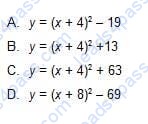
Which of these is equivalent to y = x2 + 8x - 3?
A. Option A
B. Option B
C. Option C
D. Option D
Aimee plans to open a lemonade stand. She wants to determine whether to sell an 8 ounce or 10 ounce cup of lemonade. Each 8-ounce cup costs 2 cents and 10 ounce cups are 3 cents each. The lemons to make a half-gallon of lemonade cost 5 dollars and the sugar for the half-gallon costs 85 cents. She already has all the materials needed to make the stand and she can use the location at no cost. Aimee notices that about 150 people pass by the location of her stand each day and thinks that 20 percent of these people will buy a cup of lemonade. You have made the 2 accompanying graphs to help Aimee make business decisions.
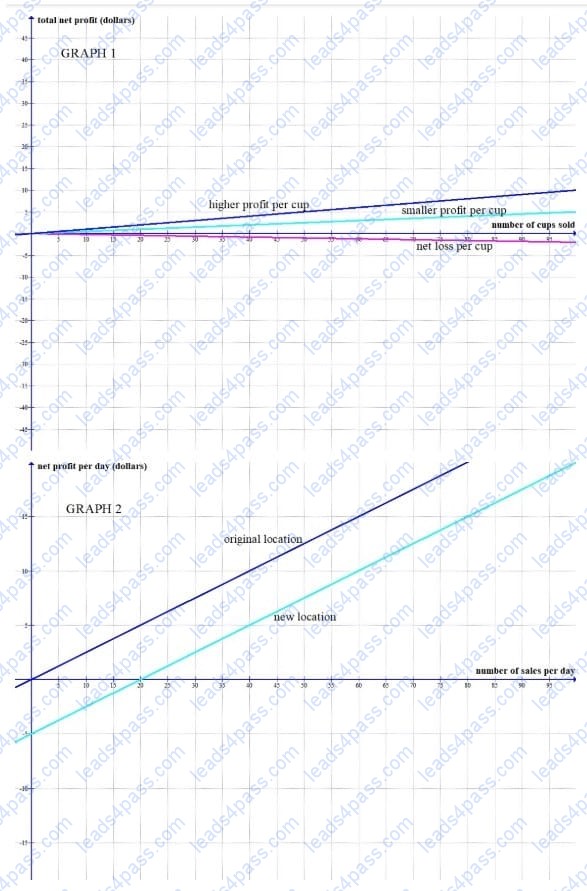
Read the attached passage and consult the attached graphs. Joshua tells Aimee to sell at a small loss and people will like the deal so much that she will sell lots of cups and still make lots of money. Use one of the attached graphs to explain to him why this is wrong.
A. Graph 2 shows that even if profit starts below zero it will go above zero at some point.
B. Graph 2 shows that a smaller profit eventually will give more income than a larger profit.
C. Graph 1 shows that selling at a net loss per cup will never reach a positive value no matter how many cups are sold.
D. Graph 1 shows that the amount lost is very small.
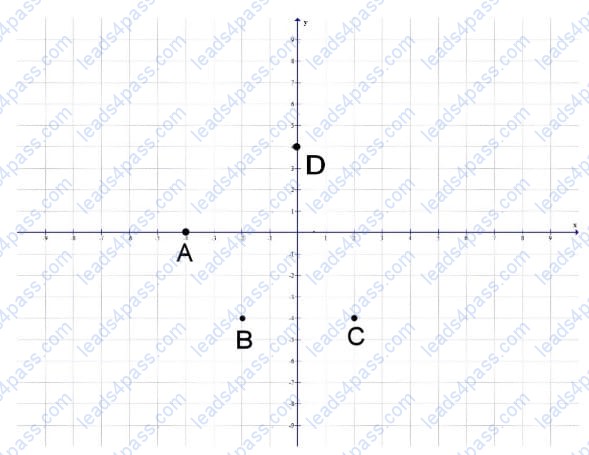
Which point on the attached graph represents the vertex of the function 2x2 - 8x + 4?
A. D
B. A
C. C
D. B
Victoria kept track of her weekly calorie intake, weight, and height. She summarized her results in the table shown here.
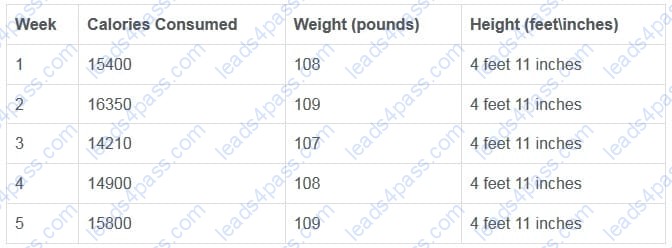
Rafael is convinced that eating helps you grow taller and is puzzled by these results. Which of these statements could you use to help him understand these results?
1.
Victoria measured her height with a bad ruler.
2.
Five weeks might be too short a time to see an increase in height
3.
Victoria ate the wrong foods to stimulate growth.
4.
The results show correlation and not causation.
A. 1 and 3
B. 2 and 4
C. 1
D. 4
Read the text and answer the question.
Blue Crabs Provide Evidence of Oil Tainting Gulf Food
Weeks ago, before engineers pumped in mud and cement to plug the gusher, scientists began finding specks of oil in crab larvae plucked from waters across the Gulf coast.
The government said last week that three-quarters of the spilled oil has been removed or naturally dissipated from the water. But the crab larvae discovery was an ominous sign that crude had already infiltrated the Gulf's vast food web – and
could affect it for years to come.
"It would suggest the oil has reached a position where it can start moving up the food chain instead of just hanging in the water," said Bob Thomas, a biologist at Loyola University in New Orleans.
"Something likely will eat those oiled larvae . . . and then that animal will be eaten by something bigger and so on."
Tiny creatures might take in such low amounts of oil that they could survive, Thomas said. But those at the top of the chain, such as dolphins and tuna, could get fatal "megadoses."
Marine biologists routinely gather shellfish for study. Since the spill began, many of the crab larvae collected have had the distinctive orange oil droplets, said Harriet Perry, a biologist with the University of Southern Mississippi's Gulf Coast
Research Laboratory.
"In my 42 years of studying crabs I've never seen this," Perry said.
She wouldn't estimate how much of the crab larvae are contaminated overall, but said about 40 percent of the area they are known to inhabit has been affected by oil from the spill.
While fish can metabolize dispersant and oil, crabs may accumulate the hydrocarbons, which could harm their ability to reproduce, Perry said in an earlier interview with Science magazine.
She told the magazine there are two encouraging signs for the wild larvae – they are alive when collected and may lose oil droplets when they molt.
Tulane University researchers are investigating whether the splotches also contain toxic chemical dispersants that were spread to break up the oil but have reached no conclusions, biologist Caz Taylor said.
If large numbers of blue crab larvae are tainted, their population is virtually certain to take a hit over the next year and perhaps longer, scientists say. The spawning season occurs between April and October, but the peak months are in July
and August.
How large the die-off would be is unclear, Perry said. An estimated 207 million gallons of oil have spewed into the Gulf since an April 20 drilling rig explosion triggered the spill, and thousands of gallons of dispersant chemicals have been
dumped.
Scientists will be focusing on crabs because they're a "keystone species" that play a crucial role in the food web as both predator and prey, Perry said.
Richard Condrey, a Louisiana State University oceanographer, said the crabs are "a living repository of information on the health of the environment."
Named for the light-blue tint of their claws, the crabs have thick shells and 10 legs, allowing them to swim and scuttle across bottomlands. As adults, they live in the Gulf's bays and estuaries amid marshes that offer protection and abundant
food, including snails, tiny shellfish, plants and even smaller crabs. In turn, they provide sustenance for a variety of wildlife, from redfish to raccoons and whooping cranes.
Adults could be harmed by direct contact with oil and from eating polluted food. But scientists are particularly worried about the vulnerable larvae.
That's because females don't lay their eggs in sheltered places, but in areas where estuaries meet the open sea. Condrey discovered several years ago that some even deposit offspring on shoals miles offshore in the Gulf.
The larvae grow as they drift with the currents back toward the estuaries for a month or longer. Many are eaten by predators and only a handful of the 3 million or so eggs from a single female live to adulthood.
But their survival could drop even lower if the larvae run into oil and dispersants.
"Crabs are very abundant. I don't think we're looking at extinction or anything close to it," said Taylor, one of the researchers who discovered the orange spots.
Still, crabs and other estuary-dependent species such as shrimp and red snapper could feel the effects of remnants of the spill for years, Perry said.
"There could be some mortality, but how much is impossible to say at this point," said Vince Guillory, biologist manager with the Louisiana Department of Wildlife and Fisheries.
Perry, Taylor and Condrey will be among scientists monitoring crabs for negative effects such as population drop-offs and damage to reproductive capabilities and growth rates.
Crabs are big business in the region. In Louisiana alone, some 33 million pounds are harvested annually, generating nearly $300 million in economic activity, Guillory said.
Blue crabs are harvested year-round, but summer and early fall are peak months for harvesting, Guillory said.
Prices for live blue crab generally have gone up, partly because of the Louisiana catch scaling back due to fishing closures, said Steve Hedlund, editor of SeafoodSource.com, a website that covers the global seafood industry.
Fishers who can make a six-figure income off crabs in a good year now are now idled – and worried about the future.
"If they'd let us go out and fish today, we'd probably catch crabs," said Glen Despaux, 37, who sets his traps in Louisiana's Barataria Bay. "But what's going to happen next year, if this water is polluted and it's killing the eggs and the larvae? I
think it's going to be a long-term problem."
Excerpt from "Blue Crabs Provide Evidence of Oil Tainting Gulf Food Web" by John Flesher. Copyright © 2010 by The Associated Press. Reprinted by permission of The Associated Press.
The following question is divided into two parts. First, answer part A. Then, answer part B.
Part A
Read this section from the text and the directions that follow.
Weeks ago, before engineers pumped in mud and cement to plug the gusher, scientists began finding specks of oil in crab larvae plucked from waters across the Gulf coast.
The government said last week that three-quarters of the spilled oil has been removed or naturally dissipated from the water. But the crab larvae discovery was an ominous sign that crude had already infiltrated the Gulf's vast food web – and
could affect it for years to come.
“It would suggest the oil has reached a position where it can start moving up the food chain instead of just hanging in the water”, said Bob Thomas, a biologist at Loyola University in New Orleans. “Something likely will eat those oiled larvae…
and then that animal will be eaten by something bigger and so on.”
What is the central idea of the section?
A. Other organisms in the Gulf waters feed on the larvae of blue crabs.
B. Most of the spilled oil that contaminated the Gulf waters recently has been cleaned up.
C. Scientists recently discovered oil droplets on blue crab larvae in waters along the Gulf coast
D. Scientists fear long-term negative effects on Gulf coast organisms from contaminated blue crab larvae.





All rights are reserved by
leads4pass.com. Any changes, copy or trademarks abuse will be
regarded as infringement.
leads4pass.com will reserve the right to pursue accountability.
Copyright © 2004-
2026 leads4pass.com.