
QSDA2018 Online Practice Questions and Answers
A data architect uses the Qlik GeoAnalytics connector to determine the closest airports to cities in an existing app. The built location generates data for the airport locations. The data load editor runs the script and sees a circular reference and a synthetic key.
How should the data architect fix these issues?
A. When selecting an operation in the Qlik GeoAnalytics connector, select Only load distinct.
B. When choosing which data to load, uncheck the non-unique field in the new data tables.
C. Concatenate the airport table and the existing tables into one master tables.
D. When selecting an operation in the Qlik GeoAnalytics connector, change the CRS to "None".
Refer to the exhibits.
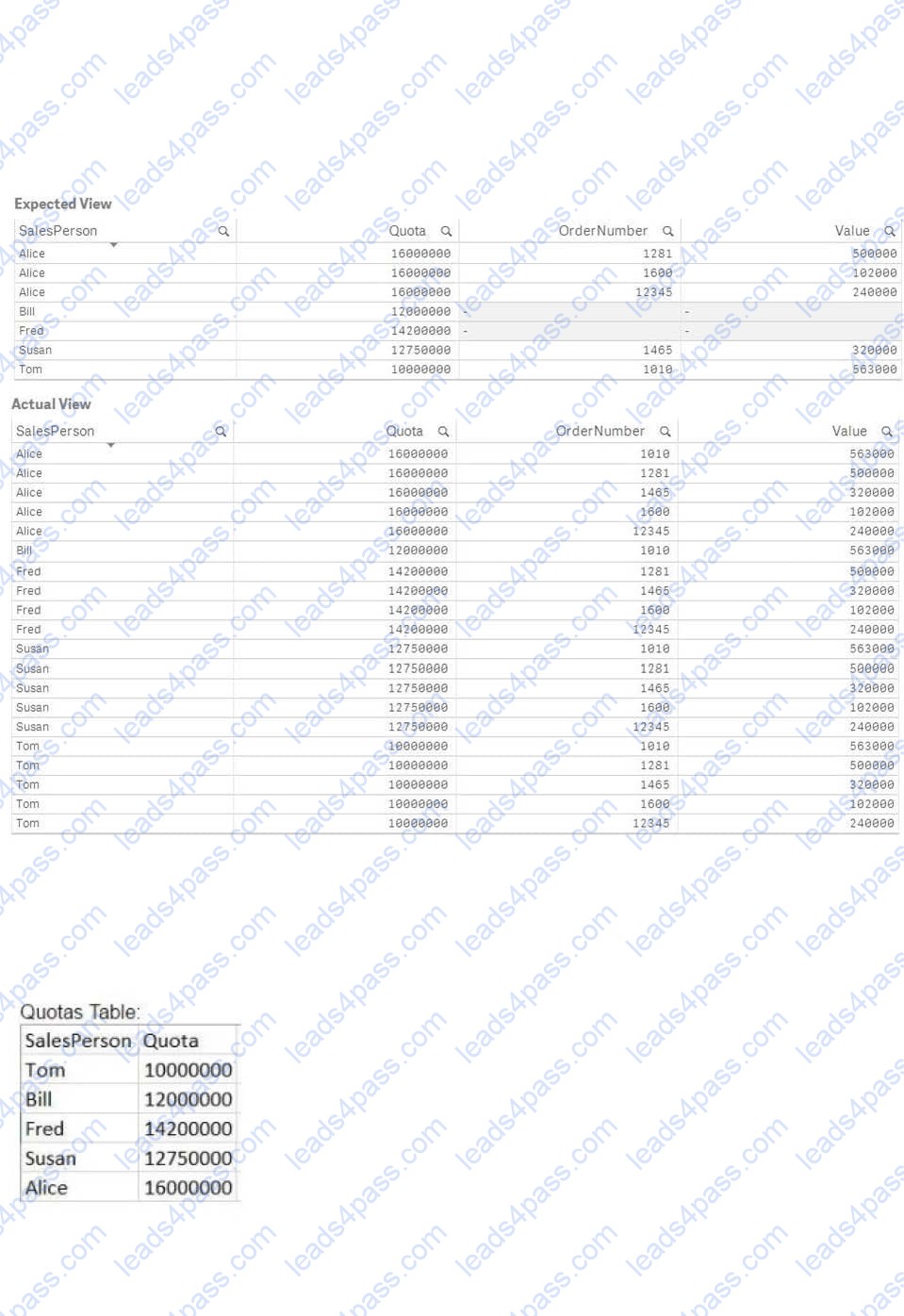
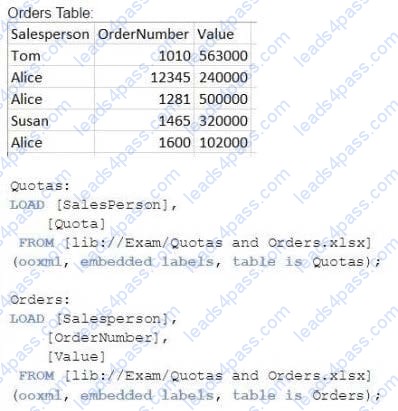
Which corrective action should be taken to achieve the expected view?
A. Alias one of the fields in the Orders table.
B. Use distinct in the LOAD statement.
C. Use Upper () to align the SalesPerson fields.
D. Add a link table.
Refer to the exhibit.
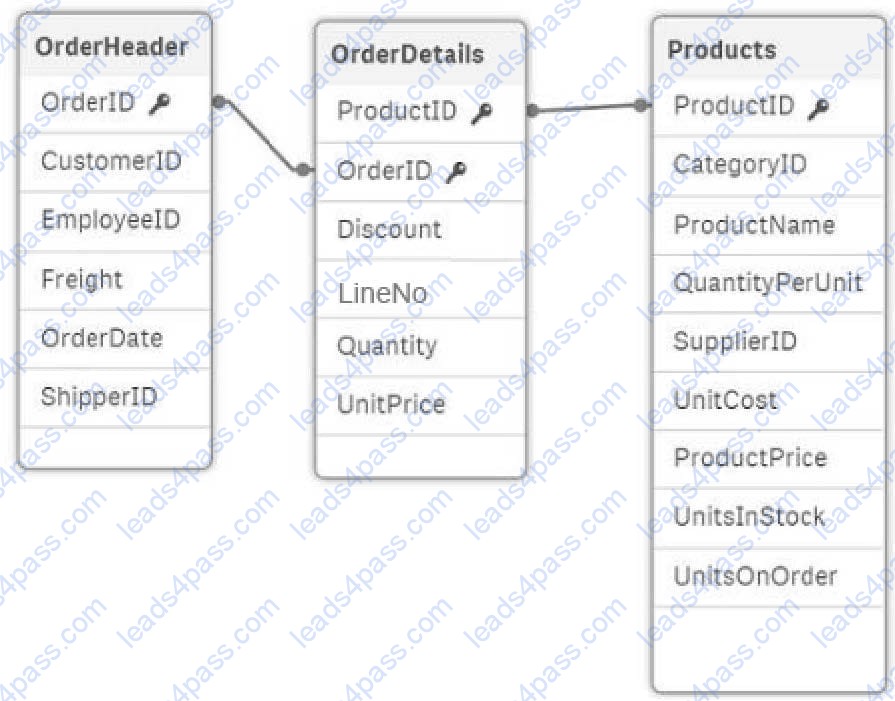
In the data load editor, the tables are loaded in the following sequence:
1.
OrderHeader
2.
OrderDetails
3.
Products
The three tables CANNOT be modified as all fields are required. A data architect must create a Cost of Goods Sold (COGS) field calculated as UnitCost* Quantity. Some products may NOT have UniCost, so the COGS value must be zero for these products.
How should the data architect meet this requirement?
A. 1. Load the Products table as the first table
2. Create a new field in the OrderDetails table: Quantity * IsNull (UnitCost) as COGS
B. 1. Perform a preceding load on the Product table
2. Create a new field in the OrderDetails table: if((UnitCost ?null() or ", 0) * Quantity as COGS
C. 1. Join the Products and OrderDetails on ProductID
2. Create a new field in the OrderDetails table: Replace(Null, 0, UnitCost) * Quantity as COGS
D. 1. Create a mapping load table as the first table from the Product table
2. Create a new field to the OrderDetails table: ApplyMap (`UnitCost_Map', ProductID, 0) * Quantity as COGS
Refer to the exhibit.
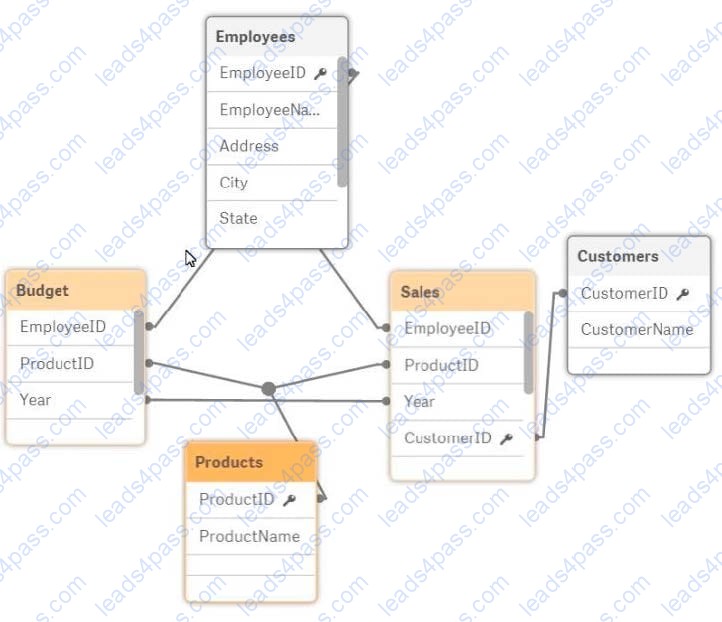
A data architect is reviewing an app that is under development. The app as NOT been published. All data has been validated in all charts and KPIs. The data architect notices that the data model has two fact tables with common field names that cause a synthetic join.
Which step should the data architect take to correct the data model without affecting the app?
A. Concatenate LOAD the data from the Sales and Budget tables to combine into a single table.
B. Create a composite key in the Sales and Budget tables that consists of the Year, EmployeeID, and ProductID
C. Perform a composite key in the Sales and Budget tables instead of loading Year, EmployeeID, and ProductID
D. Perform a mapping load for the Employees table and use ApplyMap in the Sales and Budget tables.
Refer to the exhibit.
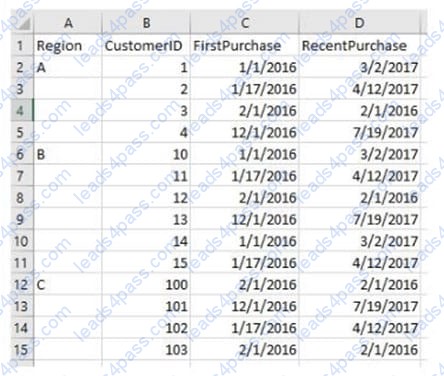
One of the data sources a data architect must add for a newly developed app is an Excel spreadsheet. The Region field only was values for the first record for the region. The data architect must perform a transformation so that each row contains the correct Region.
Which function should the data architect implement to resolve this issue?
A. CrossTable
B. IntervalMatch
C. Above
D. Previous
Refer to the exhibit.

A global company recently released an app that uses mush more memory than similar apps have used. When reviewing data in the data manager, the data architect observes that several fields use Globally Unique Identifiers (GUIDs).
There is one key field. other fields are used to different KPIs to count the number records. The data architect must reduce the memory used as much as possible.
Which steps should a data architect take to meet these requirements?
A. 1. Use the AutoNumber function to convert the linking GUIDs to numbers
2. Replace the non-key GUID fields with a flag, and use them to get a unique count for KPIs
B. 1. Replace the non-key field GUIDs with RowNo() to maintain a field that can be used to get a unique count
2. Split the linking GUID fields into five sections using the SubField function to reduce the uniqueness.
C. 1. Use the AutoNumber function to convert the linking GUIDs to numbers
2. Use Indexing for non-key GUID fields to create an Index field and use to get a unique count for KPIs
D. 1. Use the IterNo() function to convert the linking GUIDs to numbers
2. Replace the non-linking GUID fields with RowNo() to create an Index field and use to get a unique count for KPI
Refer to the exhibits.
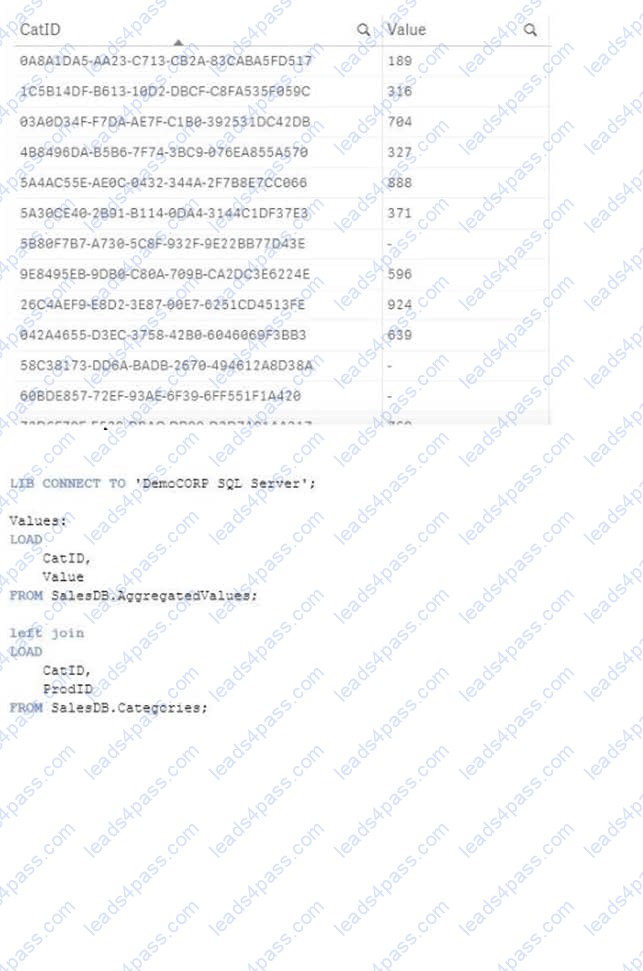
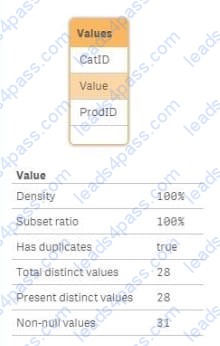
Business analytics report data issues in the Value field of a table since the latest reload of the data.
What causing this issue?
A. Null values in the source data
B. Hyphen characters (`-`) in the source data
C. Pre-aggregated data is being used
D. Some categories do NOT exist in the Category table
A customer must create a production app that pulls data from two sources.
Source 1 is large legacy system. It takes more than one hour to read and save the data to QVD. reading from the QVD only takes 20 seconds. The data only needs to be refreshed every month because it does not change very often.
Source 2 is small online data source. reloading this data takes less than one minute. The production app must be refreshed every hour to see the most updated data and needs both data sets to meet te analysis requirements.
How should the data architect set up the data reload?
A. 1. Create two QVD generation apps
2.
Create two scheduled tasks: one runs every month and one runs every hour
3.
Load the data in the production app from the QVDs
4.
Create a task to run every hour to reload the production app
B. 1. create a QVD generation app to pull both data sources in different script sections
2.
Create two reload schedules from the QVD app based on the script section
3.
Build the production app using the QVD files
4.
Create a task to run every hour to reload the production app.
C. 1. Create the production app to connect to both data sources
2.
Create a variable and set this to the last reload time using ReloadTime() function
3.
Use an IF() statement and only load the legacy data when Today() > 30 days from last reload
4.
Create a task to run every hour to reload the production app
D. 1. Create a QVD generation app for the legacy system only
2.
Create a scheduled task to generate the QVD every month
3.
Build the production app using the QVD and use ADD LOAD prefix to connect to the online data source
4.
Create a task to run every hour to perform a partial reload on the production app
Refer to the exhibit.
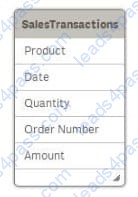
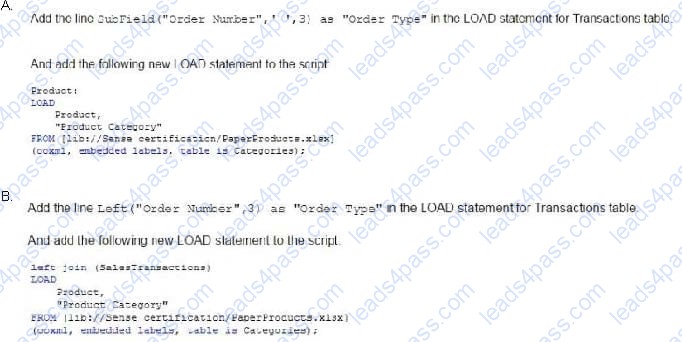
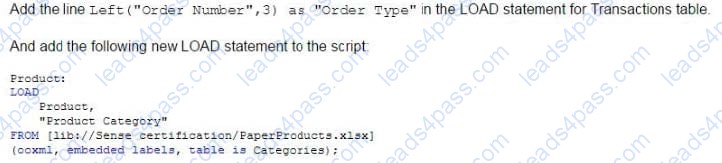
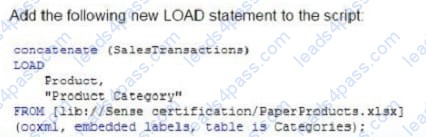
Each order can have multiple products. The data architect needs to make sure the Amount can be analyzed by order Type and product Category.
The Order Number field data always contains the order Type in the first three characters. Product, Product Category, and Sales Channel data are available in an Excel spreadsheet called "Categories" in the file PaperProducts.xlsx.
Which way can the data architect use to make additions to the existing script and meet the requirements?
A. B.
C.
D.
Refer the exhibit.
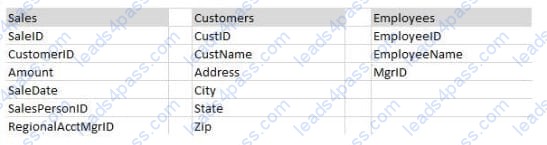
A new app is being developed. Users need to see:
Total sales for each customer
Total sales for given state
Customers that have not had any sales
Names of salesperson and regional manager
Total number of sales by date
The data architect constructs several data models and tests the validity of each model.
Which two data models meet these requirements? (Choose two.)
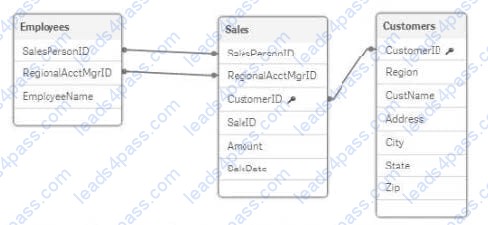
A.
The data architect aliases the MrgID field to RegionalAcctMgrID and the CustID field in the Customers table.
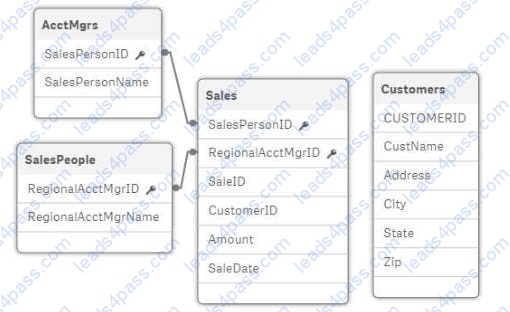
B.
The data architect loads two copies of the Employees table, aliases the appropriate fields, and aliases the CustID field when loading the Customers table.
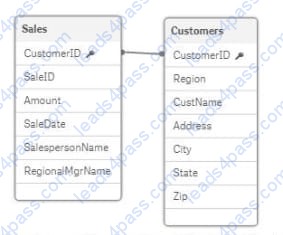
C.
The data architect performs two Left Joins to the Sales table to get the Employee names and loads the Customers table aliasing the CustID field.
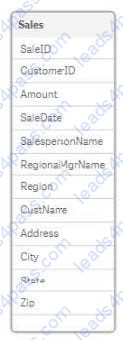
D.
The data architect performs three Left Joins to load the Customer and Employee data fields into the Sales table.





All rights are reserved by
leads4pass.com. Any changes, copy or trademarks abuse will be
regarded as infringement.
leads4pass.com will reserve the right to pursue accountability.
Copyright © 2004-
2026 leads4pass.com.