
PW0-270 Online Practice Questions and Answers
Using the exhibit as a reference, answer the following.
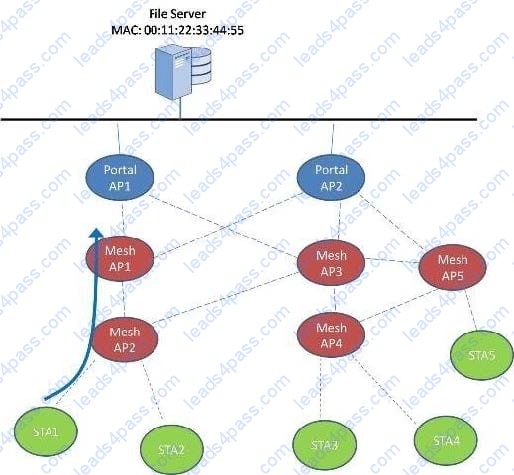
STA1 sent a data frame to Mesh AP2 destined for a local file server on the same subnet with MAC address 00:11:22:33:44:55. Mesh AP2's mesh forwarding algorithm determined that the frame should be forwarded through Mesh AP1.
In the frame sent from Mesh AP2 to Mesh AP1, what is true of the contents of the MAC header? (Choose 3)
A. SA = Mesh AP2's MAC Address
B. RA = Mesh AP1's MAC Address
C. TA = STA1's MAC Address
D. DA = 00:11:22:33:44:55
E. To DS = 0
F. From DS = 1
Which statement is true regarding the Association Identifier (AID) used in IEEE 802.11 WLANs?
A. The AID has a maximum value of 2048, and is used to uniquely identify a wireless client station associated with an access point.
B. The AID has a maximum value of 2007, and resides in the duration/ID field of a PS-Poll frame.
C. The client station is assigned an AID value in the 802.11 authentication response frame.
D. The AID field is present only in Beacons frames.
E. The AID is used by the access point in EDCA mode to reduce duplicate transmissions when sending multicasts.
Given the frame capture and the decode shown,
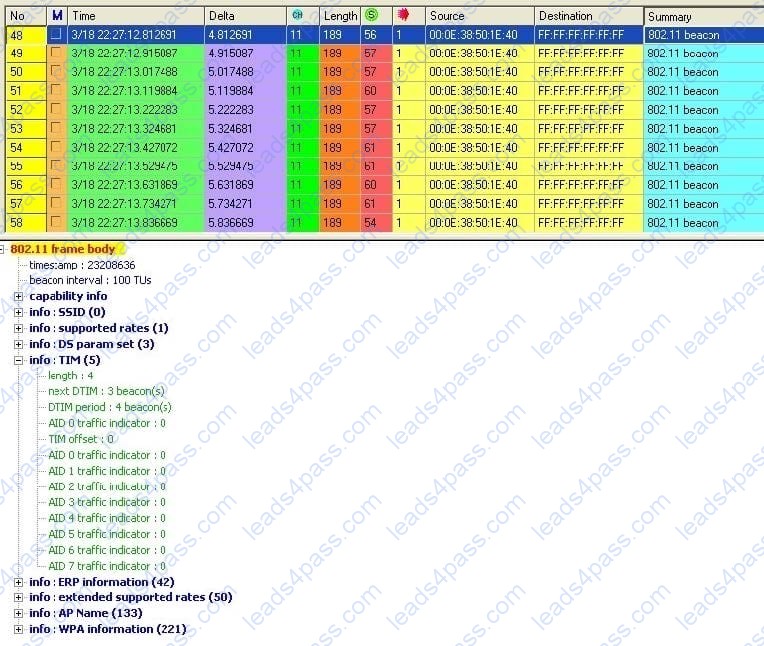
after which Beacons in the list shown (as indicated by the frame number in the leftmost column) would multicast traffic have been sent in this infrastructure BSS if multicast traffic had been queued for transmission at the access point? (Choose 2)
A. Framenumber 49
B. frame number 50
C. frame number 51
D. frame number 53
E. frame number 54
F. frame number 55
G. frame number 57
An HT STA does not receive an ACK for a first-attempt data frame that it transmitted. Assuming this STA is not using BlockAcks in this case, what happens to the HT STA's EDCA contention window?
A. The slot time within the contention window decreases by 50%.
B. It varies because the backoff algorithm is random.
C. The contention window approximately doubles in size.
D. The contention window is not affected by failed Data frame delivery.
E. The contention window is immediately closed, and the frame is retransmitted.
According to the 802.11n-2009 amendment, what security requirement is specified for HT BSSs?
A. In an RSN, HT stations may not communicate with one another using TKIP.
B. TKIP cannot be supported in an HT BSS.
C. All unicast traffic transmitted by an HT station and destined to an HT station must use AES-CCMP.
D. HT BSSs are prevented from supporting WEP.
E. HT BSSs must mandatorily support 802.11r FT.
Which statement accurately describes IEEE 802.11 Power Save operation in a Basic Service Set that does not support the QoS facility?
A. Following a period of time in a low power state, client stations wake themselves and automatically poll the access point for traffic using a PS-Poll frame.
B. When the access point's buffer is full, the access point wakes all client stations using a PS-Poll frame so that they can receive the data.
C. Upon receiving traffic for a dozing station, the access point wakes the client station using a PS-Poll frame so that the client station can receive the data.
D. After waking from a low power state, client stations listen for the next Beacon to determine if sending a PS-Poll frame to the access point is necessary.
E. After waking at a scheduled TBTT, client stations send Null Function frames to the access point with the Power Management bit set back to zero.
Given: The exhibit shows a small network environment with dual-band APs.
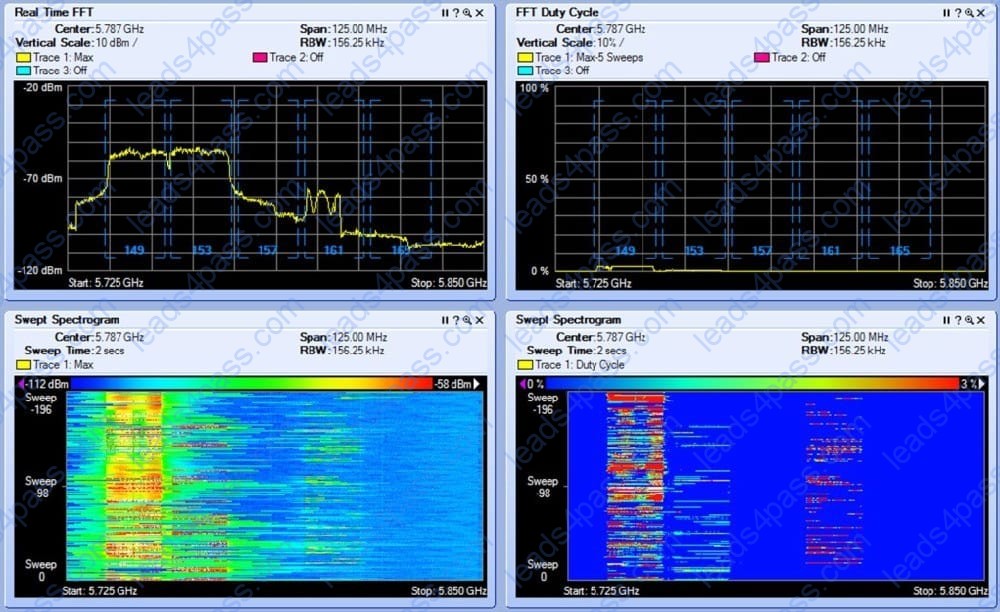
What is true of the network shown in this spectrum analyzer trace?
A. There are at least three APs operating in this environment. They are operating on channels 149, 153, and 161.
B. There are two 40 MHz BSSs in this environment. One AP has some 40 MHz traffic while the other AP has no client traffic.
C. Only one AP in this network is configured to use the upper UNII band (UNII-3). All other APs are in lower 5 GHz channels.
D. Two 802.11a APs are near the spectrum analyzer and are heavily utilized on channels 149 and 153.
What types of wireless systems are illustrated?
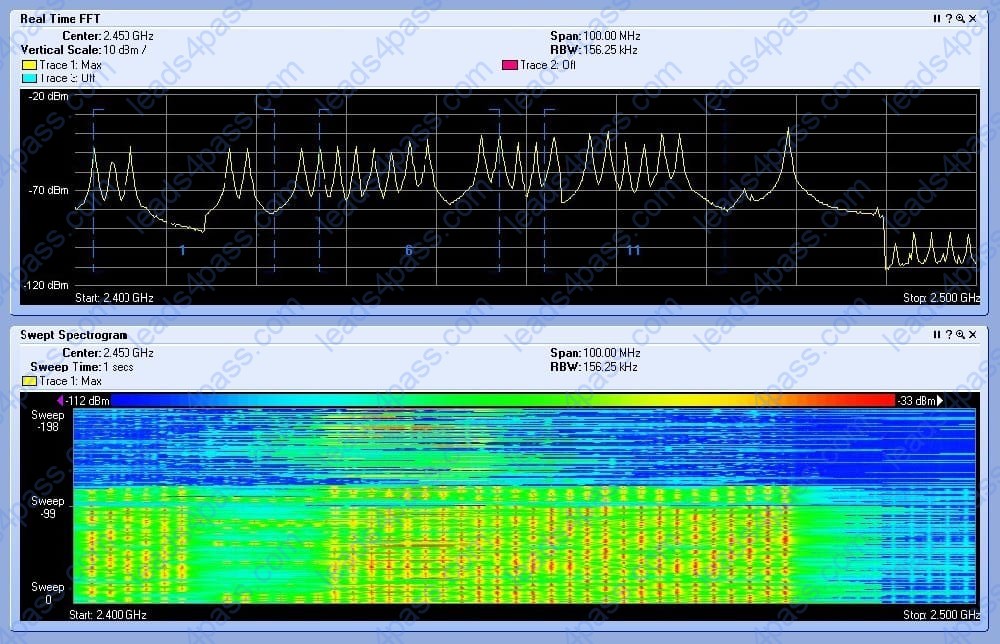
A. An ERP IEEE 802.11 system using channel 6 and Bluetooth v1.2 discovery
B. A Bluetooth v2.0 file transfer and a 40 MHz HT AP on channels 11, 7 (primary, secondary)
C. A 2.4 GHz cordless phone on channel 14 and a wireless RFID reader
D. An 802.11 HR/DSSS system using channel 2 and a digital FHSS phone
Using the exhibit as a reference,
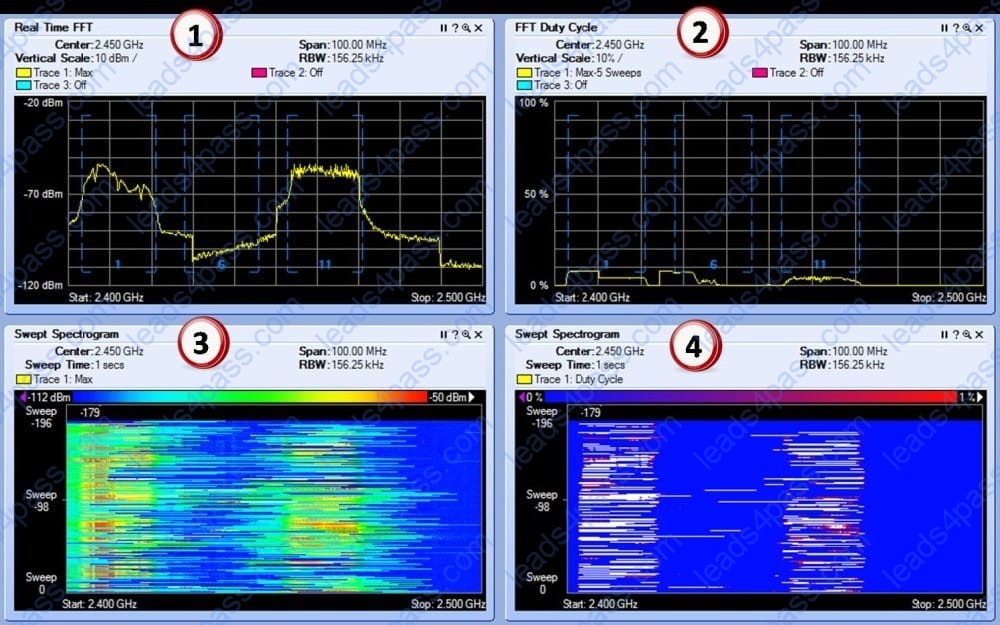
which spectrum plots display, in real time, the value of RF amplitude as a function of radio frequency?
A. 1 and 2
B. 1 and 3
C. All of the plots
D. 1, 3, and 4
E. 3 and 4
When 802.11 standard compliant AES-CCMP security is being used with IPSec/ESP for layered security, what will a WLAN protocol analyzer see as the security mechanism in use when a user browses to an HTTPS secured web page?
A. AES-CCMP
B. IPSec/ESP
C. SSLv3
D. AES-CCMP and IPSec/ESP
E. AES-CCMP, IPSec/ESP, AND SSLv3





All rights are reserved by
leads4pass.com. Any changes, copy or trademarks abuse will be
regarded as infringement.
leads4pass.com will reserve the right to pursue accountability.
Copyright © 2004-
2026 leads4pass.com.