
PROFESSIONAL-DATA-ENGINEER Online Practice Questions and Answers
You are creating a model to predict housing prices. Due to budget constraints, you must run it on a single resource-constrained virtual machine. Which learning algorithm should you use?
A. Linear regression
B. Logistic classification
C. Recurrent neural network
D. Feedforward neural network
You launched a new gaming app almost three years ago. You have been uploading log files from the previous day to a separate Google BigQuery table with the table name format LOGS_yyyymmdd. You have been using table wildcard functions to generate daily and monthly reports for all time ranges. Recently, you discovered that some queries that cover long date ranges are exceeding the limit of 1,000 tables and failing. How can you resolve this issue?
A. Convert all daily log tables into date-partitioned tables
B. Convert the sharded tables into a single partitioned table
C. Enable query caching so you can cache data from previous months
D. Create separate views to cover each month, and query from these views
You are selecting services to write and transform JSON messages from Cloud Pub/Sub to BigQuery for a data pipeline on Google Cloud. You want to minimize service costs. You also want to monitor and accommodate input data volume that will vary in size with minimal manual intervention. What should you do?
A. Use Cloud Dataproc to run your transformations. Monitor CPU utilization for the cluster. Resize the number of worker nodes in your cluster via the command line.
B. Use Cloud Dataproc to run your transformations. Use the diagnose command to generate an operational output archive. Locate the bottleneck and adjust cluster resources.
C. Use Cloud Dataflow to run your transformations. Monitor the job system lag with Stackdriver. Use the default autoscaling setting for worker instances.
D. Use Cloud Dataflow to run your transformations. Monitor the total execution time for a sampling of jobs. Configure the job to use non-default Compute Engine machine types when needed.
You are collecting loT sensor data from millions of devices across the world and storing the data in BigQuery. Your access pattern is based on recent data tittered by location_id and device_version with the following query:
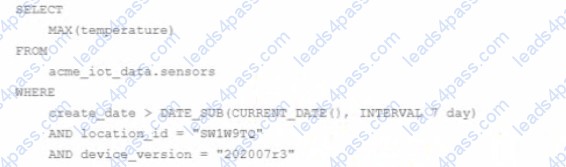
You want to optimize your queries for cost and performance. How should you structure your data?
A. Partition table data by create_date, location_id and device_version
B. Partition table data by create_date cluster table data by tocation_id and device_version
C. Cluster table data by create_date location_id and device_version
D. Cluster table data by create_date, partition by location and device_version
You are integrating one of your internal IT applications and Google BigQuery, so users can query BigQuery from the application's interface. You do not want individual users to authenticate to BigQuery and you do not want to give them access to the dataset. You need to securely access BigQuery from your IT application.
What should you do?
A. Create groups for your users and give those groups access to the dataset
B. Integrate with a single sign-on (SSO) platform, and pass each user's credentials along with the query request
C. Create a service account and grant dataset access to that account. Use the service account's private key to access the dataset
D. Create a dummy user and grant dataset access to that user. Store the username and password for that user in a file on the files system, and use those credentials to access the BigQuery dataset
You are deploying MariaDB SQL databases on GCE VM Instances and need to configure monitoring and alerting. You want to collect metrics including network connections, disk IO and replication status from MariaDB with minimal development effort and use StackDriver for dashboards and alerts.
What should you do?
A. Install the OpenCensus Agent and create a custom metric collection application with a StackDriver exporter.
B. Place the MariaDB instances in an Instance Group with a Health Check.
C. Install the StackDriver Logging Agent and configure fluentd in_tail plugin to read MariaDB logs.
D. Install the StackDriver Agent and configure the MySQL plugin.
You are working on a linear regression model on BigQuery ML to predict a customer's likelihood of purchasing your company's products. Your model uses a city name variable as a key predictive component in order to train and serve the model your data must be organized in columns. You want to prepare your data using the least amount of coding while maintaining the predictable variables. What should you do?
A. Use SQL in BigQuery to transform the stale column using a one-hot encoding method, and make each city a column with binary values.
B. Create a new view with BigQuery that does not include a column which city information.
C. Cloud Data Fusion to assign each city to a region that is labeled as 1, 2 3, 4, or 5, and then use that number to represent the city in the model.
D. Use TensorFlow to create a categorical variable with a vocabulary list. Create the vocabulary file and upload that as part of your model to BigQuery ML.
You want to optimize your queries for cost and performance. How should you structure your data?
A. Partition table data by create_date, location_id and device_version
B. Partition table data by create_date cluster table data by location_Id and device_version
C. Cluster table data by create_date location_id and device_version
D. Cluster table data by create_date partition by locationed and device_version
You are designing a data mesh on Google Cloud with multiple distinct data engineering teams building data products. The typical data curation design pattern consists of landing files in Cloud Storage, transforming raw data in Cloud Storage and BigQuery datasets. and storing the final curated data product in BigQuery datasets You need to configure Dataplex to ensure that each team can access only the assets needed to build their data products. You also need to ensure that teams can easily share the curated data product. What should you do?
A. 1 Create a single Dataplex virtual lake and create a single zone to contain landing, raw.and curated data. 2 Provide each data engineering team access to the virtual lake.
B. 1 Create a single Dataplex virtual lake and create a single zone to contain landing, raw.and curated data. 2 Build separate assets for each data product within the zone.
3. Assign permissions to the data engineering teams at the zone level.
C. 1 Create a Dataplex virtual lake for each data product, and create a single zone to contain landing, raw, and curated data.
2. Provide the data engineering teams with full access to the virtual lake assigned to their data product.
D. 1 Create a Dataplex virtual lake for each data product, and create multiple zones for landing, raw. and curated data.
2. Provide the data engineering teams with full access to the virtual lake assigned to their data product.
You are administering a BigQuery dataset that uses a customer-managed encryption key (CMEK). You need to share the dataset with a partner organization that does not have access to your CMEK. What should you do?
A. Create an authorized view that contains the CMEK to decrypt the data when accessed.
B. Provide the partner organization a copy of your CMEKs to decrypt the data.
C. Copy the tables you need to share to a dataset without CMEKs Create an Analytics Hub listing for this dataset.
D. Export the tables to parquet files to a Cloud Storage bucket and grant the storageinsights. viewer role on the bucket to the partner organization.





All rights are reserved by
leads4pass.com. Any changes, copy or trademarks abuse will be
regarded as infringement.
leads4pass.com will reserve the right to pursue accountability.
Copyright © 2004-
2026 leads4pass.com.