
PROFESSIONAL-CLOUD-DEVOPS-ENGINEER Online Practice Questions and Answers
You support a high-traffic web application and want to ensure that the home page loads in a timely manner. As a first step, you decide to implement a Service Level Indicator (SLI) to represent home page request latency with an acceptable page load time set to 100 ms. What is the Google-recommended way of calculating this SLI?
A. Bucketize the request latencies into ranges, and then compute the percentile at 100 ms.
B. Bucketize the request latencies into ranges, and then compute the median and 90th percentiles.
C. Count the number of home page requests that load in under 100 ms, and then divide by the total number of home page requests.
D. Count the number of home page request that load in under 100 ms, and then divide by the total number of all web application request.
Your company follows Site Reliability Engineering practices. You are the Incident Commander for a new, customer-impacting incident. You need to immediately assign two incident management roles to assist you in an effective incident response. What roles should you assign? (Choose two.)
A. Operations Lead
B. Engineering Lead
C. Communications Lead
D. Customer Impact Assessor
E. External Customer Communications Lead
You have an application running in Google Kubernetes Engine. The application invokes multiple services per request but responds too slowly. You need to identify which downstream service or services are causing the delay. What should you do?
A. Analyze VPC flow logs along the path of the request.
B. Investigate the Liveness and Readiness probes for each service.
C. Create a Dataflow pipeline to analyze service metrics in real time.
D. Use a distributed tracing framework such as OpenTelemetry or Stackdriver Trace.
Your organization has a containerized web application that runs on-premises. As part of the migration plan to Google Cloud, you need to select a deployment strategy and platform that meets the following acceptance criteria:
1.
The platform must be able to direct traffic from Android devices to an Android-specific microservice.
2.
The platform must allow for arbitrary percentage-based traffic splitting
3.
The deployment strategy must allow for continuous testing of multiple versions of any microservice.
What should you do?
A. Deploy the canary release of the application to Cloud Run. Use traffic splitting to direct 10% of user traffic to the canary release based on the revision tag.
B. Deploy the canary release of the application to App Engine. Use traffic splitting to direct a subset of user traffic to the new version based on the IP address.
C. Deploy the canary release of the application to Compute Engine. Use Anthos Service Mesh with Compute Engine to direct 10% of user traffic to the canary release by configuring the virtual service.
D. Deploy the canary release to Google Kubernetes Engine with Anthos Service Mesh. Use traffic splitting to direct 10% of user traffic to the new version based on the user-agent header configured in the virtual service.
You are developing the deployment and testing strategies for your CI/CD pipeline in Google Cloud. You must be able to:
? Reduce the complexity of release deployments and minimize the duration of deployment rollbacks.
? Test real production traffic with a gradual increase in the number of affected users.
You want to select a deployment and testing strategy that meets your requirements. What should you do?
A. Recreate deployment and canary testing
B. Blue/green deployment and canary testing
C. Rolling update deployment and A/B testing
D. Rolling update deployment and shadow testing
You are analyzing Java applications in production. All applications have Cloud Profiler and Cloud Trace installed and configured by default. You want to determine which applications need performance tuning. What should you do? (Choose two.)
A. Examine the wall-clock time and the CPU time of the application. If the difference is substantial increase the CPU resource allocation.
B. Examine the wall-clock time and the CPU time of the application. If the difference is substantial, increase the memory resource allocation.
C. Examine the wall-clock time and the CPU time of the application. If the difference is substantial, increase the local disk storage allocation.
D. Examine the latency time the wall-clock time and the CPU time of the application. If the latency time is slowly burning down the error budget, and the difference between wall-clock time and CPU time is minimal mark the application for optimization.
E. Examine the heap usage of the application. If the usage is low, mark the application for optimization.
You are developing reusable infrastructure as code modules. Each module contains integration tests that launch the module in a test project. You are using GitHub for source control. You need to continuously test your feature branch and ensure that all code is tested before changes are accepted. You need to implement a solution to automate the integration tests. What should you do?
A. Use a Jenkins server for CI/CD pipelines. Periodically run all tests in the feature branch.
B. Ask the pull request reviewers to run the integration tests before approving the code.
C. Use Cloud Build to run the tests. Trigger all tests to run after a pull request is merged.
D. Use Cloud Build to run tests in a specific folder. Trigger Cloud Build for every GitHub pull request.
You have deployed a fleet of Compute Engine instances in Google Cloud. You need to ensure that monitoring metrics and logs for the instances are visible in Cloud Logging and Cloud Monitoring by your company's operations and cyber security teams. You need to grant the required roles for the Compute Engine service account by using Identity and Access Management (IAM) while following the principle of least privilege. What should you do?
A. Grant the logging.logWriter and monitoring.metricWriter roles to the Compute Engine service accounts.
B. Grant the logging.admin and monitoring.editor roles to the Compute Engine service accounts.
C. Grant the logging.editor and monitoring.metricWriter roles to the Compute Engine service accounts.
D. Grant the logging.logWriter and monitoring.editor roles to the Compute Engine service accounts.
You need to create a Cloud Monitoring SLO for a service that will be published soon. You want to verify that requests to the service will be addressed in fewer than 300 ms at least 90% of the time per calendar month. You need to identify the metric and evaluation method to use. What should you do?
A. Select a latency metric for a request-based method of evaluation.
B. Select a latency metric for a window-based method of evaluation.
C. Select an availability metric for a request-based method of evaluation.
D. Select an availability metric for a window-based method of evaluation.
You are leading a DevOps project for your organization. The DevOps team is responsible for managing the service infrastructure and being on-call for incidents.
The Software Development team is responsible for writing, submitting, and reviewing code. Neither team has any published SLOs.
You want to design a new joint-ownership model for a service between the DevOps team and the Software Development team.
Which responsibilities should be assigned to each team in the new joint-ownership model?
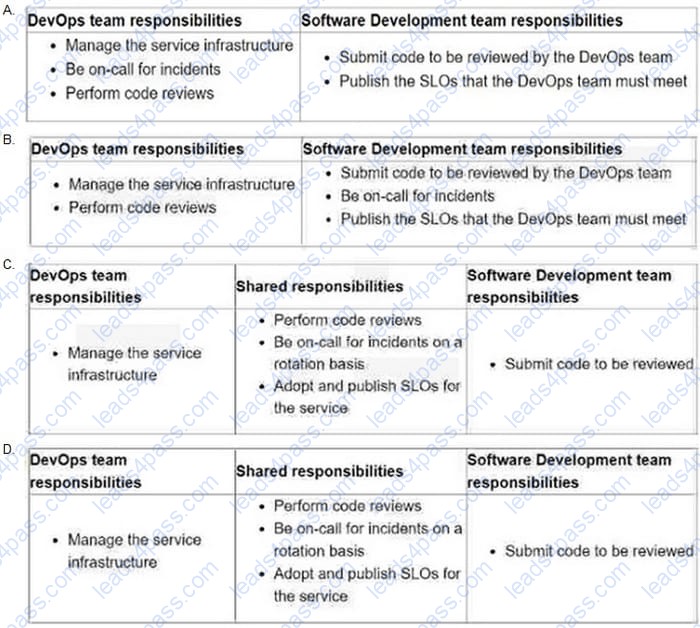
A. Option A
B. Option B
C. Option C
D. Option D





All rights are reserved by
leads4pass.com. Any changes, copy or trademarks abuse will be
regarded as infringement.
leads4pass.com will reserve the right to pursue accountability.
Copyright © 2004-
2026 leads4pass.com.