
PROFESSIONAL-CLOUD-ARCHITECT Online Practice Questions and Answers
For this question, refer to the TerramEarth case study. TerramEarth has about 1 petabyte (PB) of vehicle testing data in a private data center. You want to move the data to Cloud Storage for your machine learning team. Currently, a 1-Gbps interconnect link is available for you. The machine learning team wants to start using the data in a month. What should you do?
A. Request Transfer Appliances from Google Cloud, export the data to appliances, and return the appliances to Google Cloud.
B. Configure the Storage Transfer service from Google Cloud to send the data from your data center to Cloud Storage.
C. Make sure there are no other users consuming the 1Gbps link, and use multi-thread transfer to upload the data to Cloud Storage.
D. Export files to an encrypted USB device, send the device to Google Cloud, and request an import of the data to Cloud Storage.
For this question, refer to the EHR Healthcare case study. You need to define the technical architecture for securely deploying workloads to Google Cloud. You also need to ensure that only verified containers are deployed using Google Cloud services. What should you do? (Choose two.)
A. Enable Binary Authorization on GKE, and sign containers as part of a CI/CD pipeline.
B. Configure Jenkins to utilize Kritis to cryptographically sign a container as part of a CI/CD pipeline.
C. Configure Container Registry to only allow trusted service accounts to create and deploy containers from the registry.
D. Configure Container Registry to use vulnerability scanning to confirm that there are no vulnerabilities before deploying the workload.
To reduce costs, the Director of Engineering has required all developers to move their development infrastructure resources from on-premises virtual machines (VMs) to Google Cloud Platform. These resources go through multiple start/stop events during the day and require state to persist. You have been asked to design the process of running a development environment in Google Cloud while providing cost visibility to the finance department. Which two steps should you take? Choose 2 answers
A. Use the--no-auto-delete flag on all persistent disks and stop the VM.
B. Use the-auto-delete flag on all persistent disks and terminate the VM.
C. Apply VM CPU utilization label and include it in the BigQuery billing export.
D. Use Google BigQuery billing export and labels to associate cost to groups.
E. Store all state into local SSD, snapshot the persistent disks, and terminate the VM.
F. Store all state in Google Cloud Storage, snapshot the persistent disks, and terminate the VM.
You are creating an App Engine application that uses Cloud Datastore as its persistence layer. You need to retrieve several root entities for which you have the identifiers. You want to minimize the overhead in operations performed by Cloud Datastore. What should you do?
A. Create the Key object for each Entity and run a batch get operation
B. Create the Key object for each Entity and run multiple get operations, one operation for each entity
C. Use the identifiers to create a query filter and run a batch query operation
D. Use the identifiers to create a query filter and run multiple query operations, one operation for each entity
A news teed web service has the following code running on Google App Engine. During peak load, users report that they can see news articles they already viewed.
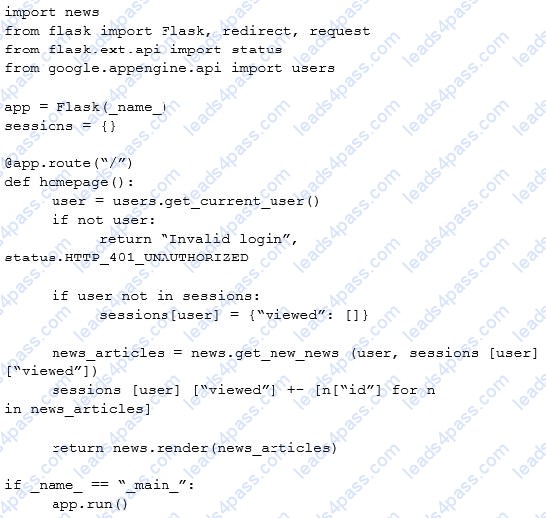
What is the most likely cause of this problem?
A. The session variable is local to just a single instance.
B. The session variable is being overwritten in Cloud Datastore.
C. The URL of the API needs to be modified to prevent caching.
D. The HTTP Expires header needs to be set to-1 to stop caching.
You have an application that will run on Compute Engine. You need to design an architecture that takes into account a disaster recovery plan that requires your application to fail over to another region in case of a regional outage. What should you do?
A. Deploy the application on two Compute Engine instances in the same project but in a different region. Use the first instance to serve traffic, and use the HTTP load balancing service to fail over to the standby instance in case of a disaster.
B. Deploy the application on a Compute Engine instance. Use the instance to serve traffic, and use the HTTP load balancing service to fail over to an instance on your premises in case of a disaster.
C. Deploy the application on two Compute Engine instance groups, each in the same project but in a different region. Use the first instance group to serve traffic, and use the HTTP load balancing service to fail over to the standby instance group in case of a disaster.
D. Deploy the application on two Compute Engine instance groups, each in separate project and a different region. Use the first instance group to server traffic, and use the HTTP load balancing service to fail over to the standby instance in case of a disaster.
You are working at an institution that processes medical data. You are migrating several workloads onto Google Cloud. Company policies require all workloads to run on physically separated hardware, and workloads from different clients must also be separated You created a sole-tenant node group and added a node for each client. You need to deploy the workloads on these dedicated hosts. What should you do?
A. Add the node group name as a network tag when creating Compute Engine instances in order to host each workload on the correct node group.
B. Add the node name as a network tag when creating Compute Engine instances in order to host each workload on the correct node.
C. Use node affinity labels based on the node group name when creating Compute Engine instances in order to host each workload on the correct node group
D. Use node affinity labels based on the node name when creating Compute Engine instances in order to host each workload on the correct node.
You want to enable your running Google Kubernetes Engine cluster to scale as demand for your application changes.
What should you do?
A. Add additional nodes to your Kubernetes Engine cluster using the following command:gcloud container clusters resizeCLUSTER_Name ?-size 10
B. Add a tag to the instances in the cluster with the following command:gcloud compute instances add-tagsINSTANCE--tags enable-autoscaling max-nodes-10
C. Update the existing Kubernetes Engine cluster with the following command:gcloud alpha container clustersupdate mycluster--enable-autoscaling--min-nodes=1--max-nodes=10
D. Create a new Kubernetes Engine cluster with the following command:gcloud alpha container clusterscreate mycluster--enable-autoscaling--min-nodes=1--max-nodes=10and redeploy your application
Your company has sensitive data in Cloud Storage buckets. Data analysts have Identity Access Management (IAM) permissions to read the buckets. You want to prevent data analysts from retrieving the data in the buckets from outside the office network. What should you do?
A. 1. Create a VPC Service Controls perimeter that includes the projects with the buckets.
2. Create an access level with the CIDR of the office network.
B. 1. Create a firewall rule for all instances in the Virtual Private Cloud (VPC) network for source range.
2. Use the Classless Inter-domain Routing (CIDR) of the office network.
C. 1. Create a Cloud Function to remove IAM permissions from the buckets, and another Cloud Function to add IAM permissions to the buckets.
2. Schedule the Cloud Functions with Cloud Scheduler to add permissions at the start of business and remove permissions at the end of business.
D. 1. Create a Cloud VPN to the office network.
2. Configure Private Google Access for on-premises hosts.
Your company has successfully migrated to the cloud and wants to analyze their data stream to optimize operations. They do not have any existing code for this analysis, so they are exploring all their options. These options include a mix of batch and stream processing, as they are running some hourly jobs and live-processing some data as it comes in. Which technology should they use for this?
A. Google Cloud Dataproc
B. Google Cloud Dataflow
C. Google Container Engine with Bigtable
D. Google Compute Engine with Google BigQuery





All rights are reserved by
leads4pass.com. Any changes, copy or trademarks abuse will be
regarded as infringement.
leads4pass.com will reserve the right to pursue accountability.
Copyright © 2004-
2026 leads4pass.com.