
PEGAPCDC80V1 Online Practice Questions and Answers
DRAG DROP
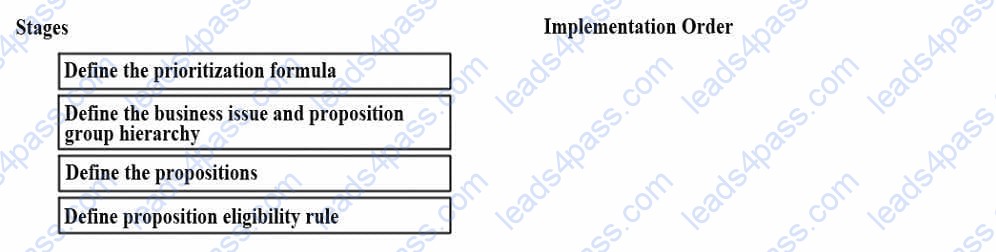
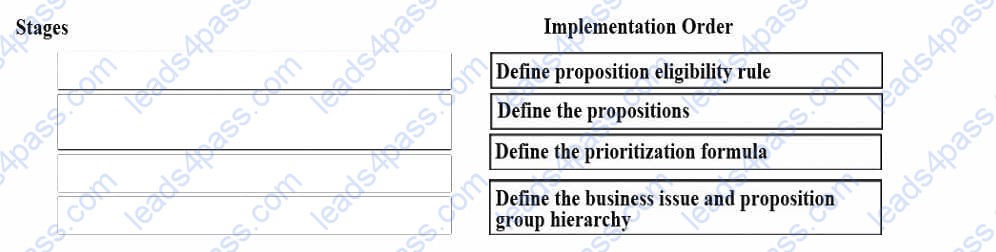
Designing the Next-Best-Action strategy that drives AI-powered one-to-one Customer Engagement is a staged process. Each stage refines the proposition selection process. Place the stages in the order of implementation.
Select and Place:
U+ Bank offers two credit cards to its customers: the Cold Card and the Silver Card. The bank wants the annual fee property of the credit cards to be dynamic based on the customer lifetime value property.
That is, customers with customer lifetime value greater than 65 receive a discount of 20% on the annual fee.
As a Strategy Designer, how do you implement this requirement in the decision strategy?
A. By using the When rule to set the annual fee
B. By using the When rule to set the customer value
C. By using the If function to set the customer value
D. By using the If function to set the annual fee
U+ Bank offers two credit cards to its customers: the Cold Card and the Silver Card. The bank wants the annual fee property of the credit cards to be dynamic based on the customer lifetime value property.
That is, customers with customer lifetime value greater than 65 receive a discount of 20% on the annual fee.
As a Strategy Designer, which component do you use to implement this requirement?
A. Set Property
B. Filter
C. Group By
D. Switch
U+ Bank uses a Next-Best-Action decision strategy to automatically approve credit card limit changes requested by customers. A scorecard model determines the customer credit score. The automatic approval of credit card limits are processed based on the following criteria set by the bank:
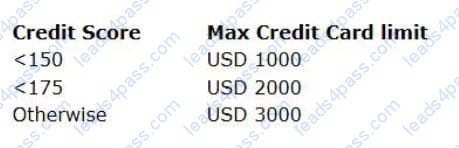
The bank wants to change the threshold value for the USD 2000 credit limit from "<175" to "<200". As a Strategy Designer, how do you implement this change?
A. Change in the strategy the condition from ".pxSegment <=175" to ".pxSegment <=200"
B. Map the score value in the decision strategy to "<=200".
C. Change the cutoff value in the results tab of the scorecard decision component
D. Change the cutoff value in the results tab of the scorecard model
The Prioritize component sorts offers in _______________.
A. ascending order only
B. descending order only
C. random order
D. ascending or descending order
Two results of an adaptive model are ________________.
A. Priority and Evidence
B. Propensity and Rank
C. Priority and Propensity
D. Propensity and Performance
Which value is output by an Adaptive Model?
A. Score
B. Behavior
C. Performance
D. Lift
An adaptive model captures outcomes of ____________.
A. only negative customer responses
B. similar propositions
C. a subset of customer responses
D. only positive customer responses
To create channel-specific Adaptive Model instances, you _____________.
A. set channel information in the strategy
B. set the channel option in the Adaptive Model component
C. do nothing; Adaptive Model instances are always channel specific
D. create channel specific Adaptive Model definition
You are the Decisioning Consultant on an AI-powered one-to-one Customer Engagement implementation project. You are asked to design the Next-Best-Action prioritization expression that balances the customer needs with the business
objectives.
What factor do you consider in the prioritization expression?
A. offer relevancy
B. customer contact policy
C. predicted customer behavior
D. offer eligibility





All rights are reserved by
leads4pass.com. Any changes, copy or trademarks abuse will be
regarded as infringement.
leads4pass.com will reserve the right to pursue accountability.
Copyright © 2004-
2026 leads4pass.com.