
P_SAPEA_2023 Online Practice Questions and Answers
As part of the mapping of a Business Architecture to the Solution Architecture, an Environment and Location Diagram must be developed in the Technology Architecture phase. In this context, numerous architecture decisions have to be made. Among other things, you must check which SAP BTP services and which SAP SaaS solutions are available as part of the Solution Architecture in which data center of the desired hyperscaler. How do you go about this validation?
A. I use the SAP Business Accelerator Hub (api.sap.com) because it provides all the required information regarding SAP BTP service and SAP SaaS solution availability for each hyperscaler, in a central location.
B. I use the SAP Discovery Center to check which of the selected SAP BTP services are offered by which hyperscaler. With help from the SAP Trust Center, I check in which data center the involved SAP SaaS solutions are available.
C. I use the SAP Discovery Center to check in which data centers the respective SAP BTP services and the SAP SaaS solutions are available.
As the Chief Enterprise Architect of Wanderlust GmbH, you know that there is very little process documentation available on online marketing processes within Wanderlust. You also know that SAP has a rich End-to-End (E2E) Business Processes content repository. To take advantage of that, you have engaged an SAP Enterprise Architect. The SAP Enterprise Architect is using SAP's Business Process Model (BPM) and the Business Capability Model (BCM) while mapping processes to capabilities, how are the two models connected? Note: There are 2 correct answers to this question.
A. Through the E2E Business Process of BPM, which is enabled by the Business Domain of BCM.
B. Through the Business Process Module of BPM, which is directly linked to the Business Area of BCM.
C. Through the Enterprise Domain, to which both the E2E Business Process of BPM and the Business Domain of BCM are assigned.
D. Through the Business Activity of BPM, which is enabled by the Business Capability of BCM.
Green Elk and Company is the world's leading manufacturer of agricultural and forestry machinery. The former company slogan "Elk always runs has recently been changed to "Elk feeds the world". One of Green Elk's strategic goals is to increase its revenue in the emerging markets of China, India, and other parts of Asia by 80% within three years. This requires a new business model that caters to significantly smaller farms with limited budgets. The CIO asks you, the Chief Enterprise Architect, to present an Architecture Roadmap that addresses the business challenge. According to the SAP Enterprise Architecture Framework, what is the best answer?
A. Create a work breakdown structure to identify milestones, key deliverables and resources to outline the planned transformation.
B. Reuse the artifacts of previous phases as input for creating roadmaps. Focus on the Target Architecture and define an application architecture roadmap.
C. Reuse the artifacts of previous phases as input for creating roadmaps. Focus on the Business Strategy Map with business capabilities and initiatives and define a business architecture roadmap
D. Reuse the artifacts of previous phases as input for creating roadmaps. Start with a roadmap construction table, by defining initiatives and business outcomes, and detailing the business capabilities and solutions, to create two versions of a roadmap (outcome- based and application-specific)
As Chief Enterprise Architect, you are asked to select an Enterprise Architecture toolset for Wanderlust GmbH' Enterprise Architecture activities. What are the most critical selection criteria you should consider? Note: There are 3 correct answers to this question.
A. The support of data import or export capabilities, to use external reference data.
B. The use of already established office applications, to keep the entry hurdle for all authors as low as possible.
C. The enforcement of strict order of activities, as defined by an enterprise architecture development method to ensure efficient project executions.
D. The support of excellent visualization, to optimally engage with portfolio and business management teams.
E. The support of version control in the repository, to manage architecture changes.
Green Elk and Company is the world's leading manufacturer of agricultural and forestry machinery. The former company slogan "Eik always runs has recently been changed to "Eik feeds the world" One of Green Elk's strategic goals is to increase its revenue in the emerging markets of China, India, and other parts of Asia by 80 % within three years. This requires a new business model that caters to significantly smaller farms with limited budgets You are the Chief Enterprise Architect and the decision was taken to implement regional S/4HANA productive systems while ensuring a high degree of standardization. Which of the following implementation approach would you consider best in this case?
A. Phased by Application
B. Big Bang
C. Small buck
D. Phased by Company
Green Elk and Company is the world's leading manufacturer of agricultural and forestry machinery. The former company slogan "Elk always runs" has recently been changed to "Elk feeds the world". One of Green Elk's strategic goals is to increase its revenue in the emerging markets of China, India, and other parts of Asia by 80 % within three years. This requires a new business model that caters to significantly smaller farms with limited budgets. You are the Chief Enterprise Architect and the CIO asks you to assess the now business model for smaller farms with smaller budgets. By applying the Sustainable Business Model Canvas, which sequence of steps is best practice?
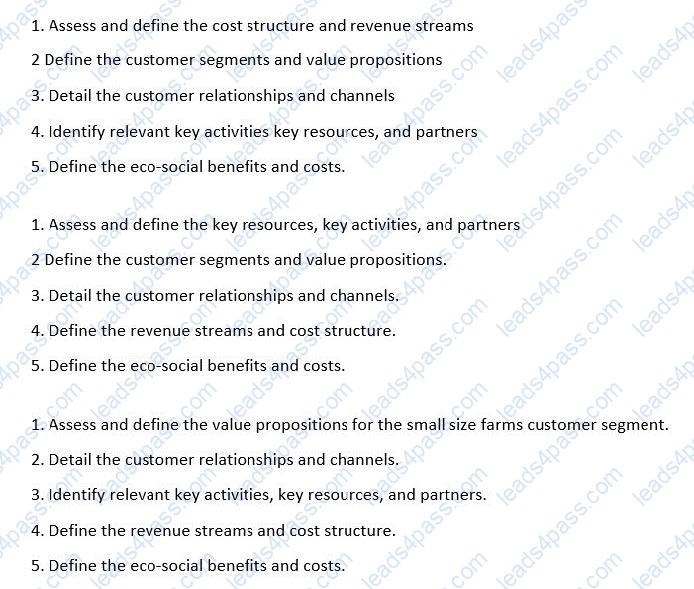
A. 1. Assess and define the cost structure and revenue streams.
2.
Define the customer segments and value propositions.
3.
Detail the customer relationships and channels.
4.
Identify relevant key activities, key resources, and partners.
5.
Define the eco-social benefits and costs.
B. 1. Assess and define the key resources, key activities, and partners.
2.
Define the customer segments and value propositions.
3.
Detail the customer relationships and channels.
4.
Define the revenue streams and cost structure.
5.
Define the eco-social benefits and costs.
C. 1. Assess and define the value propositions for the small size farms customer segment.
2.
Detail the customer relationships and channels.
3.
Identify relevant key activities, key resources, and partners.
4.
Define the revenue streams and cost structure.
5.
Define the eco-social benefits and costs.
The Wanderlust CIO, along with you, the Chief Enterprise Architect, are in the process of deciding on the application that can potentially replace your existing online marketing application, and you are trying to create the artifact Business Footprint Diagram for decision support ( See table below) Which of the following combinations of goals, business capabilities, and applications would you recommend? Note: There are 2 correct answers to this question,
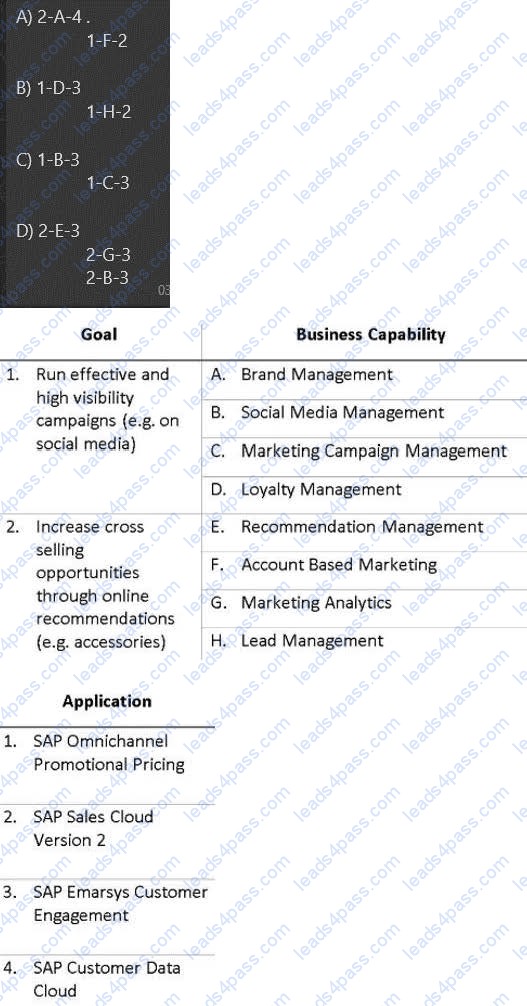
A. 2-A-4,1-F-2
B. 1-D-3,1-H-2
C. 1-B-3,1-C-3
D. 2-E-3,2-G-3,2-B-3
Which integration styles does SAP's Integration Advisory Methodology (ISA-M) cover in general?
A. Process Integration/Data Integration/Analytics Integration/User Integration/Thing Integration.
B. Ul Integration/Process Integration/Data Integration/Thing Integration.
C. Cloud2Cloud/Cloud2OnPremise/Cloud2Cloud/User2On Premise/User2Cloud/Thing2On Premise/Thing2Cloud
What kind of applications can you develop with SAP Business Application Studio?
A. SAPUI5 (SAP Fiori) applications and ABAP applications
B. ABAP applications
C. SAPUI5 (SAP Fiori) applications
HOTSPOT
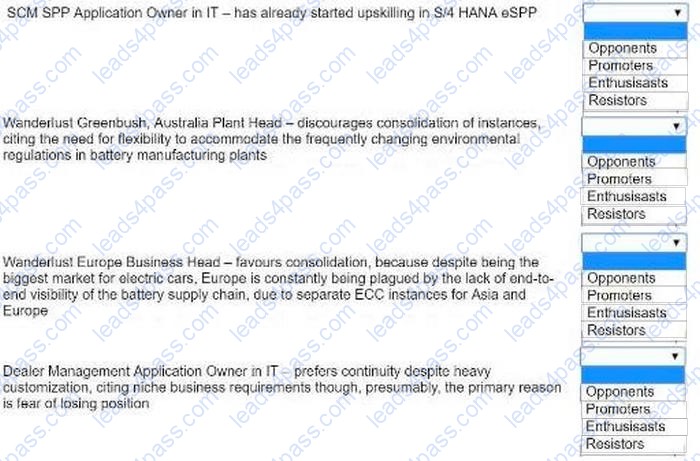
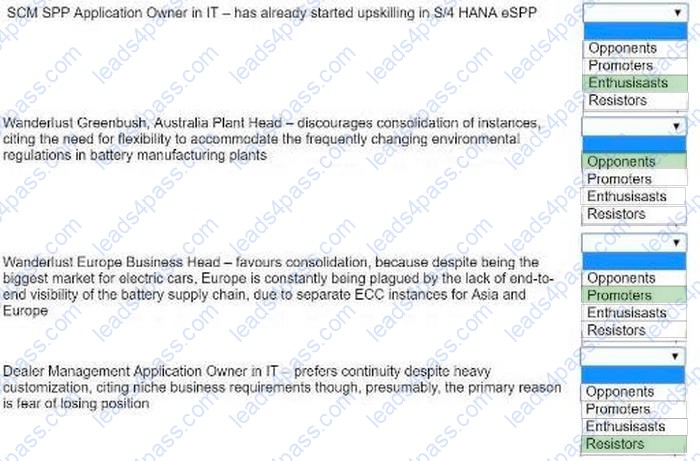
While trying to identify and map key stakeholders in Wanderlust, you, as the Chief Enterprise Architect, have been evangelizing the strategic business and IT objectives with business and IT departments across regions and taking in their views on the upcoming business transformation, Match the feedback from stakeholders (shown on the left) to the categorization and to some of the actions in the dropdown lists.
Hot Area:





All rights are reserved by
leads4pass.com. Any changes, copy or trademarks abuse will be
regarded as infringement.
leads4pass.com will reserve the right to pursue accountability.
Copyright © 2004-
2026 leads4pass.com.