
OMG-OCUP2-INT200 Online Practice Questions and Answers
What statements are true about a composite structure? (Choose two.)
A. Destroying an instance of a structured classifier normally destroys instances of its parts.
B. Structured classifiers cannot contain instances of structured classifiers.
C. The behavior of a structured classifier must be completely defined through the collaboration of owned or referenced instances.
D. Collaborations are structured classifier.
E. A structured classifier is also an encapsulated classifier.
What is NOT a purpose of a port owned by a classifier?
A. server as an end point for connectors
B. hides the internals of that classifier from other classifiers
C. provides a distinct point of interaction between the classifier and its environment
D. specifies an association to the classifier
Which statements apply to arguments of interaction occurrences? (Choose two.)
A. Arguments to interaction occurrences only apply when the corresponding interaction is value returning.
B. The arguments may be constants (literals).
C. An argument of an interaction occurrence must only have simple types.
D. Arguments to interaction occurrences must always correspond to IN-parameters.
E. The arguments may refer to parameters of the enclosing interaction.
How many arrows can point from a flow final node?
A. one
B. any number
C. none
D. two
In the exhibit, what is true for Massert?
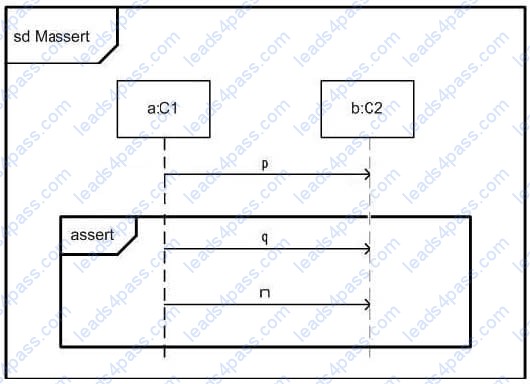
A. A message q that occurs before a message p is invalid.
B. Following a message p, a message m would be valid.
C. Following a message p, a message m would be invalid.
D. A message p may come anywhere in the assert combined fragment.
What is NOT true about a roles and role bindings?
A. A role binding is an association.
B. A role binding maps a connectable element to a role in a collaboration occurrence.
C. The same object may play roles in multiple collaborations.
D. A role types by an interface specifies a set of features required by a participant in a collaboration.
E. The same connectable element may be bound to multiple roles in a single collaboration occurrence.
What will be deleted when performing a Destroy Object Action on an object that participates in a composition association with many components?
A. component objects
B. objects, all its links and all linked objects
C. objects and all its links
D. objects and all its component objects
E. object
Why are profiles NOT a first class extension mechanism?
A. They do not allow for modifying existing metamodels.
B. They do not permit customizing for domains, platforms, and methods.
C. They permit removing constraints that apply to existing metamodels.
D. They do not allow for modifying existing stereotypes.
When an object invokes a ReadSelfAction, what will it retrieve?
A. attribute values for the invoking object
B. invoking object
C. attribute values and links for the invoking object
D. class name of the invoking object
E. name of the invoking activity
To what does an internal structure of a class refer?
A. the decomposition of that class in terms of interconnected parts
B. the set of structural features of that class
C. the inheritance structure of that class
D. the set of nested classifiers of that class
E. class and associations owned by that class





All rights are reserved by
leads4pass.com. Any changes, copy or trademarks abuse will be
regarded as infringement.
leads4pass.com will reserve the right to pursue accountability.
Copyright © 2004-
2026 leads4pass.com.