
OMG-OCUP-200 Online Practice Questions and Answers
A component may legally participate in which relationship(s)?
A. dependencies
B. associations and generalizations
C. dependencies and generalizations
D. dependencies, associations, and generalizations
What does a run-to-completion processing for state machines mean?
A. The executions of orthogonal regions are serialized.
B. Interrupts are disabled while the state machine is running.
C. No other event will be processed until the current event is fully processed.
D. The thread executing the state machine cannot be pre-empted by the scheduler.
What most accurately describes the semantics modeled by the exhibit?
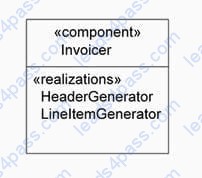
A. HeaderGenerator and LineItemGenerator realize Invoicer.
B. Invoicer realizes HeaderGenerator and LineItemGenerator.
C. HeaderGenerator and LineItemGenerator are Invoicer ports.
D. An Invoicer component is composed of a HeaderGenerator component and a LineItemGenerator component.
What are valid ways to present a component's artifacts file, such as a jar file? (Choose two)
A. as a compartment of a related component
B. stereotype of class with keyword <[file]> with a solid arrow pointing to the related component
C. stereotype of class with keyword <
D. stereotype of a component with keyword <[file]> with a solid arrow pointing to the related component
E. stereotype of a component with keyword <
What symbol depicts a CallBehaviorAction?
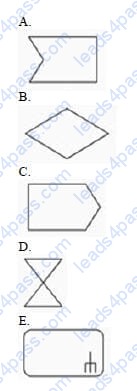
A. Option A
B. Option B
C. Option C
D. Option D
E. Option E
If the node in the exhibit receives a value, what happens to other values flowing in the diagram containing the node?
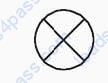
A. nothing
B. They are aborted.
C. They stop until the small circle emits a value.
D. They stop for a time specified by the small circle.
In the exhibit, what is true for Massert?
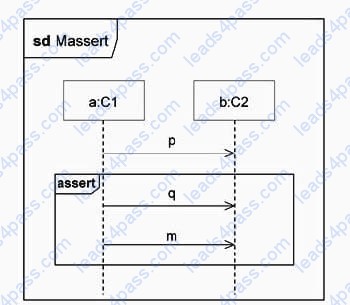
A. Following a message p, a message m would be valid.
B. Following a message p, a message m would be invalid.
C. A message q that occurs before a message p is invalid.
D. A message p may come anywhere in the assert combined fragment.
What is true about a pseudostate?
A. not a state but a vertex
B. a state entry or exit point
C. a specification of a potential state
D. a state that can be specialized for different purposes
What does the history of a state represent?
A. most recent active configuration of its substates
B. most recent transition that was taken into the state
C. most recent transition that was taken out of the state
D. number of times that the state has been active before
What is the difference between a stereotype and a metaclass?
A. Stereotypes can be specialized, but metaclasses cannot be specialized.
B. Metaclasses can be specialized, but stereotypes cannot be specialized.
C. A metaclass is a limited kind of a stereotype that can only be used in conjunction with one of the stereotypes it limits.
D. A stereotype is a limited kind of a metaclass that can be only be used in conjunction with one of the metaclasses it extends.
E. A stereotype is a specialization of a metaclass that can be used by itself, whereas a metaclass must be used with a stereotype.





All rights are reserved by
leads4pass.com. Any changes, copy or trademarks abuse will be
regarded as infringement.
leads4pass.com will reserve the right to pursue accountability.
Copyright © 2004-
2026 leads4pass.com.