
OMG-OCUP-100 Online Practice Questions and Answers
What is a relationship in UML 2.0?
A. the state of being related
B. an element that has no derived union
C. an element that has no derived composition
D. an element that must have two owned elements
E. an element that specifies a connection between elements
What is true about every named element that is a member of a namespace?
A. It is owned by the namespace.
B. It has one unique name within the namespace.
C. It is identified by its name within the namespace.
D. It can be distinguished from other members in the namespace.
What does an association specify?
A. tuples that are not links
B. relationship among models
C. links between associated types
D. links between instances of associated types
E. links between instances of untyped classes
A property is a feature that can be represented in what ways? (Choose two)
A. as an association
B. as an association end
C. as an attribute in a class
D. as an operation in a class
E. as an indication of whether the feature is public or private
Refer to the exhibit. n that class A realizes interfaces X and Y, and that class B realizes interface Y and uses interface Z, what operations must class A support?
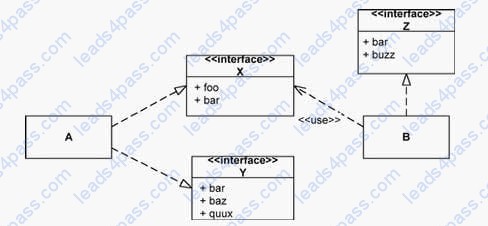
A. union of the operations in interfaces X and Y
B. union of the operations in interfaces X, Y, and Z
C. intersection of the operations in interfaces X and Y
D. intersection of the operations in interfaces X, Y, and Z
E. not required to support any operations specified by the interfaces shown
What statements are true about implementation relationships? (Choose two)
A. A classifier may only implement one interface.
B. An interface may implement multiple classifiers.
C. A classifier implementing an interface conforms to its contract.
D. The set of interfaces implemented by a classifier are its required interfaces.
E. The set of interfaces implemented by a classifier are its provided interfaces.
Which kind of behavior diagram is NOT a UML 2.0 diagram?
A. activity diagram
B. dataflow diagram
C. sequence diagram
D. interaction diagram
E. communication diagram
What is the purpose of general ordering in a UML 2.0 interaction diagram?
A. mechanism to provide partial ordering of event occurrences
B. principle of how to order the lifelines within a sequence diagram
C. construct showing the order of messages in a communication diagram
D. construct to define the generalization relationship between different interactions
Which will cause an activity to finish executing? (Choose two)
A. All guards fail.
B. No actions are executing.
C. Activity final is reached.
D. No tokens (values) are in the activity.
E. Output parameter nodes all have values.
In the exhibit, which best describes the relationship between the two use cases:
Use Case A and Use Case B?
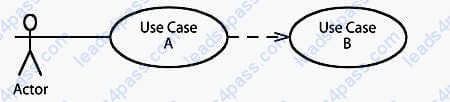
A. Use Case A extends Use Case B.
B. Use Case A includes Use Case B.
C. Use Case A generalizes Use Case B.
D. Use Case B extends Use Case A.
E. Use Case B includes Use Case A.
F. Use Case B generalizes Use Case A.





All rights are reserved by
leads4pass.com. Any changes, copy or trademarks abuse will be
regarded as infringement.
leads4pass.com will reserve the right to pursue accountability.
Copyright © 2004-
2026 leads4pass.com.