
NSE8_812 Online Practice Questions and Answers
You must analyze an event that happened at 20:37 UTC. One log relevant to the event is extracted from FortiGate logs:

The devices and the administrator are all located in different time zones Daylight savings time (DST) is disabled The FortiGate is at GMT-1000. The FortiAnalyzer is at GMT-0800 Your browser local time zone is at GMT-03.00
You want to review this log on FortiAnalyzer GUI, what time should you use as a filter?
A. 20:37:08
B. 10:37:08
C. 17:37:08
D. 12.37:08
Refer to the exhibits.
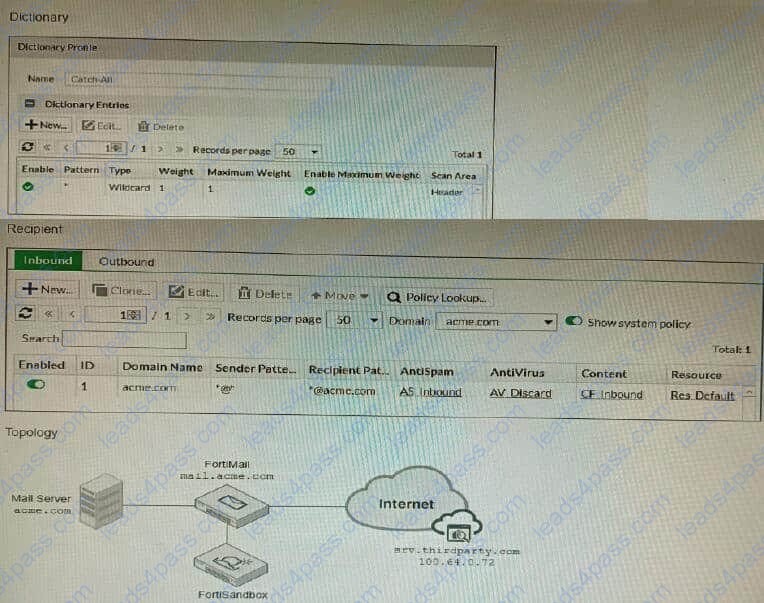
The exhibits show a FortiMail network topology, Inbound configuration settings, and a Dictionary Profile.
You are required to integrate a third-party's host service (srv.thirdparty.com) into the e-mail processing path.
All inbound e-mails must be processed by FortiMail antispam and antivirus with FortiSandbox integration. If the email is clean, FortiMail must forward it to the third-party service, which will send the email back to FortiMail for final delivery, FortiMail must not scan the e-mail again.
Which three configuration tasks must be performed to meet these requirements? (Choose three.)
A. Change the scan order in FML-GW to antispam-sandbox-content.
B. Apply the Catch-Ail profile to the CFInbound profile and configure a content action profile to deliver to the srv. thirdparty. com FQDN
C. Create an access receive rule with a Sender value of srv. thirdparcy.com, Recipient value of *@acme.com, and action value of Safe
D. Apply the Catch-AII profile to the ASinbound profile and configure an access delivery rule to deliver to the 100.64.0.72 host.
E. Create an IP policy with a Source value of 100. 64 .0.72/32, enable precedence, and place the policy at the top of the list.
Refer to the exhibit.
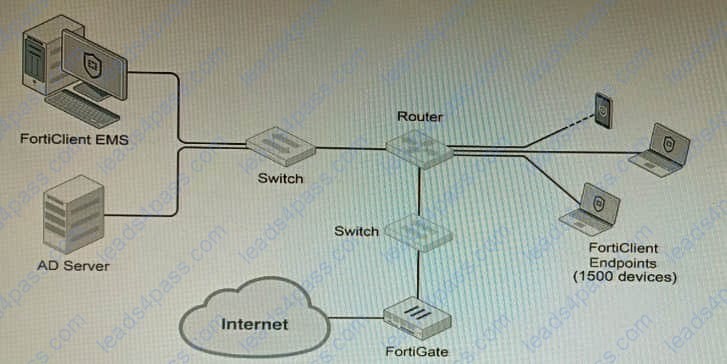
A customer wants FortiClient EMS configured to deploy to 1500 endpoints. The deployment will be integrated with FortiOS and there is an Active Directory server.
Given the configuration shown in the exhibit, which two statements about the installation are correct? (Choose two.)
A. If no client update time is specified on EMS, the user will be able to choose the time of installation if they wish to delay.
B. A client can be eligible for multiple enabled configurations on the EMS server, and one will be chosen based on first priority
C. You can only deploy initial installations to Windows clients.
D. You must use Standard or Enterprise SQL Server rather than the included SQL Server Express
E. The Windows clients only require "File and Printer Sharing0 allowed and the rest is handled by Active Directory group policy
Refer to the exhibit.
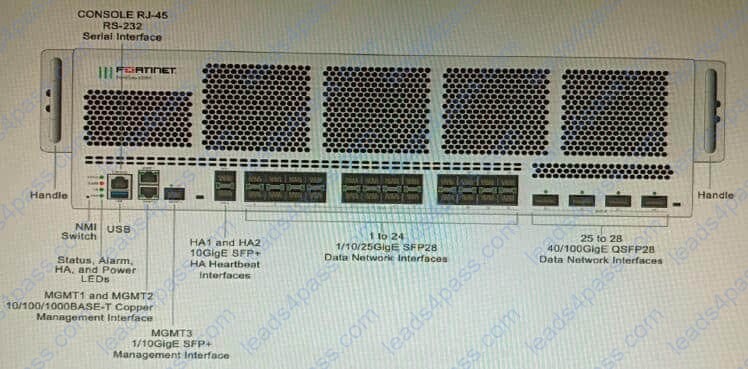
You are deploying a FortiGate 6000F. The device should be directly connected to a switch. In the future, a new hardware module providing higher speed will be installed in the switch, and the connection to the FortiGate must be moved to this higher-speed port.
You must ensure that the initial FortiGate interface connected to the switch does not affect any other port when the new module is installed and the new port speed is defined.
How should the initial connection be made?
A. Connect the switch on any interface between ports 21 to 24
B. Connect the switch on any interface between ports 25 to 28
C. Connect the switch on any interface between ports 1 to 4
D. Connect the switch on any interface between ports 5 to 8.
Which two statements are correct on a FortiGate using the FortiGuard Outbreak Protection Service (VOS)? (Choose two.)
A. The FortiGuard VOS can be used only with proxy-base policy inspections.
B. If third-party AV database returns a match the scanned file is deemed to be malicious.
C. The antivirus database queries FortiGuard with the hash of a scanned file
D. The AV engine scan must be enabled to use the FortiGuard VOS feature
E. The hash signatures are obtained from the FortiGuard Global Threat Intelligence database.
Refer to the exhibit.
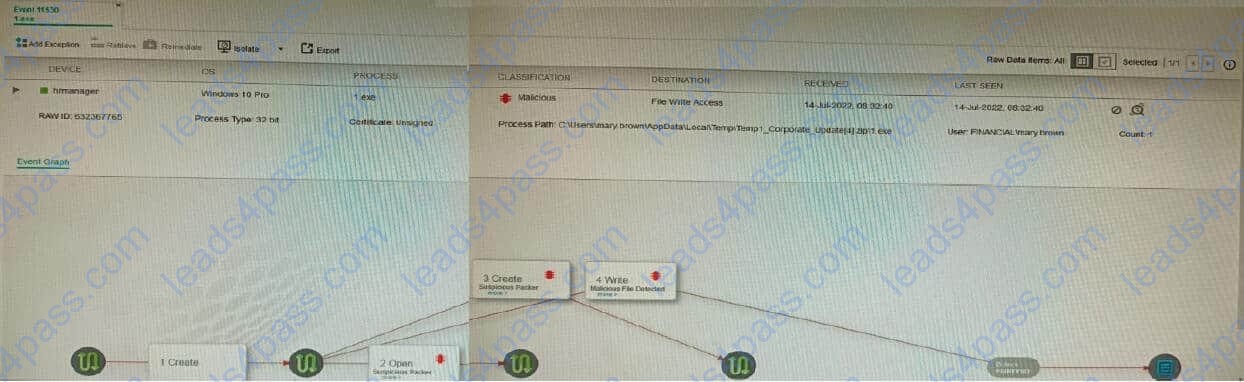
The exhibit shows the forensics analysis of an event detected by the FortiEDR core
In this scenario, which statement is correct regarding the threat?
A. This is an exfiltration attack and has been stopped by FortiEDR.
B. This is an exfiltration attack and has not been stopped by FortiEDR
C. This is a ransomware attack and has not been stopped by FortiEDR.
D. This is a ransomware attack and has been stopped by FortiEDR
Refer to the exhibits.
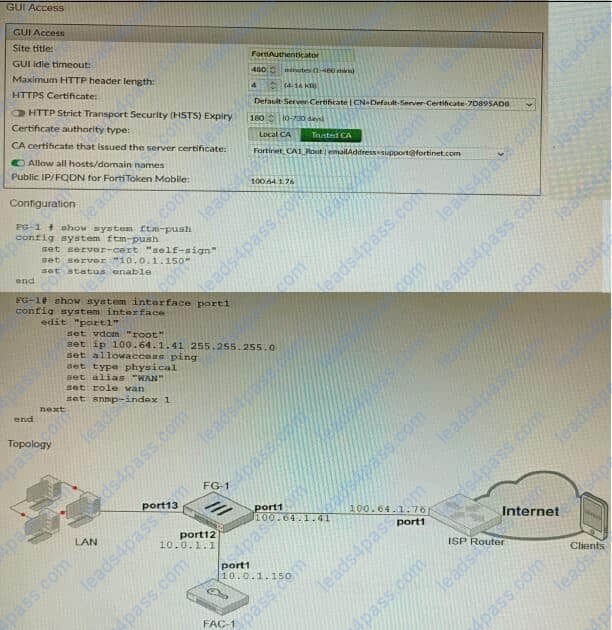
An administrator has configured a FortiGate and Forti Authenticator for two-factor authentication with FortiToken push notifications for their SSL VPN login. Upon initial review of the setup, the administrator has discovered that the customers can manually type in their two-factor code and authenticate but push notifications do not work
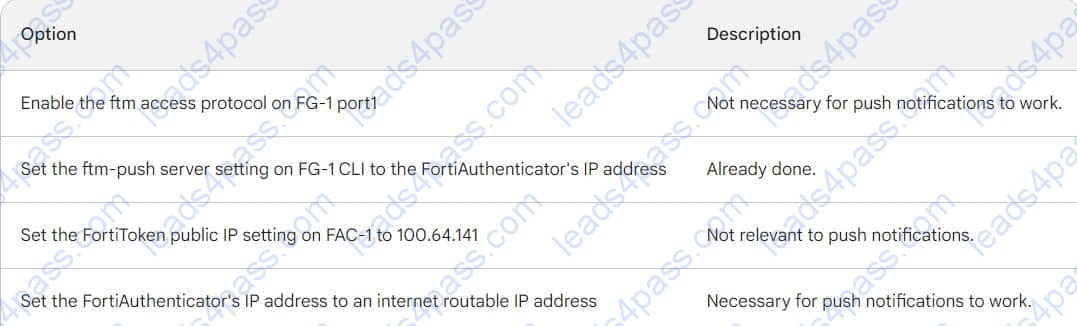
Based on the information given in the exhibits, what must be done to fix this?
A. On FG-1 port1, the ftm access protocol must be enabled.
B. FAC-1 must have an internet routable IP address for push notifications.
C. On FG-1 CLI, the ftm-push server setting must point to 100.64.141.
D. On FAC-1, the FortiToken public IP setting must point to 100.64.1 41
Refer to the exhibit.
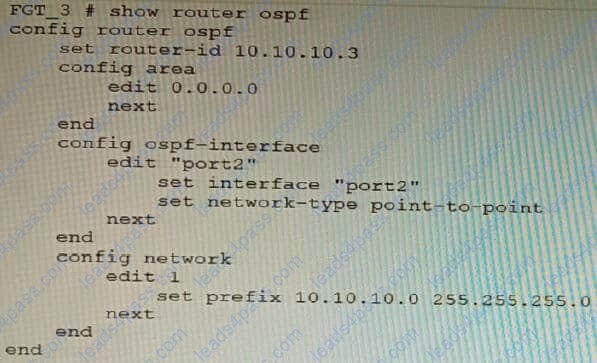
You are operating an internal network with multiple OSPF routers on the same LAN segment. FGT_3 needs to be added to the OSPF network and has the configuration shown in the exhibit. FGT_3 is not establishing any OSPF connection. What needs to be changed to the configuration to make sure FGT_3 will establish OSPF neighbors without affecting the DR/BDR election?
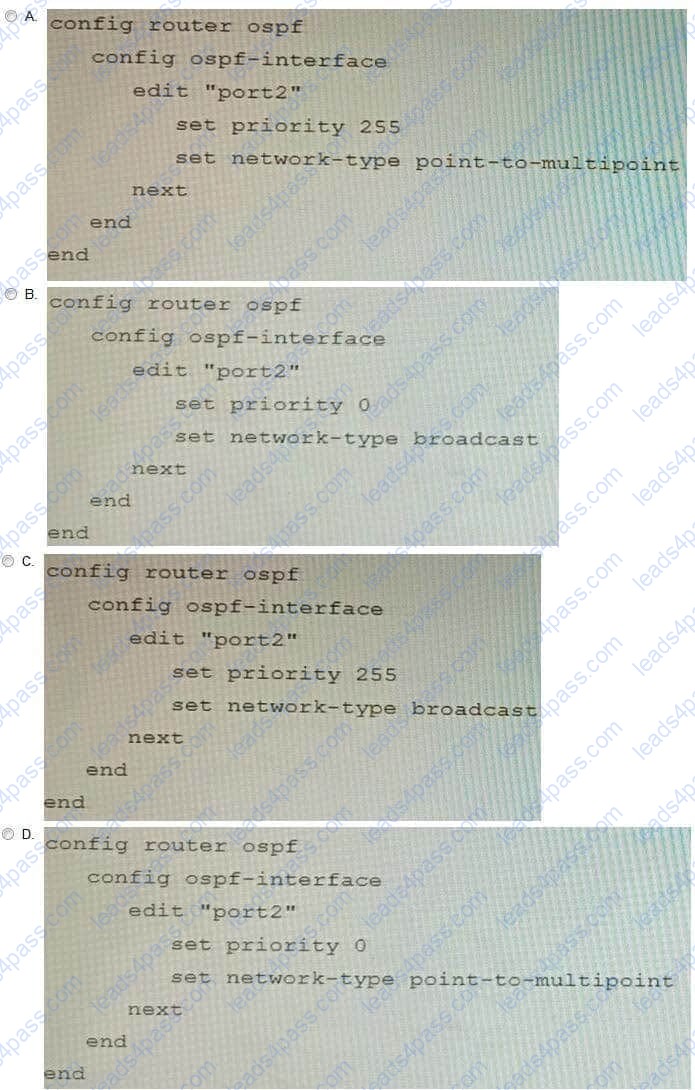
A. Option A
B. Option B
C. Option C
D. Option D
You are responsible for recommending an adapter type for NICs on a FortiGate VM that will run on an ESXi Hypervisor. Your recommendation must consider performance as the main concern, cost is not a factor. Which adapter type for the NICs will you recommend?
A. Native ESXi Networking with E1000
B. Virtual Function (VF) PCI Passthrough
C. Native ESXi Networking with VMXNET3
D. Physical Function (PF) PCI Passthrough
An administrator has configured a FortiGate device to authenticate SSL VPN users using digital certificates. A FortiAuthenticator is the certificate authority (CA) and the Online Certificate Status Protocol (OCSP) server. Part of the FortiGate configuration is shown below:
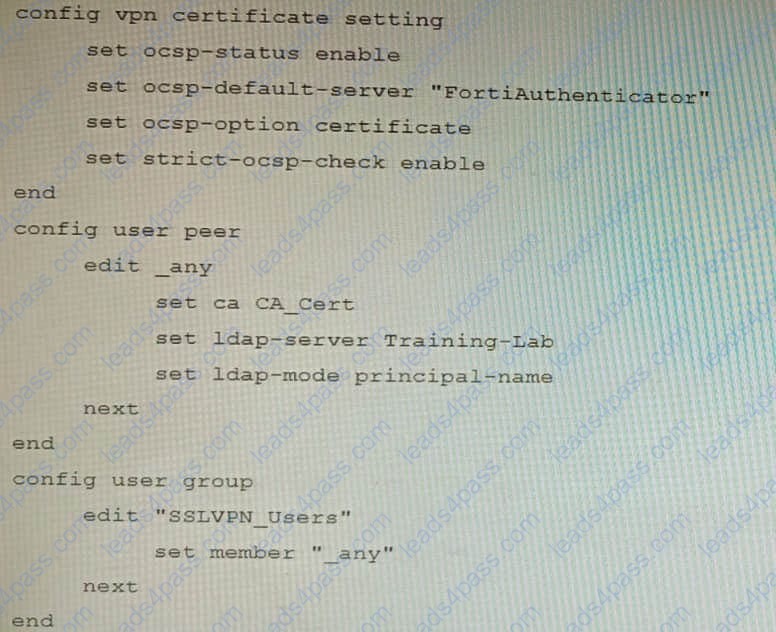
Based on this configuration, which two statements are true? (Choose two.)
A. OCSP checks will always go to the configured FortiAuthenticator
B. The OCSP check of the certificate can be combined with a certificate revocation list.
C. OCSP certificate responses are never cached by the FortiGate.
D. If the OCSP server is unreachable, authentication will succeed if the certificate matches the CA.





All rights are reserved by
leads4pass.com. Any changes, copy or trademarks abuse will be
regarded as infringement.
leads4pass.com will reserve the right to pursue accountability.
Copyright © 2004-
2026 leads4pass.com.