
NSE4_FGT-7.0 Online Practice Questions and Answers
Refer to the exhibit.
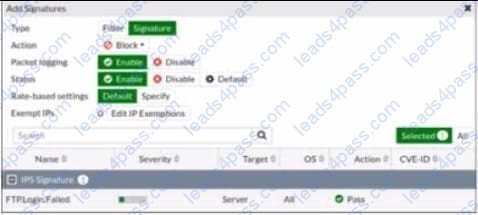
Review the Intrusion Prevention System (IPS) profile signature settings. Which statement is correct in adding the FTP.Login.Failed signature to the IPS sensor profile?
A. The signature setting uses a custom rating threshold.
B. The signature setting includes a group of other signatures.
C. Traffic matching the signature will be allowed and logged.
D. Traffic matching the signature will be silently dropped and logged.
An administrator has configured the following settings: What are the two results of this configuration? (Choose two.)
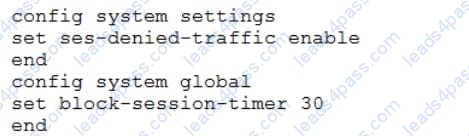
A. Device detection on all interfaces is enforced for 30 minutes.
B. Denied users are blocked for 30 minutes.
C. A session for denied traffic is created.
D. The number of logs generated by denied traffic is reduced.
Which three options are the remote log storage options you can configure on FortiGate? (Choose three.)
A. FortiCache
B. FortiSIEM
C. FortiAnalyzer
D. FortiSandbox
E. FortiCloud
Which three CLI commands can you use to troubleshoot Layer 3 issues if the issue is in neither the physical layer nor the link layer? (Choose three.)
A. diagnose sys top
B. execute ping
C. execute traceroute
D. diagnose sniffer packet any
E. get system arp
Which two statements about IPsec authentication on FortiGate are correct? (Choose two.)
A. For a stronger authentication, you can also enable extended authentication (XAuth) to request the remote peer to provide a username and password
B. FortiGate supports pre-shared key and signature as authentication methods.
C. Enabling XAuth results in a faster authentication because fewer packets are exchanged.
D. A certificate is not required on the remote peer when you set the signature as the authentication method.
Refer to the exhibit.
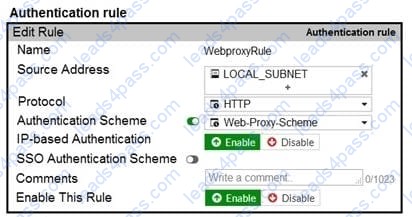
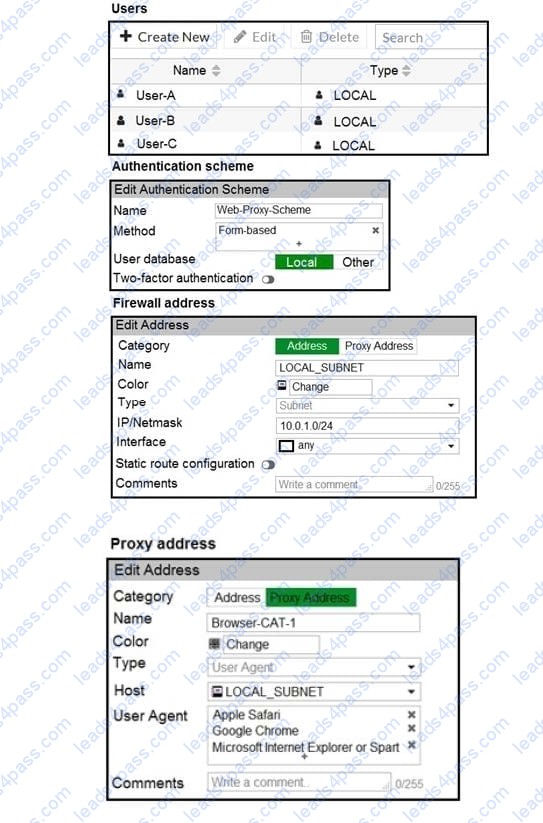
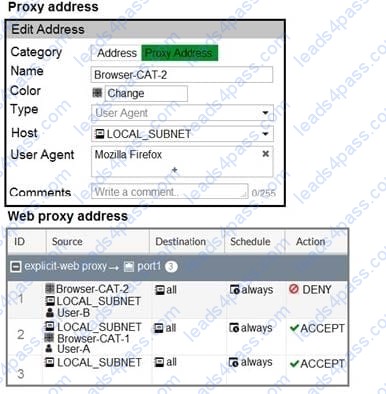
The exhibit shows proxy policies and proxy addresses, the authentication rule and authentication scheme, users, and firewall address.
An explicit web proxy is configured for subnet range 10.0.1.0/24 with three explicit web proxy policies. The authentication rule is configured to authenticate HTTP requests for subnet range 10.0.1.0/24 with a form-based authentication scheme for the FortiGate local user database.
Users will be prompted for authentication.
How will FortiGate process the traffic when the HTTP request comes from a machine with the source IP
10.0.1.10 to the destination http://www.fortinet.com? (Choose two.)
A. If a Mozilla Firefox browser is used with User-B credentials, the HTTP request will be allowed.
B. If a Google Chrome browser is used with User-B credentials, the HTTP request will be allowed.
C. If a Mozilla Firefox browser is used with User-A credentials, the HTTP request will be allowed.
D. If a Microsoft Internet Explorer browser is used with User-B credentials, the HTTP request will be allowed.
Which three statements about security associations (SA) in IPsec are correct? (Choose three.)
A. Phase 2 SAs are used for encrypting and decrypting the data exchanged through the tunnel.
B. An SA never expires.
C. A phase 1 SA is bidirectional, while a phase 2 SA is directional.
D. Phase 2 SA expiration can be time-based, volume-based, or both.
E. Both the phase 1 SA and phase 2 SA are bidirectional.
To complete the final step of a Security Fabric configuration, an administrator must authorize all the devices on which device?
A. FortiManager
B. Root FortiGate
C. FortiAnalyzer
D. Downstream FortiGate
Which three pieces of information does FortiGate use to identify the hostname of the SSL server when SSL certificate inspection is enabled? (Choose three.)
A. The subject field in the server certificate
B. The serial number in the server certificate
C. The server name indication (SNI) extension in the client hello message
D. The subject alternative name (SAN) field in the server certificate
E. The host field in the HTTP header
Which statement regarding the firewall policy authentication timeout is true?
A. It is an idle timeout. The FortiGate considers a user to be "idle" if it does not see any packets coming from the user's source IP.
B. It is a hard timeout. The FortiGate removes the temporary policy for a user's source IP address after this timer has expired.
C. It is an idle timeout. The FortiGate considers a user to be "idle" if it does not see any packets coming from the user's source MAC.
D. It is a hard timeout. The FortiGate removes the temporary policy for a user's source MAC address after this timer has expired.





All rights are reserved by
leads4pass.com. Any changes, copy or trademarks abuse will be
regarded as infringement.
leads4pass.com will reserve the right to pursue accountability.
Copyright © 2004-
2026 leads4pass.com.