
NS0-509 Online Practice Questions and Answers
An administrator has an AFF A200 cluster at their primary site that is used for FC connectivity to servers. For disaster recovery purposes they want to start replicating their data to another AFF A3Q0 cluster In a secondary location. The AFF A300 is In a site that has no FC or FCoE capable switches, and is currently only used for CIFS dat A cluster peering relationship already exists between the two clusters. Which three additional actions are needed for the data to be ready for access from hosts at the secondary site? (Choose three.)
A. Create zones with the appropriate initiators and targets for the secondary site.
B. Enable the iSCSI service on the SVM at the secondary site.
C. Replicate the data from the primary site to the secondary site with SnapMirror.
D. Create new iSCSI igroups for LUN mapping.
E. Enable the iSCSI service on the SVM at the primary site.
You have inherited a small FC SN infrastructure that consists of 15 servers (hosts), two Cisco MDS 9148s
switches, and a 4-node NetApp AFF A300 cluster. You suspect that your predecessor did not configure
zoning according to best practices.
In this scenario, what information is necessary to audit your SAN zoning? (Choose two.)
A. SVM WWNNs
B. SVN LIF WWPNs
C. Controller port WWPNs
D. Host GBA WWPNs
You have a 4-node cluster with a FAS8200 HA pair and an AFF A300 HA pair. You need to migrate a LUN from a FAS8200 node to an AFF A300 node for faster performance. Which method will non-disruptively migrate the LUN to the AFF A300 while retaining snapshots of the LUN on the FAS8200?
A. You move the LUN.
B. You relocate the aggregate.
C. You move the volume.
D. You copy the LUN.
You must relocate a LUN from one AFF A700 HA pair to another AFF A300 HA pair while preserving all storage efficiencies. What are two ways to accomplish this task? (Choose two.)
A. Copy the volume.
B. Copy the LUN.
C. Move the volume.
D. Move the LUN.
Which tool collects configuration data from hosts and switches to assist in evaluating a qualified configuration?
A. System Manager
B. sysstat. command
C. SnapCenter
D. OneCollect
Click the Exhibit button.
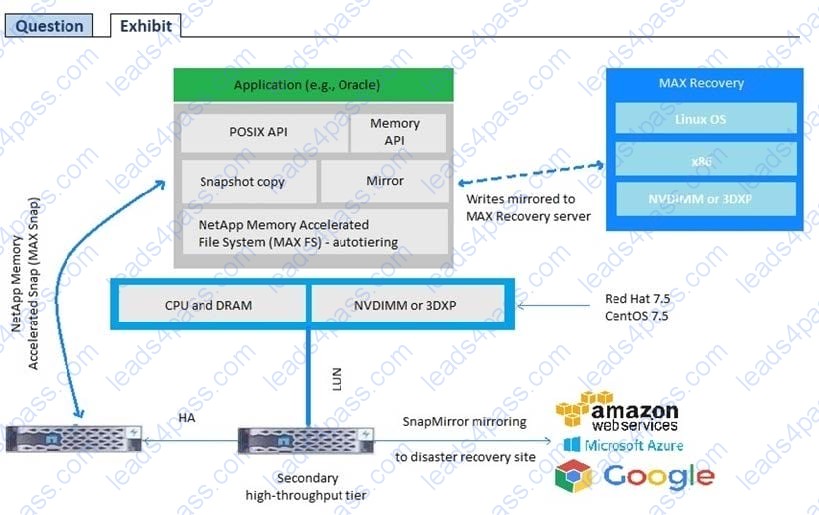
You have a requirement to serve LUNs with under 200 microsecond latency using local server lass memory. You also are required to use a shared SAN.
Using MAX Data as shown in the exhibit, which two LUN access protocols are supported with this solution? (Choose two.)
A. iSCSI
B. FCoE
C. FC
D. NVMe
Click the Exhibit button.
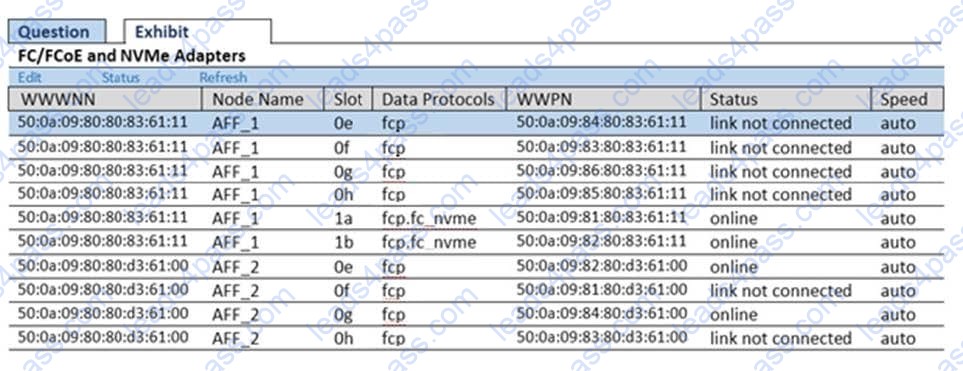
A customer is using both FC and NVMe in a cluster. The customer needs to do some work on AFF_1. Referring to the exhibit, what will happen?
A. The NVMe namespaces on AFF_2 will be available after takeover of AFF_1.
B. The FC LUNs that use cluster interconnect to access the LUNs on AFF_1 will be unavailable after failover.
C. The FC LUNs on node AFF_2 will be unavailable after failover of AFF_1.
D. The NVMe namespaces on AFF_1 will be unavailable after takeover by AFF_2.
You deployed a new SVM for FC access, and you used the vserver fcr, create -vserver svm1 - statusadmin up command to enable FC service on the SVM. You then created the LIFs for the FC protocol. When you review the status of the LIFs, they show that the admin status is up, but the operational status is down. You have already verified that the ports are physically connected.
In this scenario, what is the next step to bring the LIFs up?
A. Use the network interface modify command to change the operational status of the LIFs.
B. Create at least one zone that contains your SVM LIF WWPNs and an initiator.
C. Verify that an FC license is applied on your system.
D. Disable the SAN switch port where your NetApp storage is connected.
You currently have a FAS8200 with ONTAP 9.5. You want to expand the front end FC I/O capabilities. However, you are unsure which target adapters are supported.
What would you use to confirm which adapters are supported with your current configuration?
A. Hardware Universe (HWU)
B. Upgrade Advisor
C. OneCollect
D. Interoperability Matrix Tool (IMT)
What is a SAN best practice when initially configuring a Linux FC boot LUN?
A. Install the Host Utilities in the guest Linux OS.
B. Map the WWPN of the target.
C. Disable the HBA port with the host's BIOS.
D. Configure multipath to the LUN.





All rights are reserved by
leads4pass.com. Any changes, copy or trademarks abuse will be
regarded as infringement.
leads4pass.com will reserve the right to pursue accountability.
Copyright © 2004-
2026 leads4pass.com.