
NS0-403 Online Practice Questions and Answers
You are deploying persistent storage for Kubernetes with NetApp Trident.
In this scenario, what are the two objects that you must create? (Choose two.)
A. Trident virtual storage pool
B. Trident backend
C. Kubemetes StorageCIass
D. Trident volume
You are asked to provision storage for a development team to make use of NetApp Trident in their Kubernetes environment. You want to ensure that Trident will not be able to exhaust the storage system resources.
In this scenario, which two actions would you take to satisfy the requirements? (Choose two.)
A. Limit the maximum volume count.
B. Limit the available data LIFs.
C. Use a shared SVM.
D. Limit the maximum volume size.
Your customer is using Astra Control Service to back up applications. They require a consistent copy of the data that also captures data in flight.
Which two applications will Astra support in this scenario? (Choose two.)
A. ksqIDB
B. Jenkins
C. Argo CD
D. PostgreSQL
You have a 4-node AFF A800 cluster that is serving file data. You are required to replicate copies of the data volumes directly to Amazon S3. In this scenario, which two NetApp tools satisfy this requirement? (Choose two.)
A. Cloud Sync
B. XCP
C. FabricPool
D. SnapMirror Cloud
You have a single node Cloud Volumes ONTAP (CVO) system in AWS.
In this scenario, which two activities will cause system downtime? (Choose two.)
A. Change the disk type of a volume from HDD (st1) to SSD (gp2).
B. Change the Cloud Volumes ONTAP EC2 instance type.
C. Upgrade the Cloud Volumes ONTAP system software.
D. Apply a new Cloud Volumes ONTAP license.
You have received an internal request for persistent storage where the developer would like to be able to specify the filesystem. Which three NetApp Trident backend storage drivers would satisfy the requirement? (Choose three.)
A. ontap-nas
B. ontap-nas-economy
C. solidfire-san
D. eseries-iscsi
E. ontap-.san
Click the Exhibit button.
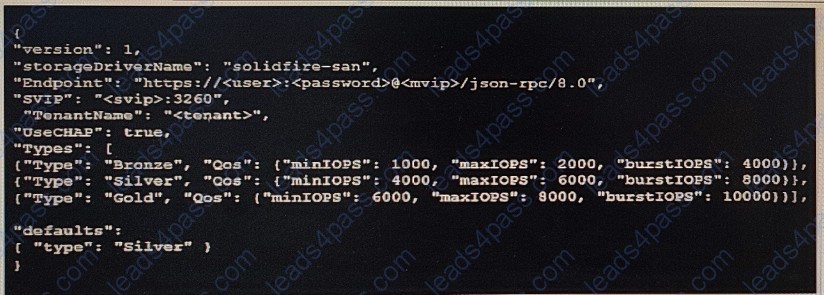
Refer to the exhibit and the Storage Class information shown below.
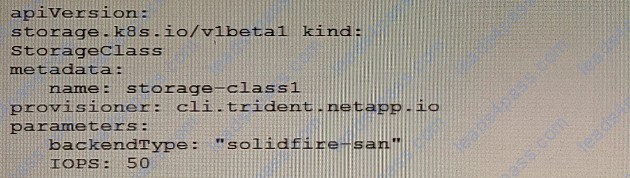
What are the minimum IOPS, maximum IOPS, and burst IOPS assigned to the persistent volumes that were created by Trident?
A. "minlOPS": 600C, "maxIOPS": 8000, "burstlOPS": 10000
B. "minlOPS": 4QG0, "maxIOPS": 6000, "burstlOPS": 8000
C. "minlOPS": 50, "maxIOPS": 50, "burstlOPS": 50
D. "minlOPS": 1000, "maxIOPS": 2000, "burstlOPS": 4000
You are asked to configure NetApp Trident to provide dynamic and persistent storage using Azure NetApp Files to your Azure Kubernetes Service (AKS) cluster.
In this scenario, which three elements do you need to configure your Trident back end? (Choose three.)
A. an App Registration or service principal
B. an ONTAP cluster credential
C. an Azure portal credential
D. an Azure subscription ID
E. an Azure location/region with a subnet delegated to Microsoft .Netapp/volumes
Your customer wants to use NetApp Trident to automate data lake provisioning on premises using a NetApp AFF array in AWS using NetApp Cloud Volumes ONTAP. Their unstructured datasets will require 200 TB of storage, will be accessed by hundreds of worker nodes simultaneously, and will have millions of small files in a complex directory hierarchy.
In this scenario, which Trident driver is appropriate for this task?
A. ontap-nas-flexgroup
B. ontap-nas-economy
C. ontap-nas
D. aws--cvs
Click the Exhibit button.
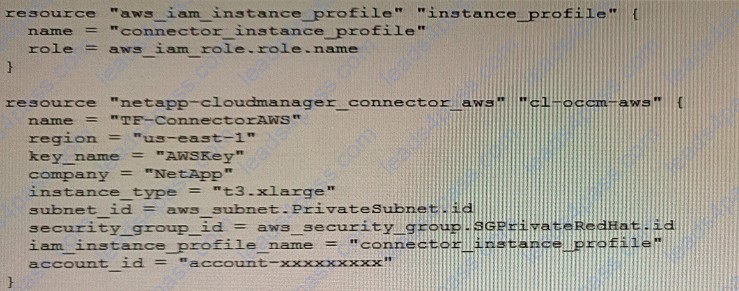
Referring to the exhibit, which two source resources? (Choose two.)
A. source = "hashicorp/terraform"
B. source = nhashicorp/aws"
C. source = "terraform/terraform"
D. source = "NetApp/netapp-cloudman





All rights are reserved by
leads4pass.com. Any changes, copy or trademarks abuse will be
regarded as infringement.
leads4pass.com will reserve the right to pursue accountability.
Copyright © 2004-
2026 leads4pass.com.