
NCM-5.15 Online Practice Questions and Answers
An administrator receives reports about a Nutanix environment. The investigation finds the following;
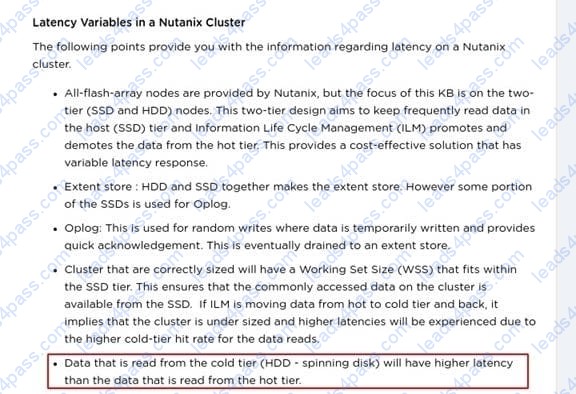
VMs are experiencing very high latency
Each node is equipped with a single SSD, utilized at 95%
Each node is equipped with three HDDs, utilized at 40%
Why are the guest VMs experiencing high latency?
A. CVMs are overwhelmed by disk balancing operations.
B. All VM write operations are going to HDD.
C. All VM read operations are coming from HDD.
D. VMs are unable to perform write operations
A customer recently set up Async Replication between Site A and Site B. The customer wants to conduct a planned failover and clicks Activate on Site B. The customer then runs the following command on Site A: ncli pd
deactivate_and__destroy_vms name=
What does this do to the customer environment?
A. VMs get deleted from Site B and the protection domain is now Active.
B. VMs are powered off on Site A and must be manually powered on at Site B.
C. VMs get deleted from Site A and the protection domain is no longer active.
D. Customer must then manually power off VMs at Site A and power them on at Site B.

An administrator is supporting a business critical environment and deploys metro availability to achieve a zero data loss configuration. The two clusters are connected by a 1GbE connection. A new workload is going to be deployed to this cluster. This workload requires a sustained 150MB/s of write throughput and 20MB/s of read throughput.
Which change must be made to deploy the workload successfully on this cluster?
A. The bandwidth must be increased to support this workload.
B. The workload must be configured to read at greater than 12.5MB/s.
C. The replication frequency must be less than 60 minutes.
D. Zero data loss nearsync must be used to support this workload.
An administrator needs to deploy an application with a large amount of data connected via Nutanix Volumes.
Which two actions should the administrator take when designing the Volume Group? (Choose two.)
A. Use multiple subnets for iSCSI traffic
B. Enable RSS (Receive Side Scaling)
C. Enable thick provisioning on the Volume Group(s)
D. Distribute workload across multiple virtual disks
An administrator deploys Exchange on a Nutanix cluster. The administrator creates two containers with RF2 configuration: One container for Exchange One container for the other VMs
The Exchange VM is experiencing I/O performance issues.
Which changes to Storage Optimization should be used on the Exchange container to enhance I/O performance?
A. No data reduction
B. Post process Deduplication only
C. Inline compression and EC-X
D. Inline compression and Deduplication
A customer with a four-node RF2 cluster is adding application VMs to their system. After adding these Vms, the Prism dashboard shows 81% storage utilization.
What is the consequence of running the cluster at 81% storage utilization?
A. The customer has the ability to add more VMs up to the 100% storage utilization.
B. There is available capacity in the storage fabric and the cluster is resilient.
C. Node failure is imminent due to storage utilization.
D. The cluster is not resilient in the storage fabric
An administrator has two clusters: Site A and Site B. Async DR is configured between the clusters as follows: Site A is the Primary Site Site B is the Secondary inactive Site, no VMs running Site A is fully in Production Site B used as Backup/Disaster Recovery
The customer wants to perform a planned failover between the sites. How should the administrator accomplish this?
A. Click Activate on the Secondary site within the Data Protection Dashboard
B. Click Activate on the Secondary site and run deactive NCLI command on Primary site
C. Choose Migrate on the Secondary site within the Data Protection Dashboard
D. Choose Migrate on the Primary site within the Data Protection Dashboard
An administrator needs to replace an aging SAN and move to a hyper-converged infrastructure. The existing environment consists of the following hosts that are connected to the SAN: 5xAIX hosts 3x Hyper-V hosts 9xESXi hosts 2x physical SQL Clusters (Windows Server 2012R2 hosts)
After deploying a Nutanix AHV cluster, which two actions should the administrator take to meet the requirements? (Choose two.)
A. Deploy Volumes to support the AIX and SQL workloads.
B. Migrate the ESXI workloads to AHV using Move.
C. Deploy Files to support the AIX hosts.
D. Migrate the ESXi and Hyper-V workloads using Move.
An administrator is updating disk firmware using LCM and receives the following message:
"There have been 10 or more cluster services restarts within 15 minutes in the Controller VM."
The message appears as each drive is upgraded.
What is the reason this message is being generated?
A. A node has been rebalanced
B. A drive has been reformatted
C. A node has been rebooted
D. A drive has been rejected
An administrator needs to initiate a new VDI project within a couple of months. Prism Central reports there are no storage resources to accommodate such workloads.
The administrator sees many powered-off VMs and has the authority to delete test VMs powered off at least for 30 days. Test VMs belong to the Test category.
Using Prism Central, which steps are required to identify the correct VMs to be deleted?
A. Use Capacity Runway to filter by Test and Powered-off VMs
B. Filter VMs list, choose Test category and Inactive under Efficiency
C. Create a new Scenario selecting Test VMs. filter by uptime
D. Create a new Project selecting Test VMs, sorting by power state





All rights are reserved by
leads4pass.com. Any changes, copy or trademarks abuse will be
regarded as infringement.
leads4pass.com will reserve the right to pursue accountability.
Copyright © 2004-
2026 leads4pass.com.