
MCPA-LEVEL1 Online Practice Questions and Answers
A set of tests must be performed prior to deploying API implementations to a staging environment. Due to data security and access restrictions, untested APIs cannot be granted access to the backend systems, so instead mocked data must be used for these tests. The amount of available mocked data and its contents is sufficient to entirely test the API implementations with no active connections to the backend systems. What type of tests should be used to incorporate this mocked data?
A. Integration tests
B. Performance tests
C. Functional tests (Blackbox)
D. Unit tests (Whitebox)
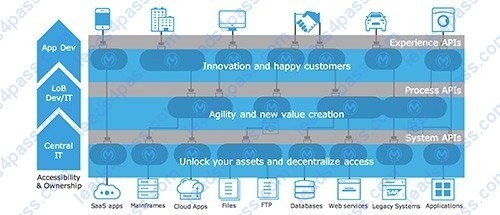
Select the correct Owner-Layer combinations from below options
A. 1. App Developers owns and focuses on Experience Layer APIs
2.
Central IT owns and focuses on Process Layer APIs
3.
LOB IT owns and focuses on System Layer APIs
B. 1. Central IT owns and focuses on Experience Layer APIs
2.
LOB IT owns and focuses on Process Layer APIs
3.
App Developers owns and focuses on System Layer APIs
C. 1. App Developers owns and focuses on Experience Layer APIs
2.
LOB IT owns and focuses on Process Layer APIs
3.
Central IT owns and focuses on System Layer APIs
An organization is deploying their new implementation of the OrderStatus System API to multiple workers in CloudHub. This API fronts the organization's on-premises Order Management System, which is accessed by the API implementation over an IPsec tunnel.
What type of error typically does NOT result in a service outage of the OrderStatus System API?
A. A CloudHub worker fails with an out-of-memory exception
B. API Manager has an extended outage during the initial deployment of the API implementation
C. The AWS region goes offline with a major network failure to the relevant AWS data centers
D. The Order Management System is Inaccessible due to a network outage in the organization's on-premises data center
Refer to the exhibit.
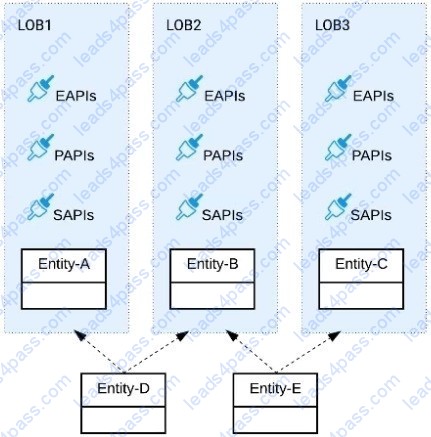
Three business processes need to be implemented, and the implementations need to communicate with several different SaaS applications.
These processes are owned by separate (siloed) LOBs and are mainly independent of each other, but do share a few business entities. Each LOB has one development team and their own budget
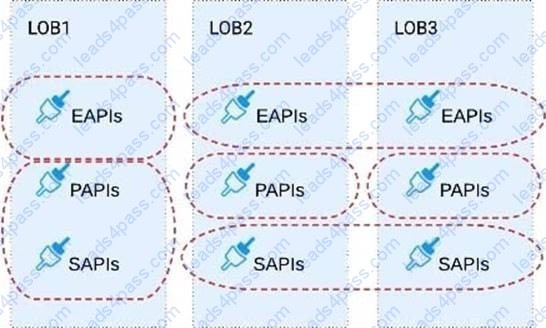
In this organizational context, what is the most effective approach to choose the API data models for the APIs that will implement these business processes with minimal redundancy of the data models?
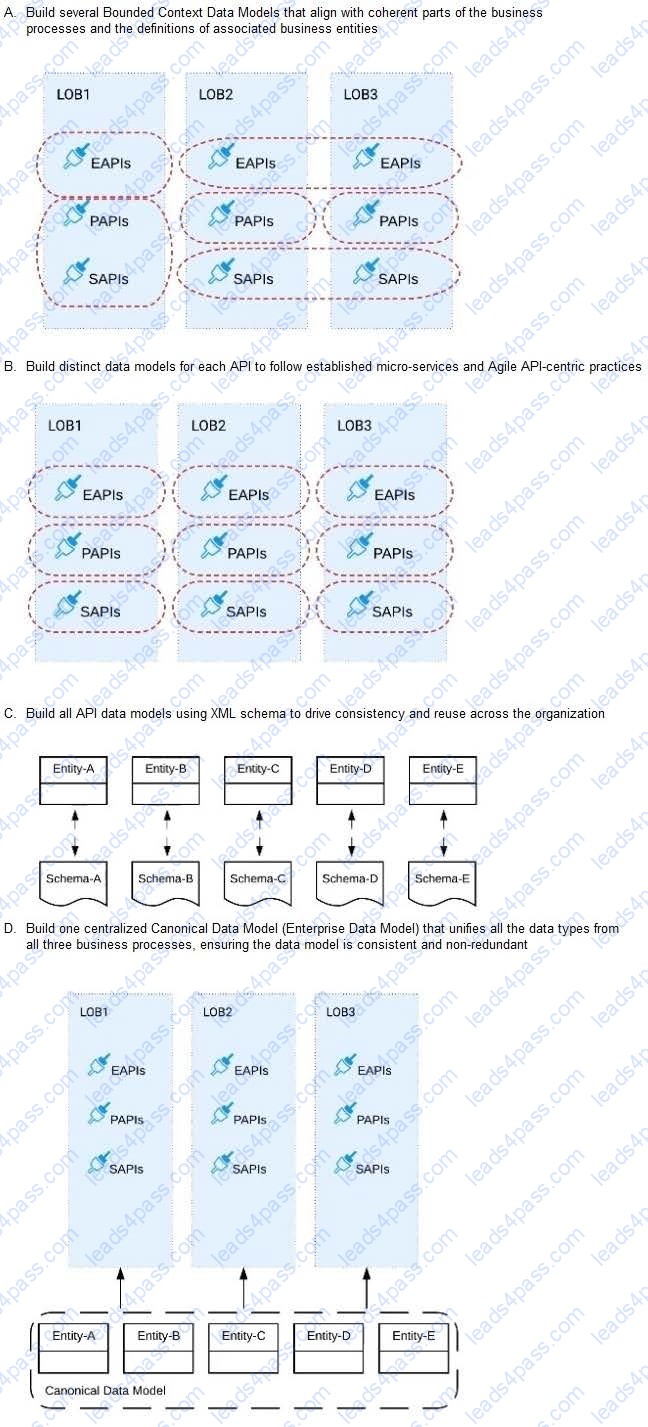
A. Option A
B. Option B
C. Option C
D. Option D
What best describes the Fully Qualified Domain Names (FQDNs), also known as DNS entries, created when a Mule application is deployed to the CloudHub Shared Worker Cloud?
A. A fixed number of FQDNs are created, IRRESPECTIVE of the environment and VPC design
B. The FQDNs are determined by the application name chosen, IRRESPECTIVE of the region
C. The FQDNs are determined by the application name, but can be modified by an administrator after deployment
D. The FQDNs are determined by both the application name and the Anypoint Platform organization
A company wants to move its Mule API implementations into production as quickly as possible. To protect access to all Mule application data and metadata, the company requires that all Mule applications be deployed to the company's customer-hosted infrastructure within the corporate firewall. What combination of runtime plane and control plane options meets these project lifecycle goals?
A. Manually provisioned customer-hosted runtime plane and customer-hosted control plane
B. MuleSoft-hosted runtime plane and customer-hosted control plane
C. Manually provisioned customer-hosted runtime plane and MuleSoft-hosted control plane
D. iPaaS provisioned customer-hosted runtime plane and MuleSoft-hosted control plane
An organization has several APIs that accept JSON data over HTTP POST. The APIs are all publicly available and are associated with several mobile applications and web applications.
The organization does NOT want to use any authentication or compliance policies for these APIs, but at the same time, is worried that some bad actor could send payloads that could somehow compromise the applications or servers running the API implementations.
What out-of-the-box Anypoint Platform policy can address exposure to this threat?
A. Shut out bad actors by using HTTPS mutual authentication for all API invocations
B. Apply an IP blacklist policy to all APIs; the blacklist will Include all bad actors
C. Apply a Header injection and removal policy that detects the malicious data before it is used
D. Apply a JSON threat protection policy to all APIs to detect potential threat vectors
A company has created a successful enterprise data model (EDM). The company is committed to building an application network by adopting modern APIs as a core enabler of the company's IT operating model. At what API tiers (experience, process, system) should the company require reusing the EDM when designing modern API data models?
A. At the experience and process tiers
B. At the experience and system tiers
C. At the process and system tiers
D. At the experience, process, and system tiers
What is true about automating interactions with Anypoint Platform using tools such as Anypoint Platform REST APIs, Anypoint CU, or the Mule Maven plugin?
A. Access to Anypoint Platform APIs and Anypoint CU can be controlled separately through the roles and permissions in Anypoint Platform, so that specific users can get access to Anypoint CLI white others get access to the platform APIs
B. Anypoint Platform APIs can ONLY automate interactions with CloudHub, while the Mule Maven plugin is required for deployment to customer-hosted Mule runtimes
C. By default, the Anypoint CLI and Mule Maven plugin are NOT included in the Mule runtime, so are NOT available to be used by deployed Mule applications
D. API policies can be applied to the Anypoint Platform APIs so that ONLY certain LOBs have access to specific functions
A retail company with thousands of stores has an API to receive data about purchases and insert it into a single database. Each individual store sends a batch of purchase data to the API about every 30 minutes. The API implementation uses a database bulk insert command to submit all the purchase data to a database using a custom JDBC driver provided by a data analytics solution provider. The API implementation is deployed to a single CloudHub worker. The JDBC driver processes the data into a set of several temporary disk files on the CloudHub worker, and then the data is sent to an analytics engine using a proprietary protocol. This process usually takes less than a few minutes. Sometimes a request fails. In this case, the logs show a message from the JDBC driver indicating an out-of-file-space message. When the request is resubmitted, it is successful. What is the best way to try to resolve this throughput issue?
A. se a CloudHub autoscaling policy to add CloudHub workers
B. Use a CloudHub autoscaling policy to increase the size of the CloudHub worker
C. Increase the size of the CloudHub worker(s)
D. Increase the number of CloudHub workers





All rights are reserved by
leads4pass.com. Any changes, copy or trademarks abuse will be
regarded as infringement.
leads4pass.com will reserve the right to pursue accountability.
Copyright © 2004-
2026 leads4pass.com.