
MCIA-LEVEL-1 Online Practice Questions and Answers
Which Exchange asset type represents a complete API specification in RAML or OAS format?
A. Connectors
B. REST APIs
C. API Spec Fragments
D. SOAP APIs
What condition requires using a CloudHub Dedicated Load Balancer?
A. When cross-region load balancing is required between separate deployments of the same Mule application
B. When custom DNS names are required for API implementations deployed to customer- hosted Mule runtimes
C. When API invocations across multiple CloudHub workers must be load balanced
D. When server-side load-balanced TLS mutual authentication is required between API implementations and API clients
A company is building an application network and has deployed four Mule APIs: one experience API, one process API, and two system APIs. The logs from all the APIs are aggregated in an external log aggregation tool. The company wants to trace messages that are exchanged between multiple API implementations. What is the most idiomatic (based on its intended use) identifier that should be used to implement Mule event tracing across the multiple API implementations?
A. Mule event ID
B. Mule correlation ID
C. Client's IP address
D. DataWeave UUID
A new upstream API Is being designed to offer an SLA of 500 ms median and 800 ms maximum (99th percentile) response time. The corresponding API implementation needs to sequentially invoke 3 downstream APIs of very similar complexity. The first of these downstream APIs offers the following SLA for its response time: median: 100 ms, 80th percentile: 500 ms, 95th percentile: 1000 ms. If possible, how can a timeout be set in the upstream API for the invocation of the first downstream API to meet the new upstream API's desired SLA?
A. Set a timeout of 100 ms; that leaves 400 ms for the other two downstream APIs to complete
B. Do not set a timeout; the Invocation of this API Is mandatory and so we must wait until it responds
C. Set a timeout of 50 ms; this times out more invocations of that API but gives additional room for retries
D. No timeout is possible to meet the upstream API's desired SLA; a different SLA must be negotiated with the first downstream API or invoke an alternative API
A leading bank implementing new mule API.
The purpose of API to fetch the customer account balances from the backend application and display them on the online platform the online banking platform. The online banking platform will send an array of accounts to Mule API get the account balances.
As a part of the processing the Mule API needs to insert the data into the database for auditing purposes and this process should not have any performance related implications on the account balance retrieval flow How should this requirement be implemented to achieve better throughput?
A. Implement the Async scope fetch the data from the backend application and to insert records in the Audit database
B. Implement a for each scope to fetch the data from the back-end application and to insert records into the Audit database
C. Implement a try-catch scope to fetch the data from the back-end application and use the Async scope to insert records into the Audit database
D. Implement parallel for each scope to fetch the data from the backend application and use Async scope to insert the records into the Audit database
When designing an upstream API and its implementation, the development team has been advised to not set timeouts when invoking downstream API. Because the downstream API has no SLA that can be relied upon. This is the only donwstream API dependency of that upstream API. Assume the downstream API runs uninterrupted without crashing. What is the impact of this advice?
A. The invocation of the downstream API will run to completion without timing out.
B. An SLA for the upstream API CANNOT be provided.
C. A default timeout of 500 ms will automatically be applied by the Mule runtime in which the upstream API implementation executes.
D. A load-dependent timeout of less than 1000 ms will be applied by the Mule runtime in which the downstream API implementation executes.
What is required before an API implemented using the components of Anypoint Platform can be managed and governed (by applying API policies) on Anypoint Platform?
A. The API must be published to Anypoint Exchange and a corresponding API instance ID must be obtained from API Manager to be used in the API implementation
B. The API implementation source code must be committed to a source control management system (such as GitHub)
C. A RAML definition of the API must be created in API designer so it can then be published to Anypoint Exchange
D. The API must be shared with the potential developers through an API portal so API consumers can interact with the API
Anypoint Exchange is required to maintain the source code of some of the assets committed to it, such as Connectors, Templates, and API specifications.
What is the best way to use an organization's source-code management (SCM) system in this context?
A. Organizations should continue to use an SCM system of their choice, in addition to keeping source code for these asset types in Anypoint Exchange, thereby enabling parallel development, branching, and merging
B. Organizations need to use Anypoint Exchange as the main SCM system to centralize versioning and avoid code duplication
C. Organizations can continue to use an SCM system of their choice for branching and merging, as long as they follow the branching and merging strategy enforced by Anypoint Exchange
D. Organizations need to point Anypoint Exchange to their SCM system so Anypoint Exchange can pull source code when requested by developers and provide it to Anypoint Studio
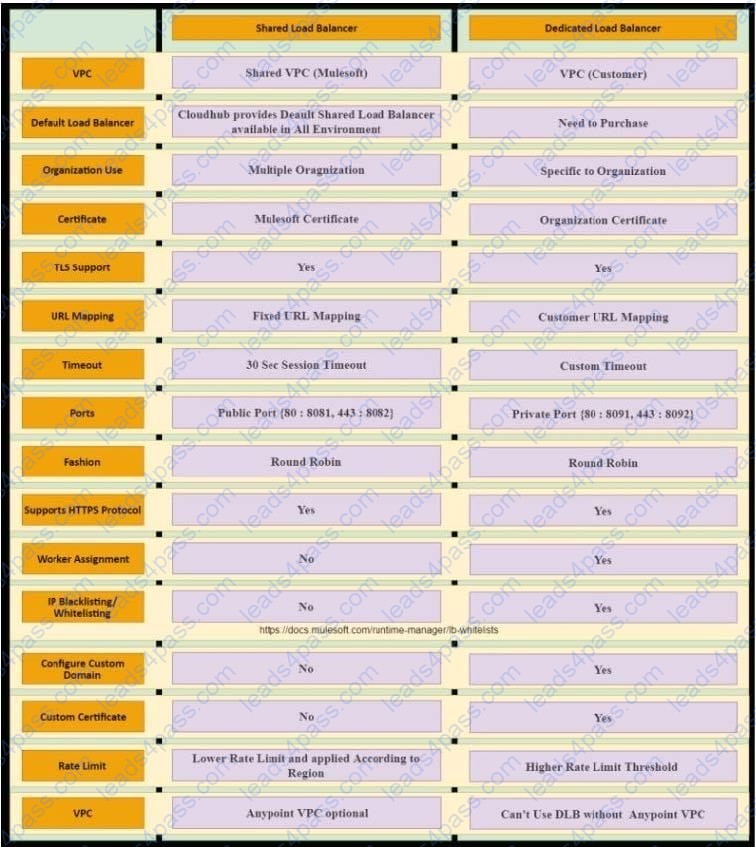
What comparison is true about a CloudHub Dedicated Load Balancer (DLB) vs. the CloudHub Shared Load Balancer (SLB)?
A. Only a DLB allows the configuration of a custom TLS server certificate
B. Only the SLB can forward HTTP traffic to the VPC-internal ports of the CloudHub workers
C. Both a DLB and the SLB allow the configuration of access control via IP whitelists
D. Both a DLB and the SLB implement load balancing by sending HTTP requests to workers with the lowest workloads
Refer to the exhibit.
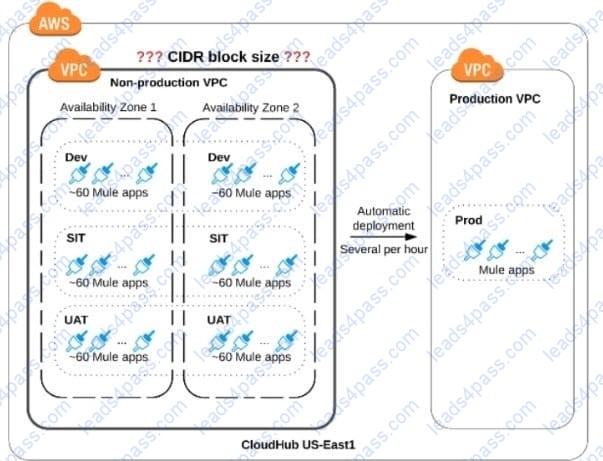
An organization is sizing an Anypoint VPC for the non-production deployments of those Mule applications that connect to the organization's on-premises systems. This applies to approx. 60 Mule applications. Each application is deployed to
two CloudHub i workers. The organization currently has three non-production environments (DEV, SIT and UAT) that share this VPC. The AWS region of the VPC has two AZs.
The organization has a very mature DevOps approach which automatically progresses each application through all non-production environments before automatically deploying to production. This process results in several Mule application
deployments per hour, using CloudHub's normal zero-downtime deployment feature.
What is a CIDR block for this VPC that results in the smallest usable private IP address range?
A. 10.0.0.0/26 (64 IPS)
B. 10.0.0.0/25 (128 IPs)
C. 10.0.0.0/24 (256 IPs)
D. 10.0.0.0/22 (1024 IPs)





All rights are reserved by
leads4pass.com. Any changes, copy or trademarks abuse will be
regarded as infringement.
leads4pass.com will reserve the right to pursue accountability.
Copyright © 2004-
2026 leads4pass.com.