
MCAT-TEST Online Practice Questions and Answers
Millenialism is, generally speaking, the religious belief that salvation and material benefits will be conferred upon a society in the near future as the result of some apocalyptic event. The term derives from the Latin word for 1,000; in early Christian theology, believers held that Christ would return and establish his kingdom on earth for a period of a thousand years.
Millenialist movements, Christian and non-Christian, have arisen at various points throughout history, usually in times of great crisis or social upheaval. In "nativistic" millenialist movements, a people threatened with cultural disintegration attempts to earn its salvation by rejecting foreign customs and values and returning to the "old ways." One such movement involving the Ghost Dance cults, named after the ceremonial dance which cult members performed in hope of salvation, flourished in the late 19th century among Indians of the western United States.
By the middle of the 19th century, western expansion and settlement by whites was seriously threatening Native American cultures. Mining, agriculture and ranching encroached on and destroyed many Indian land and food sources. Indian resistance led to a series of wars and massacres, culminating in the U.S. Government's policy of resettlement of Indians onto reservations which constituted a fraction of their former territorial base. Under these dire circumstances, a series of millenialist movements began among western tribes.
The first Ghost Dance cult arose in western Nevada around 1870. A Native American prophet named Wodziwob, a member of a Northern Paiute tribe, received the revelation of an imminent apocalypse which would destroy the white man, restore all dead Indians to life, and return to the Indians their lands, food supplies (such as the vanishing buffalo), and old way of life. The apocalypse was to be brought about with the help of a ceremonial dance and songs, and by strict adherence to a moral code which, oddly enough, strongly resembled Christian teaching. In the early 1870s, Wodziwob's Ghost Dance cult spread to several tribes in California and Oregon, but soon died out or was absorbed into other cults.
A second Ghost Dance cult, founded in January 1889, evolved as the result of a similar revelation. This time Wovoka -- another Northern Paiute Indian, whose father had been a disciple of Wodziwob -- received a vision during a solar eclipse in which he died, spoke to God, and was assigned the task of teaching the dance and the millennial message. With white civilization having pushed western tribes ever closer to the brink of cultural disintegration during the previous twenty years, the Ghost Dance movement spread rapidly this time, catching on among tribes from the Canadian border to Texas, and from the Missouri River to the Sierra Nevadas -- an area approximately one-third the size of the continental United States.
Wovoka's Ghost Dance doctrine forbade Indian violence against whites or other Indians; it also involved the wearing of "ghost shirts," which supposedly rendered the wearers invulnerable to the white man's bullets. In 1890, when the Ghost Dance spread to the Sioux Indians, both the ghost shirts and the movement itself were put to the test. Violent resistance to white domination had all but ended among the Sioux by the late 1880s, when government- ordered reductions in the size of their reservations infuriated the Sioux, and made them particularly responsive to the millenialist message of the Ghost Dance. As the Sioux organized themselves in the cult of the dance, an alarmed federal government resorted to armed intervention which ultimately led to the massacre of some 200 Sioux men, women and children at Wounded Knee, South Dakota in December of 1890. The ghost shirts had been worn to no avail, and Wounded Knee marked the end of the second Ghost Dance cult.
The passage implies that the second Ghost Dance cult gained widespread popularity quickly because:
A. the U.S. government no longer attempted to suppress Native American religious practices.
B. many Native Americans felt particularly threatened by white civilization.
C. Wovoka was a more charismatic religious leader than Wodziwob had been.
D. it was founded on the basis of a spiritual revelation.
By now the image of California in decline looms as large in the conventional media wisdom as the Golden State --triumphant clich閟 of a generation ago -- "this El Dorado," as Time magazine had put it in 1969, that was to be "the mirror of America as it will become." Hardly anyone mentions the sunshine these days, or the beaches, or the beautiful young families around the pool, or the new lifestyles that all Americans will soon emulate, or how the University of California is wall-to-wall with cyclotrons and Nobel laureates, or how the state's higher-education system is accommodating absolutely all comers at little or no cost.
Today, California classrooms are among the most crowded in the country; many schools operate without libraries, without counselors, without nurses, without art or music, with greatly diminished curricular offerings. And what's true for the schools is true for the other services that have no powerful constituencies: children's protective services, probation, public health. Many cities have shut down swimming and wading pools because they cannot be safely maintained, and fenced playgrounds have been shut because of the danger presented by cracked and splintered structures. The list could be extended indefinitely. As thousands of professors receive golden handshakes from the University of California and California State University, among them some of the stars recruited in the go- go Fifties, the crowding in the lecture halls has increased and the lines at the classroom door have gotten longer and longer ("Don't panic," says the T-shirt on a student waiting to enroll at a Sacramento junior college, but many have been in line since four in the morning). U.C. tuition, which was roughly $800 a year in the early 1980s, is now over $4,000, a figure not out of line with tuitions at public colleges in other states but a far cry from the cost of a California state education in the golden days -- and it is almost certain to increase again next year. More than 200,000 students -- roughly 10 percent -- have vanished from the rolls of the state's colleges and universities in the past two years. While per capita tax revenues have been effectively frozen, and while they have declined relative to other states, client rolls for state services -- schools, prisons, Medicaid, welfare -- have been rising faster than population, leaving a structural gap that no one has yet confronted, much less closed. Again this year, the governor and legislature borrowed $7 billion from the banks and rolled over a $5 billion budget deficit, for which few politicians have proposed any remedies. Thanks to the deficit, California, which a decade ago, had one of the highest bond ratings in the country, has one of the lowest. "Were California a corporation," said John Vasconcellos, the chairman of the State Assembly Ways and Means Committee, "it would have little option but to initiate some sort of bankruptcy proceeding." The new image of California is familiar enough: a state suffering from earthquakes, fires, drought, floods, urban riots, dirty air, schools as overcrowded as the freeways; a legislature -- once said to be the nation's most professional and progressive -- oozing with corruption and stuck in the budgetary gridlock; and of course, recession, unemployment, chronic budget deficits, and financial calamity. For those who know their Nathaniel West, their Raymond Chandler, and their Joan Didion, the California apocalypse imagery is hardly new; it was always there on the dark side of the dream. This was the place, as Didion wrote back in the 1960s, "in which a boom mentality and a sense of Chekhovian loss meet in uneasy suspension; in which the mind is troubled by some buried but ineradicable suspicion that things better work here, because here, beneath that immense bleached sky, is where we run out of continent." os Angeles has burnt before. If you believe people like Governor Wilson, most of the state's problems were created somewhere else, usually in Washington, where the Clinton Administration has, on the one hand, cost California hundreds of thousands of jobs through excessive defense cuts and, on the other, allowed a horde of illegal immigrants to overrun the state's schools and health facilities without paying them for the immense costs that come with them...much has been changed in California since the days of West and Chandler, but the capacity for denial and self-deception is undiminished. In fact, California's trouble is at once more prosaic and more complex than the political rhetoric claims or the apocalyptic imagery suggests. It began before the recent recession, the big 1991 fire in the Oakland hills or the San Francisco earthquake of 1989 (itself a rerun of a classic), before those L.A. cops beat up Rodney King or the riot and the fire that followed their acquittal in the first trial, before the eight-year drought that still may not be over. And contrary to what a lot of Californians believe, a lot of the damage didn't just happen to us: we inflicted it on ourselves.
Which of the following most weakens the image of California as an "El Dorado"?
A. "...the California apocalypse imagery...was always there on the dark side of the dream..."
B. "...the University of California is wall-to-wall with cyclotrons and Nobel laureates..."
C. "...U.C. tuition...is now over $4,000, a figure not out of line with tuitions at public colleges in other states..."
D. "...the new lifestyles that all Americans will soon emulate..."
The mind, just like the body, has its needs. The needs of the body are the foundations of society; those of the mind are its amenities. While government and laws provide for the safety and well-being of men when they gather together, the sciences and the arts, which are less despotic but perhaps more powerful, spread garlands of flowers over the iron chains that bind them, stifle in them the sense for that original liberty for which they seem to have been born, cause them to love their own enslavement, and turn them into so-called "civilized people." Necessity raised thrones; the sciences and the arts have strengthened them. O earthly powers: cherish talents and protect those who cultivate them. O civilized people, cultivate them: you happy slaves owe to them that delicate and refined taste of which you are so proud, that gentleness of character and urbanity of manner which make relations among you so amiable and easy -- in other words, that semblance of all the virtues, none of which you actually possess... ...How pleasant it would be to live among us, if our external appearance were always a reflection of what is in our hearts, if decency were virtue, if our maxims served as our rules, and if true philosophy were inseparable from the title of philosopher! But so many qualities are seldom found together, and virtue hardly ever walks in such great pomp. Richness of adornment may be the mark of a man of taste, but a healthy, robust man is known by other signs: it is beneath the rustic clothes of a farmer, and not the gilt of a courtier, that strength and vigor of the body will be found. Ornamentation is just as foreign to virtue, which is the strength and vigor of the soul. The good man is an athlete who prefers to compete in the nude: he disdains all those vile ornaments which would hinder the use of his strength, ornaments which were for the most part invented only to hide some deformity. Before art had molded our manners and taught our passions to speak an affected language, our customs were rustic but natural, and differences in conduct revealed clearly differences in character. Human nature, basically, was no better, but men found security in being able to see through each other easily, and this advantage, which we no longer appreciate, spared them many vices. Now that more subtle refinements and more delicate taste have reduced the art of pleasing to set rules, a base and deceptive uniformity prevails in our behavior, and all minds seem to have been cast in the same mold. Incessantly politeness and propriety make demands on us, and incessantly we follow usage but never our own inclinations. We no longer dare to appear as we are, and under this perpetual constraint, the men who form this herd called society, when placed in the same circumstances, will all act similarly unless stronger motives direct them to do otherwise. Therefore we will never know well those with whom we deal, for to know our friends we will have to wait for some crises to arise -- which is to say that we will have to wait until it is too late, as it is for these very crises that it is essential to know one's friends well. What vice would not accompany this uncertainty? No more sincere friendships, no more genuine esteem, no more well-based confidence. Suspicion, offenses, fears, coldness, reserve, hatred and betrayal will constantly hide under the same false veil of politeness, under that much touted urbanity which we owe to the enlightenment of our times. The name of the Master of the Universe will no longer be profaned by swearing, but insulted by blasphemies that will not offend our scrupulous ears. Men will not boast of their own merits, but belittle those of others. An enemy will not be crudely insulted, but adroitly slandered. National hatreds will die, but so will patriotism. A dangerous skepticism will take the place of the scorning of ignorance. Some excesses will be forbidden, some vices dishonored, but others will be dignified with the name of virtues, and one must either have them or feign them. Let those who want to praise the sobriety of the sages of our time do so; as for me, I see in it only a refinement of intemperance that is as unworthy of my praise as their hypocritical simplicity.
According to the tone and content of the passage, which statement best reflects the author's opinion of the purpose of the sciences and the arts?
A. They are necessary for the safety and well-being of mankind.
B. They interfere with responsive action and honest communication.
C. They reinforce the sense of "original liberty" that is present in all men.
D. They have molded our reactions into predictable but essential forms.
(1) Fluorescent proteins are found in bioluminescent sea creatures, such as jellyfish. (2) In 1969, the green fluorescent protein was discovered and, since then, prolific research has resulted in the discovery and development of many new fluorescent proteins. (3) Fluorescent proteins can be expressed in cells, making them easily visible under a microscope. (4) In fact, the use of fluorescent proteins revolutionized bio- imaging because the inherently natural nature meant that they could be incorporated into living cells with no deadly toxic effects. (5) Numerous other scientific and medical applications also exploit the unique properties of fluorescent proteins, which is why they were the subject of the 2008 Nobel Prize for Chemistry. (6) However, the science behind fluorescent proteins is still not fully understood and there are many more avenues for exploration.
Which term might you suggest the author abbreviate in this passage?
A. living cells
B. sea creatures
C. fluorescent protein
D. microscope
Destroying the cerebellum of a cat would cause significant impairment of normal:
A. urine formation.
B. sense of smell.
C. coordinated movement.
D. thermoregulation.
Which two elements are needed for the production of chlorophyll?
A. Phosphorus and Sulfur
B. Chlorine and Copper
C. Magnesium and Iron
D. Calcium and Phosphorus
A gibbon (lesser ape) of mass m and arm length l reaches to a branch level with its shoulder and starts to swing with its arm fully extended. At the bottom of the swing, its velocity is: A. Option A
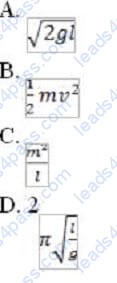
B. Option B
C. Option C
D. Option D

Arsenic is widely distributed in sulfide ores of many metals and is obtained as a byproduct of copper smelting. The element, as well as many compounds of arsenic -- for example arsine, AsH3 -- are extremely poisonous. Arsenic compounds, as might be expected, have found use in herbicides and pesticides, but have also been successful in some pharmacological agents. The first useful antisyphilitic agent, Salvarsan, or 3,3'-diamino-4,4'-dihydroxyarsenobenzene dihydrochloride, is an arsenic compound. The element sublimes at 600°C, forming tetrahedral molecules, As4. Arsenic is a metalloid, possessing properties characteristic of both metals and non-metals. Arsenic is a gray-colored, metalliclooking solid, but arsenic vapor is yellow in color, has a garlic-like odor, and is very poisonous. If the arsenic vapor is cooled rapidly, an unstable, yellow crystalline allotrope consisting of As4 molecules is produced. The Marsh test, based on the instability of arsine, is a very sensitive test for the presence of arsenic. This test is commonly employed in the detection of arsenic poisoning -- either before or after death. The apparatus for the Marsh test is shown in Figure 1.

Figure 1
Typically, a sample, usually hair, is taken from a person suspected of being the victim of arsenic poisoning. This sample is then treated in such a way so as to produce arsenic oxide, As4O6. The oxide is then placed into the apparatus shown in Figure 1 and reacted according to Reaction 1. As4O6 + 12Zn(s) + 24H+(aq) AsH3(g) + 12Zn2 +(aq) + 6H2O Reaction 1 When the evolved arsine is ignited it decomposes into its elements. The arsenic vapor is rapidly cooled when it encounters the porcelain evaporating dish and deposits a black mirror of arsenic on the bottom, indicating the presence of arsenic in the original sample.
If equal masses of gray arsenic and yellow arsenic are allowed to completely react with oxygen at 298 K and constant pressure to form As4O6, which would produce more heat and why?
A. The yellow, because it is less stable than the gray.
B. The gray, because it is more stable than the yellow.
C. Both would produce the same amount of heat because they form the same product.
D. Both would produce the same amount of heat because they are the same element.
Detergents are:
A. natural products.
B. synthetic products.
C. Both A and B.
D. None of above.
In the United States, breast cancer is the second leading cause of death for women, and as a result, the American Cancer Society, has recommended annual mammography screening for women age 40 years and older. It is estimated that the risk of mortality can be reduced through this procedure by approximately 20-25% during a ten-year period for women age 40 years and older.
In general, cancer screening behaviors have increased in the United States. According to the National Health Interview Survey, in 1987, approximately 29% of women age 40 years and older reported having had a mammogram in the last 2 years. By 2000, this increased to 70%. However, there are racial disparities, as fewer African American and Hispanic women have mammograms compared to their Caucasian female counterparts. Some studies have looked into these differences. Cultural factors seem to play a role in minority women obtaining fewer mammograms. Asian women, for example, do not like to discuss sensitive topics with strangers.
Prevention promotions have been designed to increase awareness for the need of breast cancer screening, particularly for women in racial and ethnic minority groups. An innovative breast cancer education program, called the Educational Intervention Asian Grocery Store-Based Education Program, was designed to target Asian women. Located in 20 different Asian grocery stores in communities, the cancer screening exhibits were placed at the entrances of the stores. As Asian women came into the grocery store, health information was passed out to Asian women. Even though only a small amount of women who were considered non-adherents to breast cancer screening ended up scheduling a screening, the study demonstrated an innovative culturally competent approach to health promotion. Source: Adapted from G.R. Sadler, P.R. Beerman, K. Lee et al. "Promoting Breast Cancer Screening Among Asian American Women: The Asian Grocery Store Based Cancer Education Program." Copyright 2012 Journal of Cancer Education.
How must promoters of health behaviors communicate with a high-context culture like the Asian?
A. Communicate directly with participants, using informal language mostly, and with little emphasis on nonverbal cues
B. Assume what is being said is what is actually meant
C. Get to the point of the discussion as quickly as possible
D. Employ formal language, rely on nonverbal cues, and be comfortable with silences





All rights are reserved by
leads4pass.com. Any changes, copy or trademarks abuse will be
regarded as infringement.
leads4pass.com will reserve the right to pursue accountability.
Copyright © 2004-
2026 leads4pass.com.