
LOOKML-DEVELOPER Online Practice Questions and Answers
Business users report that they are unable to build useful queries because the list of fields in the Explore is too long to find what they need.
Which three LookML options should a developer use to curate the business user's experience? (Choose three.)
A. Add a description parameter to each field with context so that users can search key terms.
B. Create a separate project for each business unit containing only the fields that the unit needs.
C. Add a group_label parameter to relevant fields to organize them into logical categories.
D. Use the hidden parameter to remove irrelevant fields from the Explore.
E. Use a derived table to show only the relevant fields.
A user needs to create a report that shows a count of all orders and of orders over $100. Which solution should the developer implement to meet these requirements?
A. An always_filter parameter
B. A front-end filter in the Explore
C. A sql_always_where parameter
D. A filtered measure
Only users with department attributes of Finance and Executive should be able to access the revenue view. Only users with the value of Executive for the department user attribute should be able to view the total_revenue field.
Given the code snippet below: How should the required access grants be structured to set up this system of access?
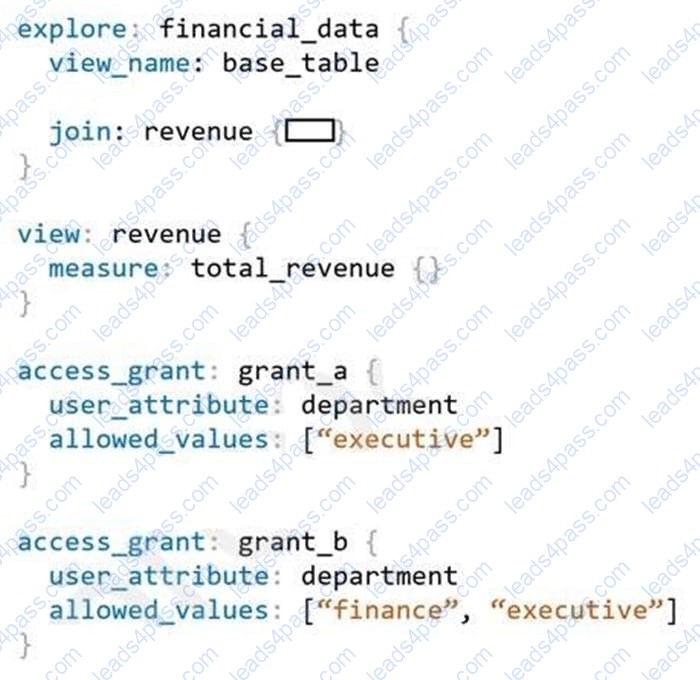
A. required_access_grants: [grant_b] in the revenue view, required_access_grants: [grant_a] in the total_revenue field
B. required_access_grants: [grant_a] in the revenue view, required_access_grants: [grant_a, grant_b] in the total_revenue field
C. required_access_grants: [grant_b] in the financial_data Explore, required_access_grants: [grant_a] in the total_revenue field
D. required_access_grants: [grant_a, grant_b] in the revenue view, required_access_grants: [grant_a] in the total_revenue field
Users viewing an Explore should be able to view rows of data only where the value of the product.brand column matches the value of the user's company user attribute.
Which access filter should the developer use to meet this requirement?
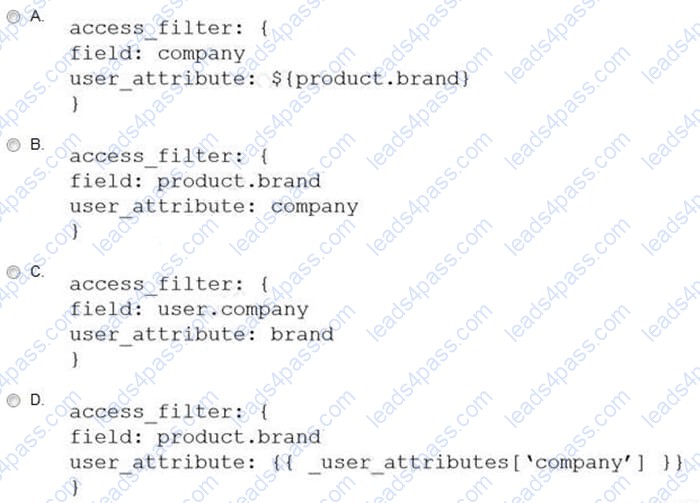
A. Option A
B. Option B
C. Option C
D. Option D
A LookML developer is creating a new view with 20 dimensions in Development Mode using the Create View from Table functionality. Now users want the developer to add only four dimensions from this new view to an existing Explore.
What can the developer add to the Explore to limit the number of fields from the view that are accessible to the user in the Explore?
A. Set definition
B. Join condition
C. Fields parameter
D. Hidden parameter
The developer is creating an Explore that includes the product users, and orders views that will meet the following guidelines.
Joins between the orders and users views should not incur high performance costs.
Users of this Explore will primarily be looking at data from the orders view.
Users of this Explore should only be able to see orders from the retailer “Fashion.ly”.
The only field the users need from the products view is product.name.
Which LookML should the developer use?
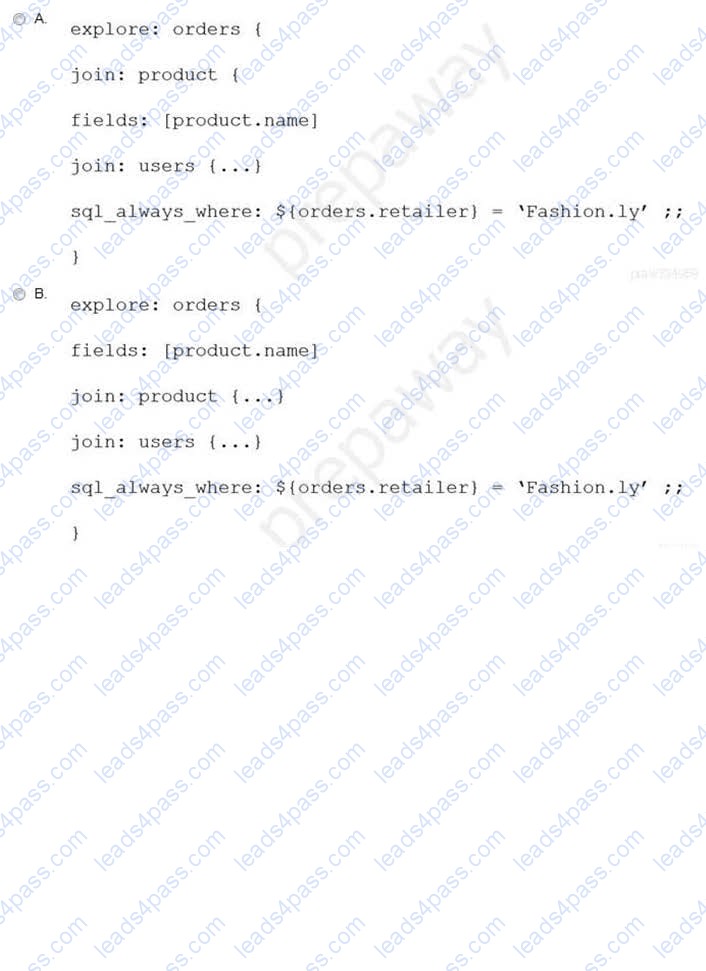
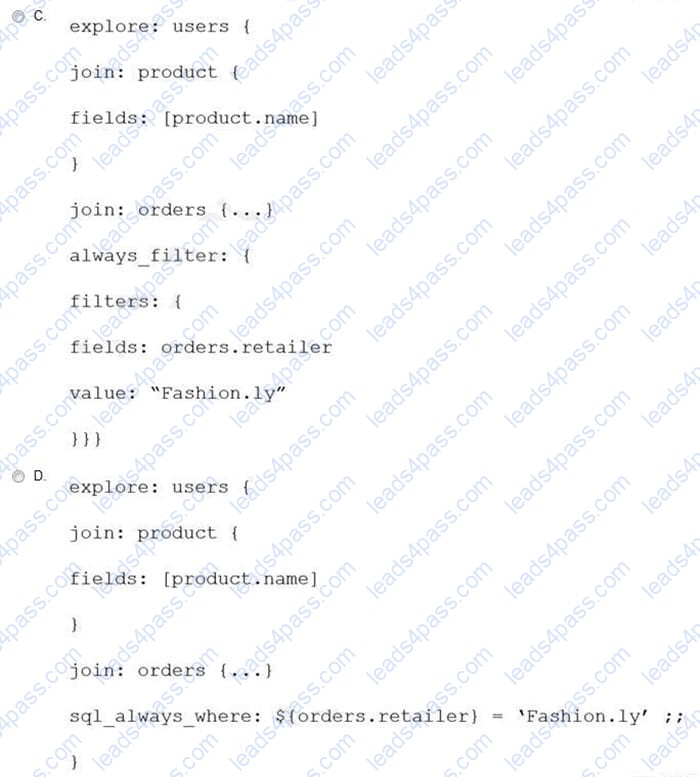
A. Option A
B. Option B
C. Option C
D. Option D
A developer needs to model out LookML to convert existing reports into Looker. The existing reports are:
Report 1: A report with order and order_items data, which finds the order with the largest total value of the order_item prices. Report 2: A report with order and order_items data, which finds the order with the largest total number of
products ordered.
Report 3: A report with data on every product, whether or not it has been ordered.
Each database table used is updated in real time as orders are made.
How should the developer construct an Explore using the order_items view as the base view?
A. Create one persistent derived table to calculate Report 1, create one persistent derived table to calculate Report 2, and join in the products view with a full_outer join.
B. Create one persistent derived table to calculate Reports 1 and 2, and join in the products view with a full_outer join.
C. Create one ephemeral derived table to calculate Report 1, create one ephemeral derived table to calculate Report 2, and join in the products view with a left_outer join.
D. Create one ephemeral derived table to calculate Reports 1 and 2, and join in the products view with a full_outer join.
After validating LookML code, a developer receives the following error message:
“Unknown or Inaccessible Field users.name”
What is causing this error?
A. There is a missing join.
B. The field is set to “hidden”.
C. The join relationship is incorrect.
D. The field uses incorrect SQL syntax.
A developer creates a derived table and wants to add persistence to it. Because the table is not used on a frequent basis, the developer wants the table to be cached for 12 hours, but only when a user has queried it.
Which persistence parameter should be added to the derived table's definition in order to satisfy this use case?
A. persist_with: “12 hours”
B. datagroup: 12_hours { max_cache_age: “12 hours” }
C. persist_for: “12 hours”
D. sql_trigger_value: SELECT FLOOR{UNIX_TIMESTAMP{} / {6*60*60}} ;;
A user reports that, when a date dimension is filtered to “before now” results are returned that consistently include tomorrow. Dimension fill has been ruled out as a cause of the issue.
Which LookML parameter should be used to resolve this issue?
A. Week_start_day
B. Convert_tz
C. Datatype
D. Fiscal_month_offset





All rights are reserved by
leads4pass.com. Any changes, copy or trademarks abuse will be
regarded as infringement.
leads4pass.com will reserve the right to pursue accountability.
Copyright © 2004-
2026 leads4pass.com.