
JN0-348 Online Practice Questions and Answers
Which statement is true about IP-IP tunnels?
A. Intermediate devices must have a route to the destination address of the traffic being tunneled.
B. Intermediate devices must have a route to both the tunnel source address and the tunnel destination address.
C. Intermediate devices must have a route to the tunnel destination address but do not require a route to the tunnel source address.
D. Intermediate devices must have a route to the tunnel source address but do not require a route to the tunnel destination address.
Which statement is correct about IS-IS link state PDUs?
A. They are used to maintain link-state database synchronization.
B. They are used to establish adjacencies.
C. They are used to build the link-state database.
D. They are used to determine whether the neighbors are Level 1 or Level 2.
Which two routes belong to the 172.16.0.0/22 aggregate route? (Choose two.)
A. 172.16.4.0/24
B. 172.16.0.0/24
C. 172.16.5.0/24
D. 172.16.3.0/24
You configured a GRE tunnel that traverses a path using default MTU settings. You want to ensure that packets are not dropped of fragmented.
In this scenario, what is the maximum packet size that would traverse the GRE tunnel?
A. 1500
B. 1400
C. 1524
D. 1476
Click the Exhibit button.
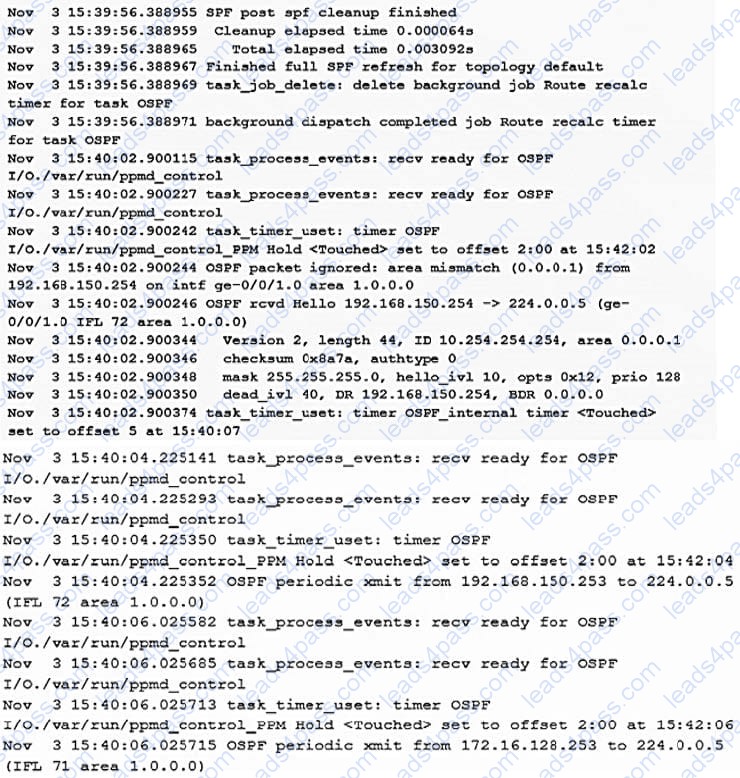
Based on the traceoptions output shown in the exhibit, what is the problem with the adjacency?
A. connectivity
B. authentication mismatch
C. MTU mismatch
D. area mismatch
Click the Exhibit button.
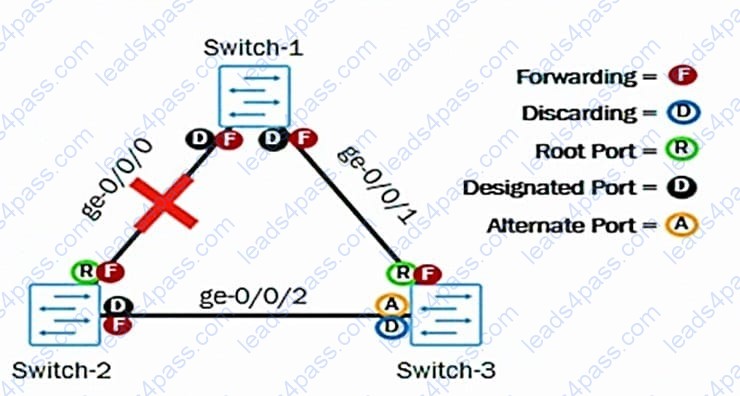
You manage the Layer 2 network shown in the exhibit. You experience a failure on the ge-0/0/0 link between Switch-1 and Switch-2.
Which statement is correct about the expected behavior?
A. Switch-2 will remove itself from the RSTP topology
B. Switch-2's ge-0/0/2 port role and state will transition to root and forwarding
C. Switch-2 will become the root bridge for a separate RSTP topology
D. Switch-2's ge-0/0/2 port role and state will remain as designated and forwarding
Which statement is true about IP-IP tunnels?
A. The time-to-live value of the original packet is decremented.
B. IP-IP tunnels are protocol agnostic.
C. The packet is encapsulated unchanged before entering the tunnel.
D. The packet header is replaced before entering the tunnel.
Click the Exhibit button.
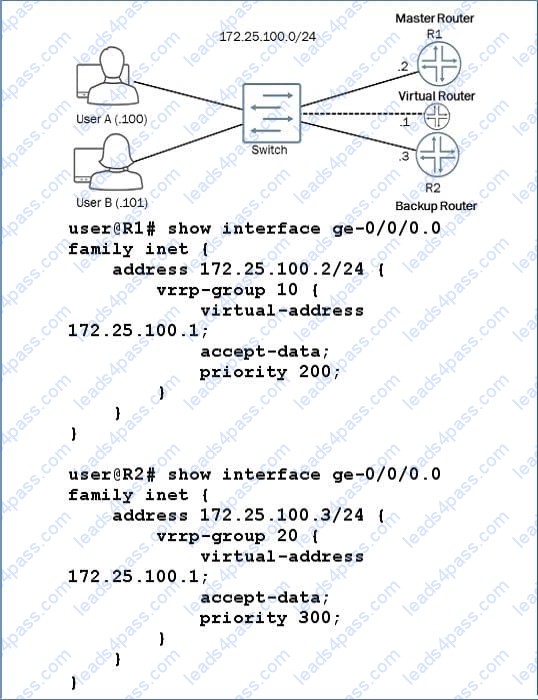
You are attempting to set up VRRP with R1 and R2 being participating members. You want R1 to be the master router and R2 to be the backup router with the virtual router they create being at address
172.25.100.1. The virtual router is not pinging from either User A or User B.
Referring to the exhibit, what must be done to correct the problem?
A. A VRRP policy is needed on R1 and R2.
B. The VRRP group value on R1 and R2 must match.
C. The VRRP priority value on R1 and R2 must match.
D. A VRRP authentication type value is needed on R1 and R2.
Click the Exhibit button.
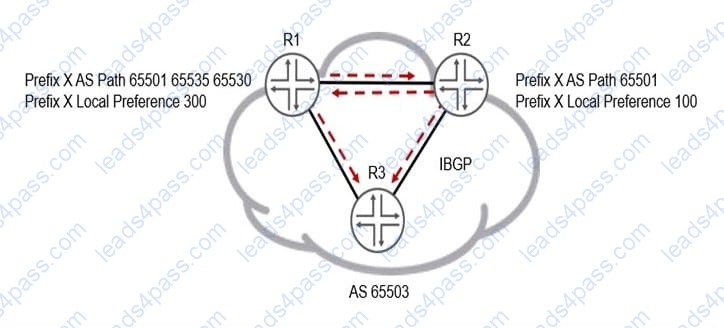
Both the R1 and R2 devices are advertising prefix X into AS 65530 with the BGP attributes shown in the exhibit.
Which statement is correct in this scenario?
A. R2's version of prefix X will be active because of the local preference attribute.
B. R1's version of prefix X will be active because of the local preference attribute.
C. R1's version of prefix X will be active because of the AS path attribute.
D. R2's version of prefix X will be active because of the AS path attribute.
Click the Exhibit button.
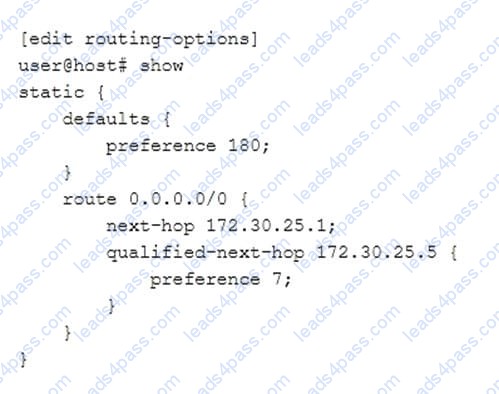
Which statement is true about the configuration shown in the exhibit?
A. The preference for the 172.30.25.1 next hop is 5.
B. The preferred next hop is 172.30.25.5.
C. The preference for the 172.30.25.1 next hop is 7.
D. 172.30.25.1 is the preferred next hop.





All rights are reserved by
leads4pass.com. Any changes, copy or trademarks abuse will be
regarded as infringement.
leads4pass.com will reserve the right to pursue accountability.
Copyright © 2004-
2026 leads4pass.com.