
HPE6-A77 Online Practice Questions and Answers
You have recently implemented a serf-registration portal in ClearPass Guest to be used on a Guest SSID broadcast from an Aruba controller. Your customer has started complaining that the users are not able to reliably access the internet after clicking the login button on the receipt page. They tell you that the users will click the login button multiple times and alter about a minute they gain access. What could be causing this issue?
A. The self-registration page is configured with a 1 minute login delay.
B. The guest client is delayed getting an IP address from the DHCP server.
C. The guest users are assigned a firewall user role that has a rate limit.
D. The enforcement profile on ClearPass is set up with an lETF:session delay.
What is the Open SSID (otherwise referred to as Dual SSID) Onboard deployment service workflow?
A. OnBoard Pre-Auth Application service, OnBoard Authorization Application service. OnBoard Provisioning RADIUS service
B. OnBoard Pre-Auth RADIUS service. OnBoard Authorization Application service. OnBoard Provisioning RADIUS service
C. OnBoard Authorization Application service, OnBoard Pre-Auth Application service, OnBoard Provisioning RADIUS service
D. OnBoard Authorization RADIUS service, OnBoard Pre-Auth Application service, OnBoard Provisioning RADIUS service
Refer to the Exhibit:
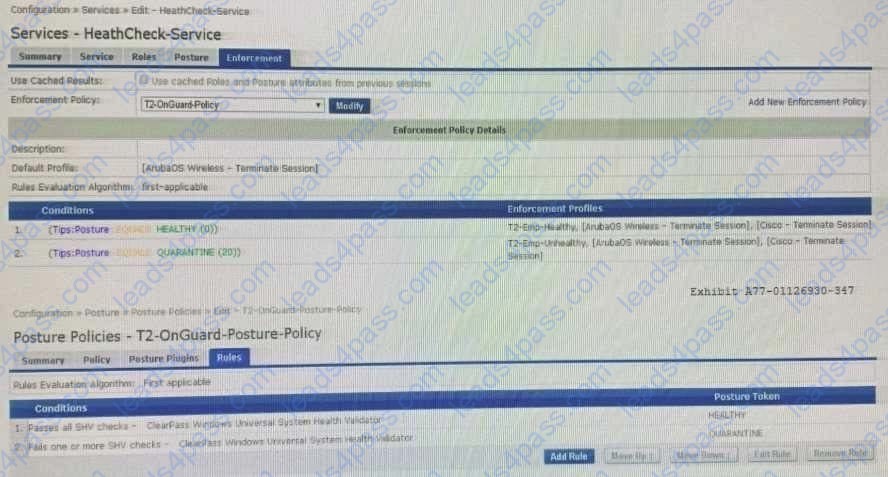
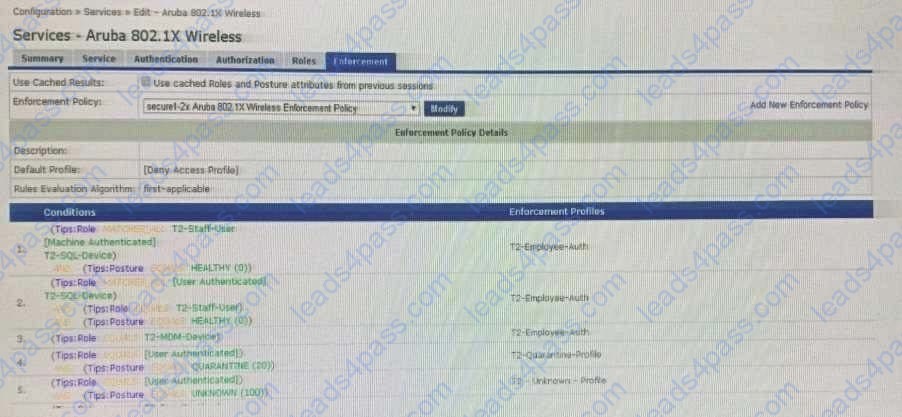
A customer wants to integrate posture validation into an Aruba Wireless 802.1X authentication service
During testing, the client connects to the Aruba Employee Secure SSID and is redirected to the Captive Portal page where the user can download the OnGuard Agent After the Agent is installed, the client receives the Healthy token the client remains connected to the Captive Portal page ClearPass is assigning the endpoint the following roles: T2-Staff-User. (Machine Authenticated! and T2-SOL-Device. What could cause this behavior?
A. The Enforcement Policy conditions for rule 1 are not configured correctly.
B. Used Cached Results: has not been enabled In the Aruba 802.1X Wireless Service
C. RFC-3576 Is not configured correctly on the Aruba Controller and does not update the role.
D. The Enforcement Profile should bounce the connection instead of a Terminate session
Refer to the exhibit:
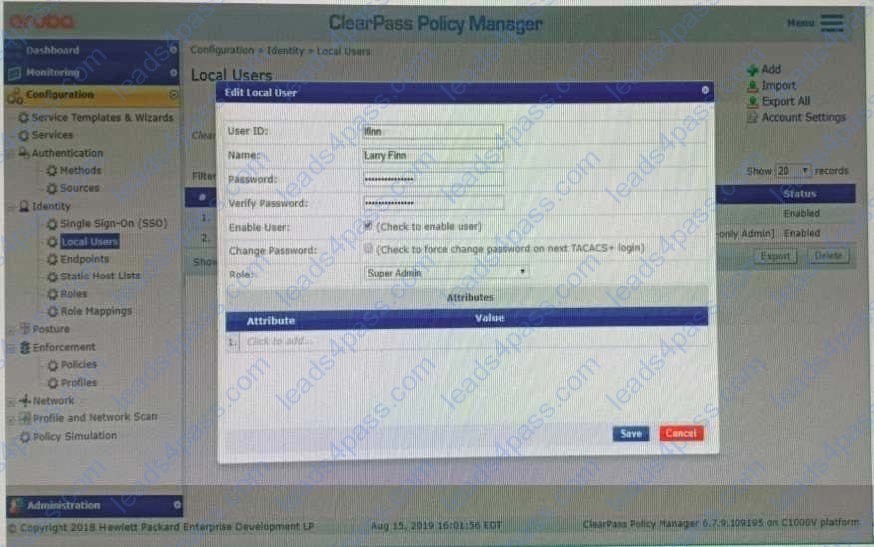
The customer complains that the user shown cannot log into the ClearPass Server as an administrator using the [Policy Manager Admin Network Login Service]. What could be the reason for this?
A. The user might be used for a TACACS authentication
B. The account created does not fit this purpose.
C. The mapping on the role should be changed to [RADIUS Super Admin]
D. The local user authentication might be disabled
A customer is complaining that some of the devices, in their manufacturing network, are not getting profiled while other loT devices from the same subnet have been correctly profiled. The network switches have been configured for DHCP IP helpers and IF-MAP has been configured on the Aruba Controllers. What can the customer do to discover those devices as well? (Select two.)
A. Update the Fingerprints Dictionary to the latest in case new devices have been added.
B. Open a TAC case to help you troubleshoot the DHCP device profile functionality.
C. Add the ClearPass Server IP as an IP helper address on the default gateway as well.
D. Allow time for IF-MAP service on the controller to discover the new devices as well.
E. Manually create a new device fingerprint for the devices that are not being profiled.
You are deploying ClearPass Policy Manager with Guest functionality for a customer with multiple Aruba Networks Mobility Controllers The customer wants to avoid SSL errors during guest access but due to company security policy cannot use a wildcard certificate on ClearPass or the Controllers. What is the most efficient way to configure the customers guest solution? (Select two.)
A. Build multiple Web Login pages with vendor settings configured for each controller
B. Install the same public certificate on all Controllers with the common name "controller {company domain}"
C. Build one Web Login page with vendor settings for controller {company domain)
D. Install multiple public certificates with a different Common Name on each controller
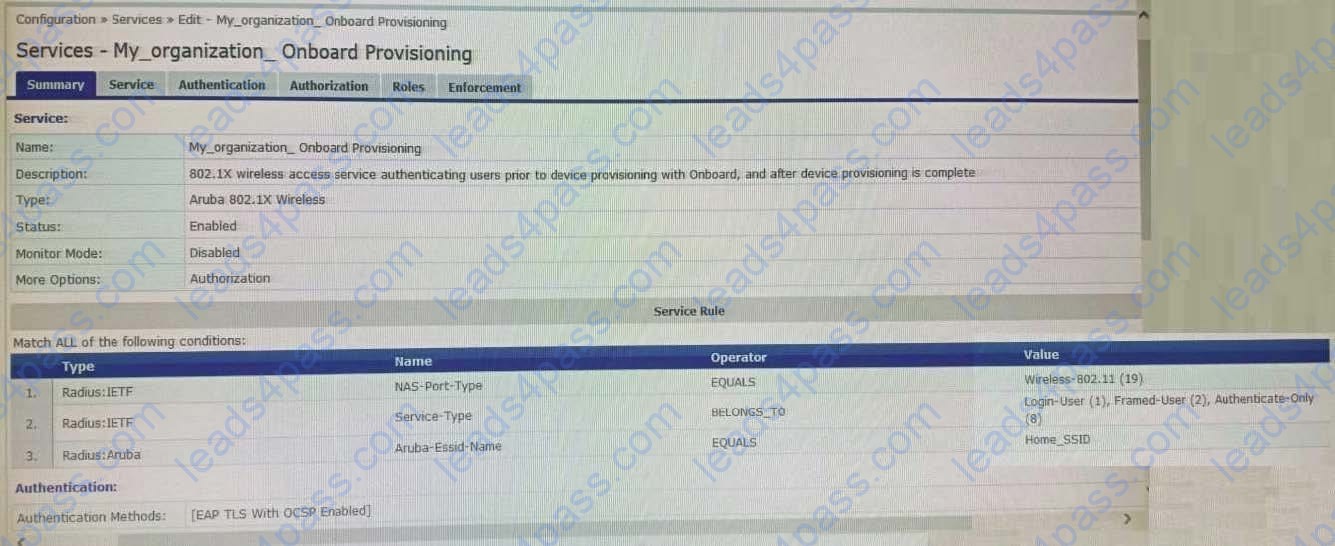
Refer to the exhibit: A customer has configured a service with the Onboard Devices Repository as an Authentication Source and an Active Directory Domain Server as an Authorization Source. What will happen if the client certificate is still valid and the user account associated with the certificate is disabled in Active Directory?
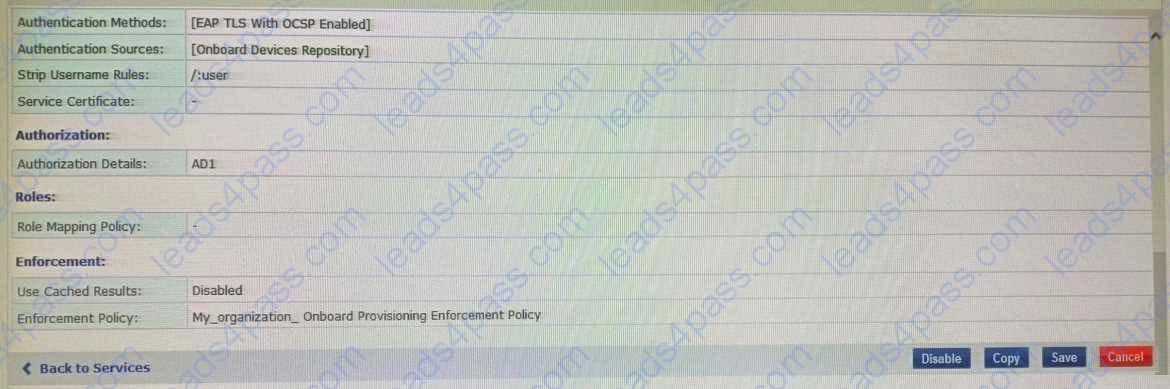
A. ClearPass will not process the request
B. Enforcement will apply the [Deny Access Profile]
C. ClearPass will redirect the client to Onboard again
D. ClearPass will block network access to the device
E. ClearPass will allow the device to access the network.
You are integrating a Postgres SQL server with the ClearPass Policy Manager. What steps will you follow to complete the integration process? (Select three)
A. Click on the default filter name with pre-defined filter queries and check box to enable as role.
B. Specify a new filter with filter queries to fetch authentication and authorization attributes.
C. Attribute Name under filter configuration must match one of the columns being requested from the database table.
D. Create a new Endpoint context server and add the SQL server IP, credentilas and the database name.
E. Alias Name under filter configuration must match one of the columns being requested from the database table.
F. Create a new authentication source and add the SQL server IP, credentials and the database name.
What type of EAP certificate are you able to use on ClearPass? (Select two.)
A. Self signed, when all the clients are Onboarded with the same Root CA as the Self signed certificate.
B. Private signed, when the clients are onboarded or are part of the organization domain.
C. Private signed, when some clients are onboarded and some are not part of the organization.
D. Public signed, when not all of the clients are part of the organization domain.
E. Self signed, when all the clients are part of the organization domain.
Refer to the exhibit:
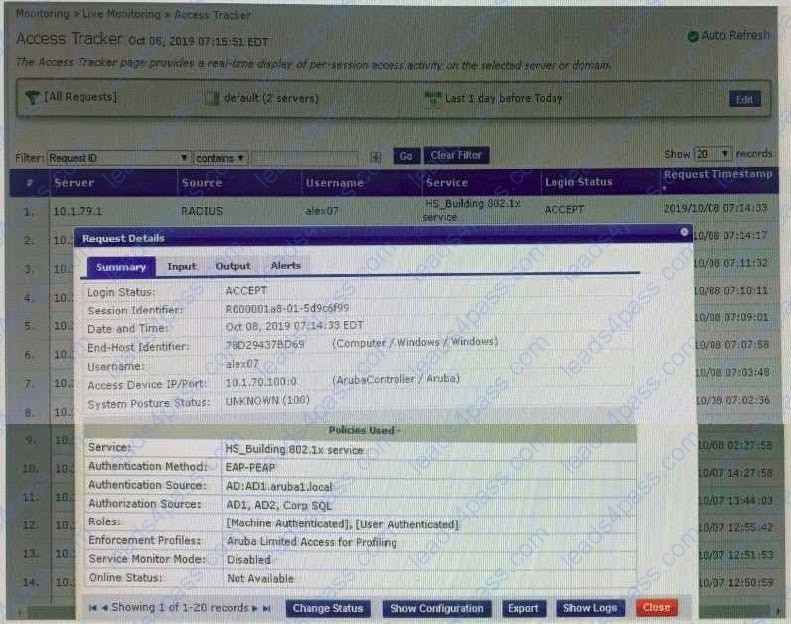
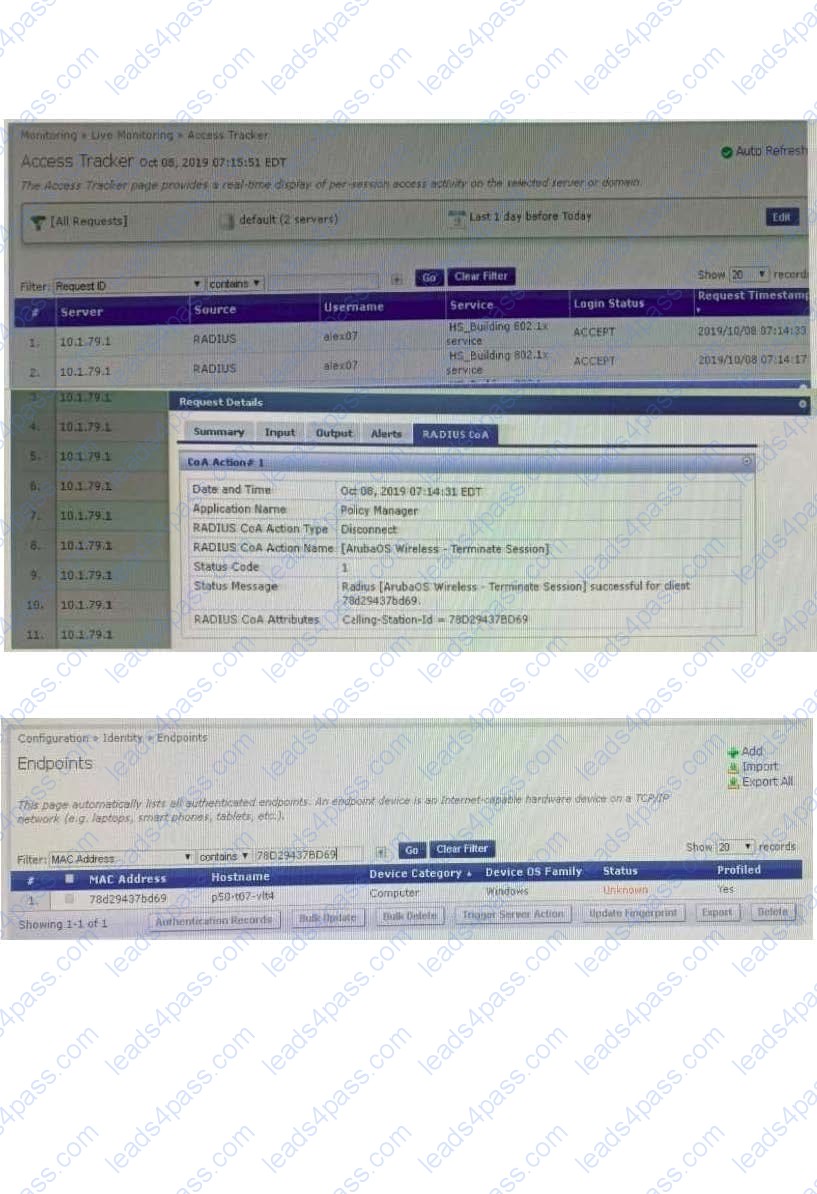
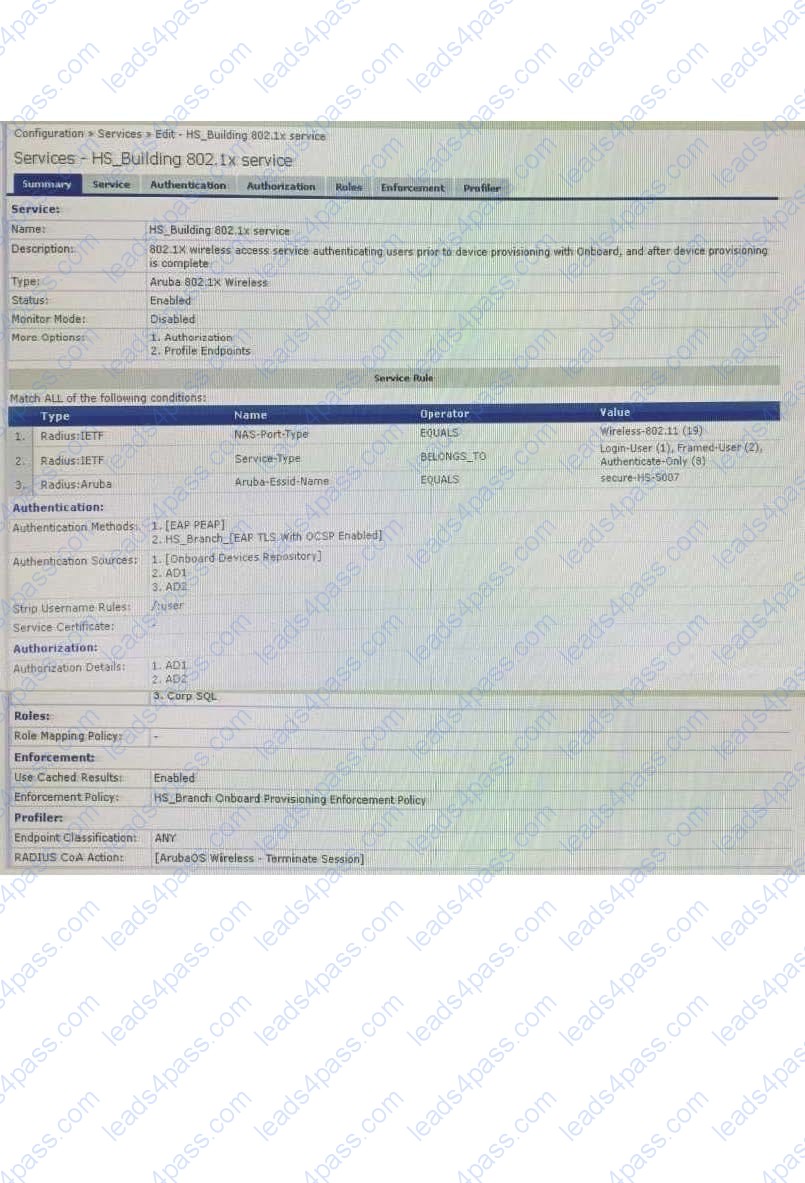
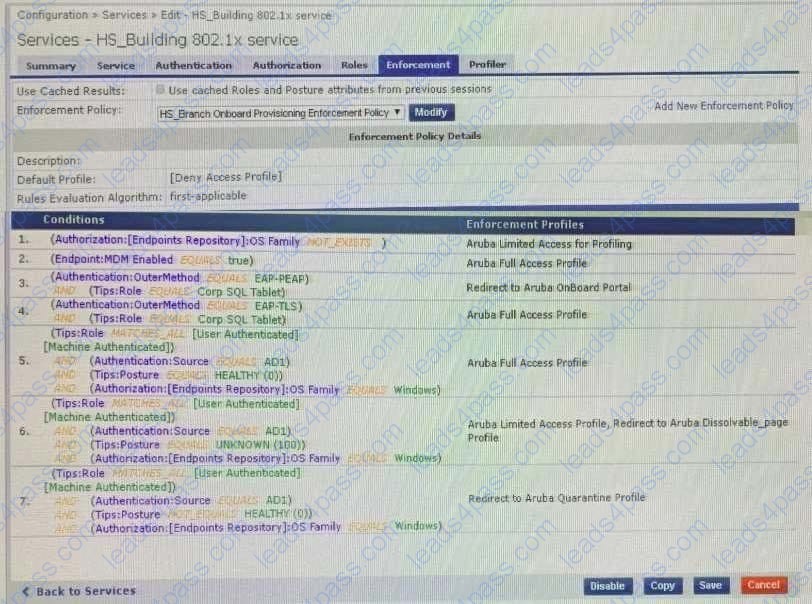
You configured the 802 1 x service enforcement conditions with the Endpoint profiling data. When the client connects to the network. ClearPass successfully profiles the client but the client always receives an incorrect enforcement profile The configurations in the Aruba controller are completed correctly. What is the cause of the issue?
A. An additional authorization source should be configured for profiling to work.
B. The enforcement policy conditions configured with profiling data are not correct.
C. The enforcement policy rules evaluation algorithm Is not configured correctly.
D. The option, use cached roles and posture from previous sessions should be enabled.





All rights are reserved by
leads4pass.com. Any changes, copy or trademarks abuse will be
regarded as infringement.
leads4pass.com will reserve the right to pursue accountability.
Copyright © 2004-
2026 leads4pass.com.