
HPE6-A49 Online Practice Questions and Answers
Refer to the exhibits.
Exhibit 1. Existing wiring plan:
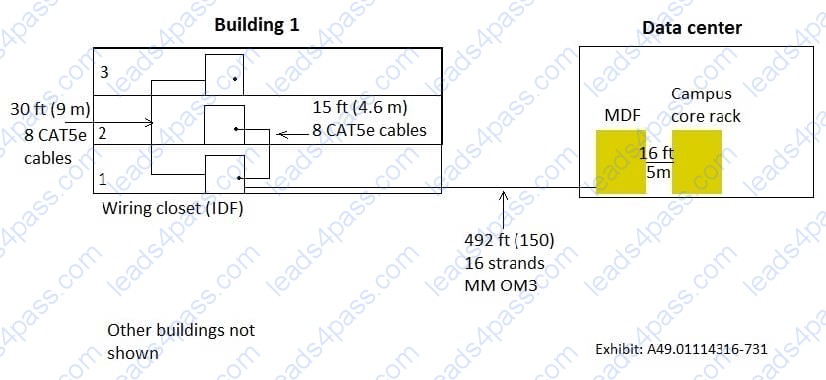
Exhibit 2. Current proposal:
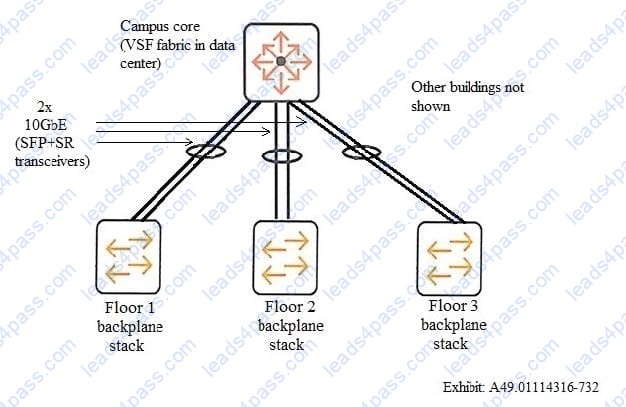
A customer has a building that needs a switch upgrade. The customer would like at least 20Gbps for the
uplink bandwidth out of each closet. The building writing plan is shown in Exhibit 1. The customer will not
consider any cable upgrades at this point. The current proposal is shown in Exhibit 2.
Which correction must architect make to the proposal to meet the customer requirements?
A. Change the SR transceivers for each link between the writing closet switches and the network core to LRM transceivers.
B. Add an aggregation layer, and connect writing closet switches to the aggregation layer on Smart Rate ports.
C. Add an aggregation layer, and connect writing closet switches to the aggregation layer with SFP+ SR transceivers.
D. Add a mode conditioning cable for each link between the writing closet switches and the network core.
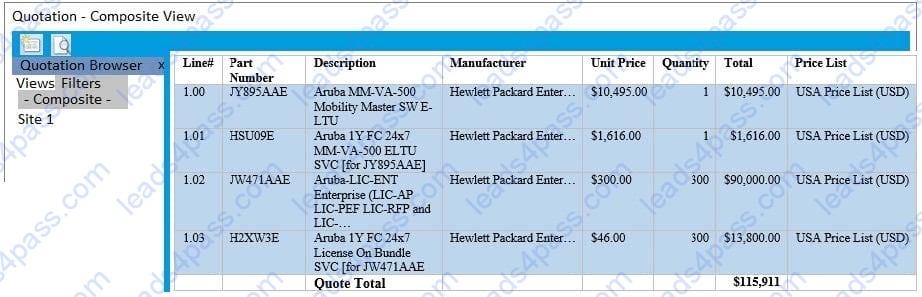
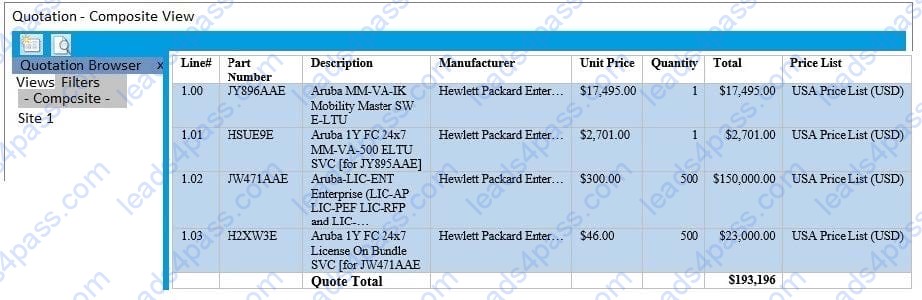
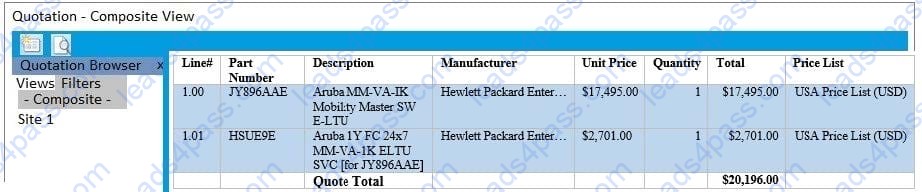
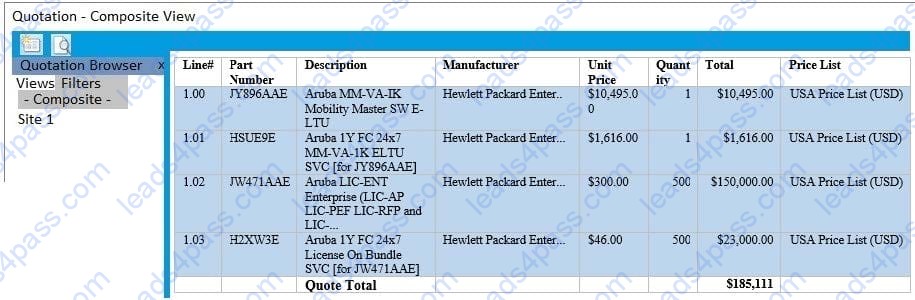
A customer has an existing Aruba network, which currently supports up to 9,000 wireless client devices. The existing network includes these components: Four 7210 MCs Five 7030 MCs 200 AP-303HRs 300 AP-345s
The customer wants to convert to an ArubaOS 8.x architecture. The architect plans to deploy a virtual MM.
Which exhibit shows the correct BOM for the MM?
A.
B.
C.
D.
Refer to the exhibit.
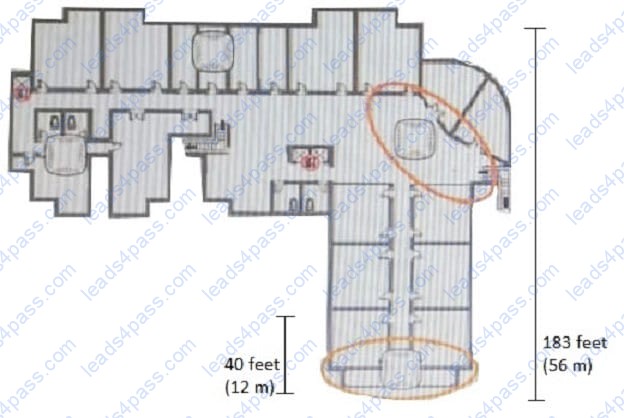
A casino and a retail space has an existing Aruba network with Aruba AP-335s. The customer wants to
deploy Meridian and enable proximity-based campaigns. The exhibit shows a segment of the floor plan.
When visitors enter the areas circled in the exhibit, they should receive a targeted notification about
promotions and sales.
What should the architect explain to the customer about how to finish the solution?
A. This solution will require about 6 battery-powered beacons, which can be managed by the APs.
B. While these APs cannot act as beacons, they have a USB slot that accepts USB beacons.
C. The customer can enable the built-in BLE capability in the AP-335 radio to meet these requirements.
D. The customer must remember to purchase a Meridian Maps license with the Campaigns license.
Refer to the exhibit.
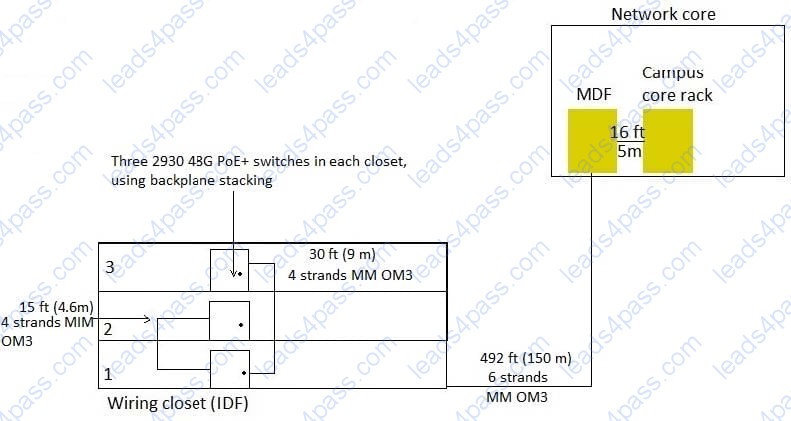
A customer needs a wired upgrade for a building on its main campus. The exhibit shows the switches that
architect has selected for each closet and the existing cabling. The customer is not open to changing the cabling. The customer requires link redundancy for the uplinks from each closet and for the links from the building to the core. In non link failure situations, the uplinks from each closet must support at least 20 Gbps, and the building as a whole must have at least 20 Gbps to the core in non link failure situations.
Which options for connecting the closets to the network core are valid? (Select two.)
A. Connect the switch stack on each floor directly to the network core on two fiber connections per floor. Achieve this by patching the inter-floor fiber through the inter-building fiber.
B. Add two aggregation switches in the Floor 1 closet. Connect the switch stack for each closet to the aggregation switches on two fiber links each and the aggregation switches to the core on two fiber links.
C. Combine the nine switches on all three floors into a single switch stack with stacking cables in a ring topology. Connect two Floor 1 members to the network core with one fiber connection each.
D. Combine the nine switches on all three floors into a single switch stack with the MM OM3 fiber cables in a ring topology. Connect two Floor 1 members to the network core with one fiber connection each.
E. Connect the Floor 2 switch stack to Floor 1 with two fiber connections. Do the same for Floor 3. Connect the Floor 1 switch stack to the network core with two fiber connections.
Refer to the exhibit.
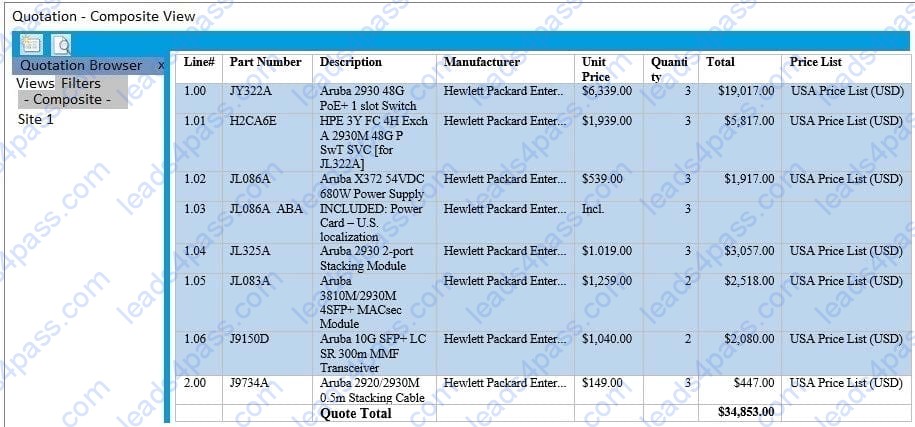
A writing closet needs to support these devices: 100 desktops 5 printers 20 AP-345s
The customer wants to single-home the AP-345s and support higher than 1GbE speeds on the AP connections to future proof. The customer also requires that the closet have two 10GbE links to the core with SR transceivers. The exhibit shows the preliminary plan for this closet.
Which correction should the architect make to the plan to meet the customer requirements?
A. Change all of the switches to the Aruba 2930M 40G 8 HPE Smart Rate PoE+ 1-Slot Switch.
B. Change one switch to the 2930M 24-port Smart Rate PoE+ model.
C. Add a 4-port SFP+ module to one of the switches.
D. Add a Smart Rate module to each of the switches.
A company currently has 45 IAP-315 at a remote site. These IAPs connect to the main office on a WAN link and use an IPsec VPN to an MC. The company has determined that it needs better optimization and higher VPN throughput for traffic sent to the main office.
What should the network architect propose to fill this gap?
A. a subscription to Aruba Central services for WAN optimization
B. the deployment of several additional IAP-315 to boost throughput
C. the deployment of a local MC at the remote site
D. the purchase of SD-WAN licenses for the remote site IAPs
A customer has Aruba network infrastructure devices that could be managed by either Aruba Central or
Aruba AirWave.
Which customer characteristic should point the architect toward an AirWave recommendation as opposed
to a Central recommendation?
A. desire to lease managed services on an ongoing basis
B. small IT staff and preference for cloud solutions
C. policies that network management occurs on premises
D. need to support Zero Touch Provisioning (ZTP)
Refer to the exhibit.
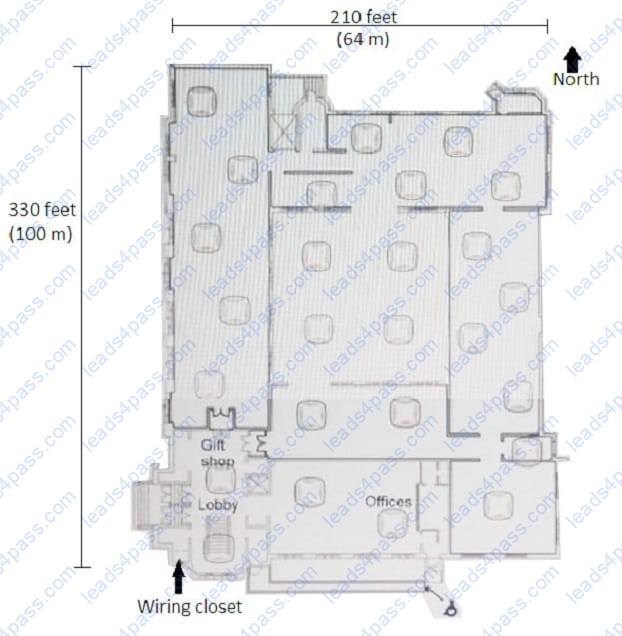
A museum wants to add full 802.11ac wireless coverage across the building, which is about 210 feet (64 m) by 330 feet (100m). The museum has 15-foot (4,6 m) ceilings and stone interior walls. The network needs to support up to 600 wireless guest devices. The exhibit also shows a preliminary plan for AP locations. The museum has eight Ethernet drops in the lobby and gift shop, but has otherwise not been wired.
What is one recommendation that the architect should make to ensure a successful deployment?
A. use of directional antennas to avoid lost signal
B. addition of a writing closet closer to the north side
C. use of at least CAT5 cable to connect to the APs
D. addition of about 10 APs to achieve adequate density
A university has a dormitory with several floors. Currently APs are deployed in the hallways about every 50
feet (15m). The university has several issues with the existing network:
Students complain that the network is very slow, and the wireless signal is poor.
Students want to connect some equipment such as gaming consoles and IP TVs on Ethernet, but the dorm
rooms just have one Ethernet port.
How does the deployment of AP303Hs resolve the customer issues?
A. They are specialized to provide wireless coverage for single-room deployment and also provide wired ports for clients.
B. They are specialized for wireless meshing, which conserves Ethernet ports, and for high-speed wireless services.
C. They have high-gain antennas designed for older buildings and support Smart Rate for high bandwidth on one port.
D. They have directional antennas that will improve the wireless signal and require just one Ethernet port.
A retailer wants to provide wireless services for guests across a section of store floor, which consists of 82 foot (25m) long aisles of cans and dry food goods. The shelves are six feet (1.8 m) high, and the ceiling height is 13 feet (4 m) high. The architect recommends overhead APs deployed at 40-50 foot (12 to 15 m) intervals every few aisles rather than in every aisle.
What is one factor that justifies this recommendation?
A. the low transmit power of most guest devices
B. the low shelf height relative to ceiling height
C. the aisle length
D. the low ceiling height





All rights are reserved by
leads4pass.com. Any changes, copy or trademarks abuse will be
regarded as infringement.
leads4pass.com will reserve the right to pursue accountability.
Copyright © 2004-
2026 leads4pass.com.