
HPE6-A45 Online Practice Questions and Answers
Refer to the exhibits.
Exhibit 1.
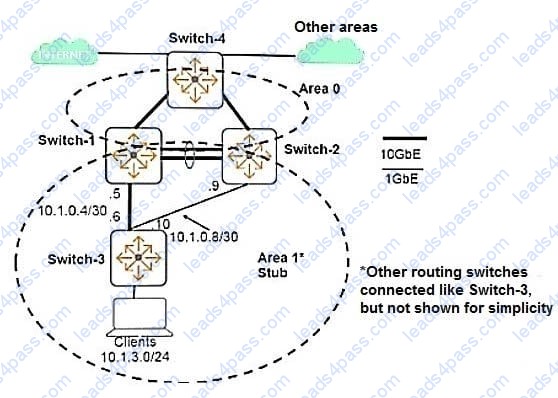
Exhibit 2.
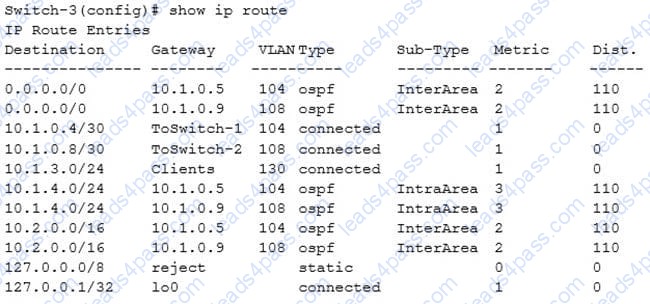
The exhibits show the current operational state for routes on Switch-3. The company wants Switch-3 to prefer the link to Switch-1 over the link to Switch-2 for all intra-area, inter-area, and external traffic.
What can the network administrator do to achieve this goal?
A. Set the OSPF cost on VLAN 108 higher than 1 on Switch-2 and Switch-3.
B. Set the OSPF administrative distance on Switch-2 higher than 110.
C. Set the OSPF area type to normal on all of the switches in Area 1.
D. Set the cost in the OSPF Area 1 stub command higher than 1 on Switch-2.
A network administrator configures connection rate filtering on interface 1 with the throttle action. Device 1 crosses the threshold and triggers the action.
What does the switch do?
A. It temporarily drops all IP traffic from Device 1 only.
B. It temporarily drops all IP traffic on interface 1.
C. It drops all IP traffic from Device 1 until the host is manually unblocked.
D. It drops all IP traffic on interface 1 until the interface is manually unblocked.
Refer to the exhibit.
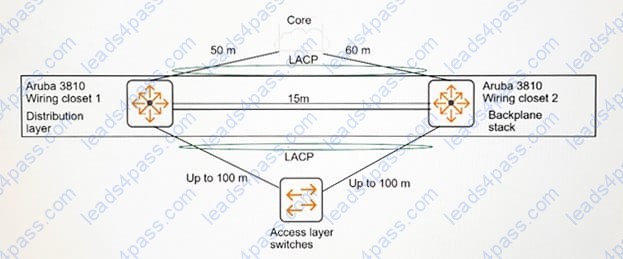
A company requires distribution layer switches that can provide Layer 2 and Layer 3 redundancy. The exhibit shows the proposal for these switches.
Which change to the proposal will help meet the company's requirements?
A. The proposed switches should be replaced with switches such as the Aruba 2930M to support the backplane stacking technology.
B. VRRP should be implemented instead of backplane stacking to support the Layer 3 redundancy requirements.
C. Link aggregations should be established without LACP to support the Layer 2 redundancy requirements and backplane stacking limitations.
D. The proposed switches should be replaced with switches that support VSF to support the required distance between stack members.
Refer to the exhibit.
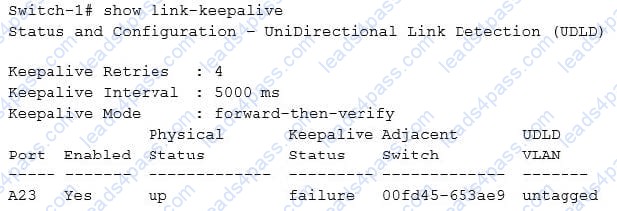
Switch-1 and Switch-2 connect on interface A23. The switches experience a connectivity issue. The network administrator sees that both switches show this interface as up. The administrator sees the output shown in the exhibit on Switch-1.
What is a typical issue that could cause this output?
A. asymmetric routing introduced by a routing protocol
B. an issue with VLAN mismatch
C. mismatched subnet mask on the VLAN for the link
D. a jumbo frame mismatch
Refer to the exhibit.
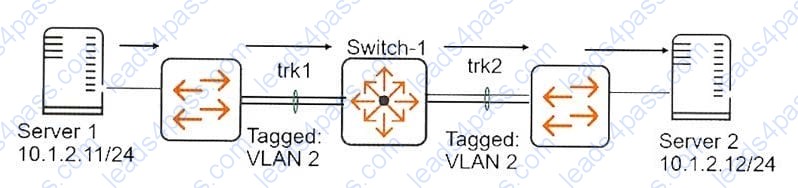
Switch-1 is an AOS-switch that is operating at factory default settings for QoS and has type of service disabled. It receives a frame with 802.1p value 5 on trk1, on VLAN 2.
How does the switch treat the frame when it forwards it on TRK2?
A. It forwards it with higher than normal priority and 802.1p 0.
B. It forwards it with normal priority and 802.1p 0.
C. It forwards it with normal priority and 802.1p 5
D. It forwards it with higher than normal priority and 802.1p 5.
Refer to the exhibits. Exhibit 1 Exhibit 2
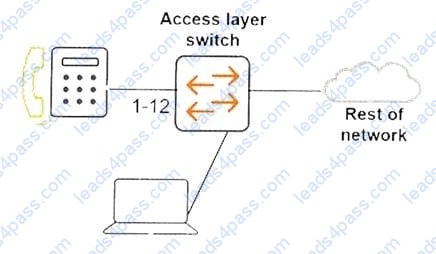
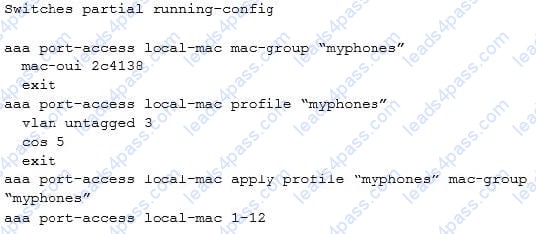
A company does not require authentication for security, but AOS-Switches are set up to use local MAC authentication (LMA) to assign the correct VLAN and priority to IP phones. IP phones and computers belong to different VLANs. Each device is supposed to connect to a specific port, but sometimes users connect their devices to the wrong ports and cannot receive access without help from IT.
How can a network administrator configure the switches to eliminate this issue?
A. Set the address limit to 2 on the switch ports that apply LMA.
B. Create a user role that applies the user VLAN, and set this role as the initial role.
C. Add the MAC addresses for computers to the myPhones MAC group.
D. Apply LMA to all edge switch ports, and set the unauth VLAN to the user VLAN.
A network uses MSTP and has AOS-Switches at the access layer. The company wants edge ports on the
access layer switches to meet these criteria:
They prevent all rogue switches that run STP, RSTP, or MSTP from connecting to the network.
If a rogue switch connects and is then replaced by a proper endpoint, the port recovers automatically
without IT staff involvement.
How should the network administrator set up the edge ports to meet these requirements?
A. Enable loop protection with a timeout period.
B. Enable BPDU filtering.
C. Enable both root guard and BPDU protection.
D. Enable BPDU protection with a timeout period.
Refer to the exhibits. Exhibit 1

Exhibit 2
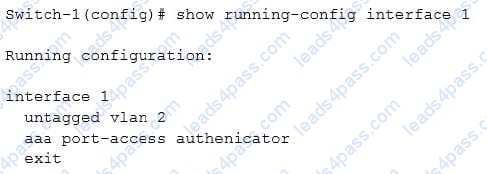
The IP phone in the exhibit is set up to complete 802.1x authentication to the network.
How can the netwotk administrator prevent a user on the computer from receiving network access without authentication?
A. Set an 802.1X client limit of 2 on interface 1.
B. Set up the MAC filter on interface 1.
C. Enable static mode port security on interface 1.
D. Enable MAC-based VLANs on interface 1.
A network administrator needs to configure an AOS-Switch to classify traffic. Comparing QoS policy and global policy, what is one function that only a class-based QoS policy can fulfill?
A. Apply a DSCP to HTTP traffic from some sources but not other sources.
B. Apply a DSCP rather than an 802.1p value to classified traffic.
C. Override the incoming DSCP in the received traffic.
D. Override the DSCP or priority applied directly to an interface.
A company needs to update the software on a VSF fabric with two Aruba 540GR switches.
What can the network administrator do to minimize downtime during the update?
A. Ensure that both switches have redundant management modules
B. Deploy the new software with the enhanced PAPI feature
C. Upload the new software through the OOBM ports
D. Implement a sequenced reboot of the new software





All rights are reserved by
leads4pass.com. Any changes, copy or trademarks abuse will be
regarded as infringement.
leads4pass.com will reserve the right to pursue accountability.
Copyright © 2004-
2026 leads4pass.com.