
HPE2-W09 Online Practice Questions and Answers
Does this correctly describe Network Analytics Engine (NAE) limitations on ArubaOS-CX switches?
Solution: You can run NAE with VSX, but only the primary VSX member will actually run agents during normal operation.
A. Yes
B. No
You ate using NetEdit to manage AruDaOS-CX switches. You want to deploy a standard conflg to the switches, but need the config to include a few device-specific settings such as hostname and IP address.
Is this what you should do?
Solution: Instead of using a standard configuration plan to deploy the configuration, create an auto config plan that uses scripts.
A. Yes
B. No
Refer to the exhibit.
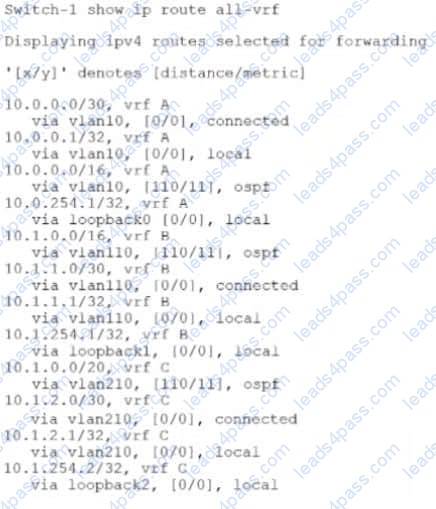
You want to enable devices in VRF B and VRF C to reach shared resources in VRF A. is this a valid strategy for meeting this goal?
Solution: Create a separate OSPF process for each VRF on Switch-1. Then redistribute each process into the other VRFs' processes.
A. Yes
B. No
Is this a use case for disabling split-recovery mode on ArubaOS-CX switches in a Virtual Switching Extension (VSX) fabric?
Solution: You want an admin to manually fail traffic over to the secondary member if the primary member fails.
A. Yes
B. No
You are configuring Ethernet Ring Protection Switching (ERPS) on an ArubaOS-CX switch.
Is this a guideline for configuring timers?
Solution: The guard interval is set in units of seconds and is used to prevent frequent topology changes due to a link going up and down.
A. Yes
B. No
You need to integrate Aruba Fabric Composer (AFC) with customer datacenter software. Is this integration possible?
Solution: Aruba Fabric Composer (AFC) with Nutanix Hypervisor (AHV)
A. Yes
B. No
Is this statement about ARP and ND Suppression true?
Solution: The switch replies to ARP requests with information present in the local ARP Table when ARP-Suppression is enabled.
A. Yes
B. No
Is this part of a valid strategy for load sharing traffic across the links in an Ethernet Ring Protection Switching (ERPS) ring?
Solution: Implement Virtual Switching Extension (VSX) on pairs of ERPS switches at the same site. Then combine multiple links between two data centers into VSX LAGs (M- LAGs).
A. Yes
B. No
Refer to the exhibit.
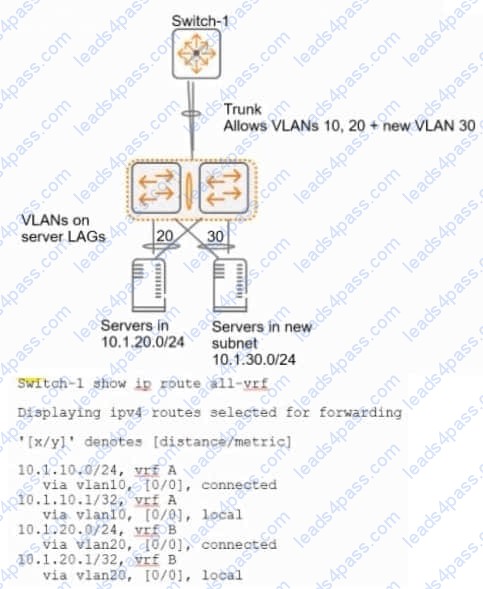
You are adding a VLAN 30, subnet 10.0.30.0/24 to the network shown in the exhibit. (This network is simplified to just the relevant switches for this item.) This subnet belongs in VRF A, and you have added a Layer 3 VLAN 30 interface
attached to this VRF on Switch-1. You want to make the services in this VLAN available to devices in 10.1.20.0/24 in VRF B.
Is this part of a valid setup for meeting these requirements?
Solution: Add a route with this command: ip route 10.1.20.0/24 vlan20 vrf A
A. Yes
B. No
Refer to the exhibits.
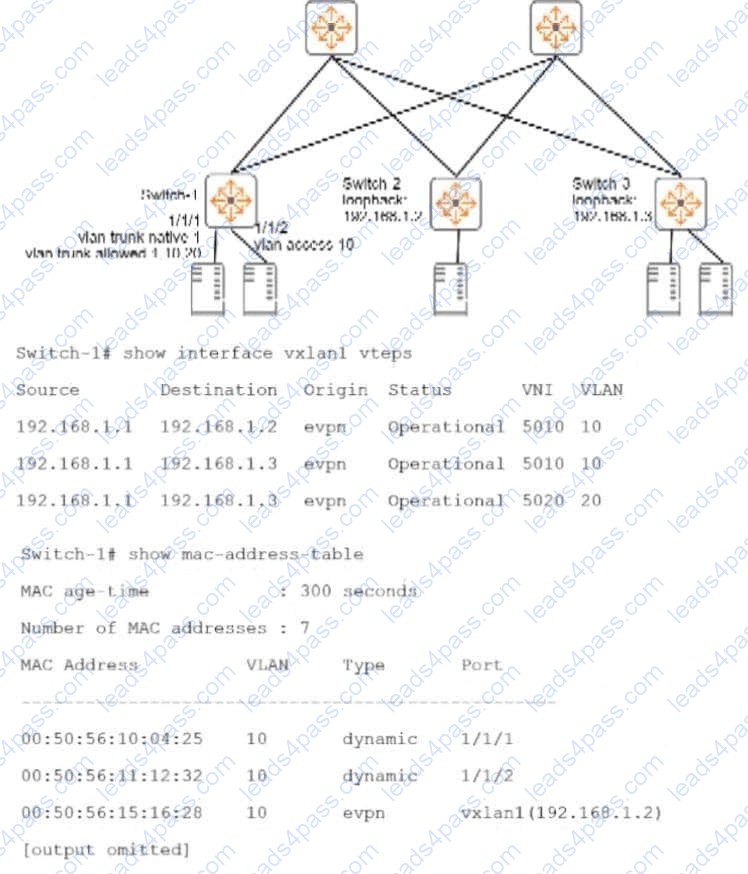
Is this how the switch handles the traffic?
Solution: A frame with destination MAC address, 00:50:56:00:00:03 arrives with a VLAN 10 tag on 1/1//1 on Switch-1. Switch-1 switches the frame out interface 1/1/2 without VXLAN.
A. Yes
B. No





All rights are reserved by
leads4pass.com. Any changes, copy or trademarks abuse will be
regarded as infringement.
leads4pass.com will reserve the right to pursue accountability.
Copyright © 2004-
2026 leads4pass.com.