
HPE2-N68 Online Practice Questions and Answers
A company wants to use Ezmeral Data Fabric to provide storage to Kubernetes Tenants on HPE Ezmeral Container Platform. What deployment option should you choose?
A. Enable the embedded Data Fabric during the controller install. Create hybrid Kubernetes clusters that use Data Fabric and non-Data Fabric nodes.
B. Enable the embedded Data Fabric during the controller install. Also create a dedicated Data Fabric Kubernetes cluster.
C. Disable the embedded Data Fabric during the controller install. Create a dedicated Data Fabric Kubernetes cluster.
D. Disable the embedded Data Fabric during the controller install. Create hybrid Kubernetes clusters that use Data Fabric and non-Data Fabric nodes.
Refer to the exhibits.
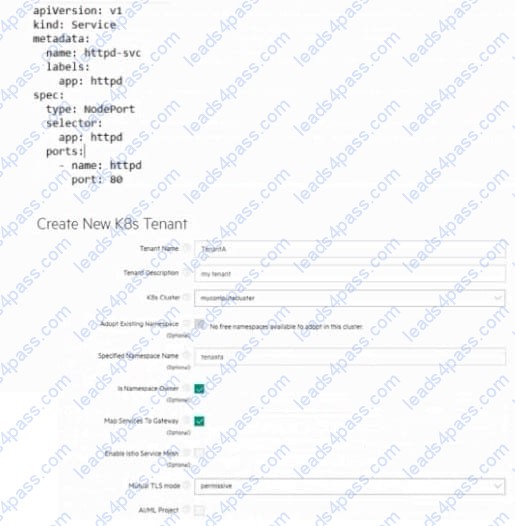
You want the HPE Ezmeral Container Platform gateway to provide external access to the service shown in the exhibit. The service is deployed in the Kubernetes Tenant tor which the exhibit shows the settings. However, it is not currently doing so.
What correction must you make to achieve this goal?
A. Reapply the service object with the "Port type" changed to "ClusterlP" and a valid cluster IP specified.
B. Check which ports are available on the gateway. Specify one of those ports as the "nodePort" in the service and reapply it.
C. Select the "Enable Istio Service Mesh" option In the Kubernetes Tenant options; then reapply the service object.
D. Reapply the service object with the "hpecp.hpe.com/hpecp-internal-gateway" label set to "true" in the metadata.
A company IT department has strict requirements around data protection and wants you to explain how to use the Max Target and Mm Target options for an HPE Ezmeral Data Fabric volume.
What should you explain?
The Max Target sets the desired RAID level for data In the primary volume. The Mm Target sets the desired RAID level for data In associated mirror and snapshot volumes.
A. The Max Target sets the desired number of replicas for data; the Min Target sets a replica number at which the fabric still tries to reach the Max Target, but less aggressively.
B. The Max Target and Min Target work together to set the erasure coding level for data in the volume. C. The Max Target is the total number of blocks and the Min Target is the total minus redundant blocks.
C. The Max Target sets the desired number of replicas for "hot" (frequently used) data; the Min Target sets the desired number of replicas for "warm" (less frequently used) data.
What Is one way that KubeDirector differs from typical Kubernetes Operators?
A. KubeDlrector embeds a ticket-based authentication system to enhance security for communications across stateful sets.
B. KubeDlrector uses the same deployment objects with which IT is probably already familiar, but makes it easier for IT to catalog and mange the objects.
C. KubeDlrector has a flexible framework that can work for many stateful apps, and Is easier for non-Kubernetes experts to use.
D. KubeDirector is optimized for establishing secure service meshes across cloud-scale, stateless, micro-service-based architectures.
You have used Ezmeral Container Platform to create a Kubernetes cluster, which has 3 conductor (master) nodes tor HA and 12 workers. Which correctly describes how the platform manages this cluster?
A. The controller elects one conductor as the primary conductor and places the other conductors in standby mode.
B. The controller places the conductor nodes in standby mode and takes over as the active conductor for the Kubernetes cluster.
C. The controller sends API requests through the gateway, which load balances them across the conductor nodes.
D. The controller can manage the cluster, but using HA for the conductors limits a few features such as Data Taps and the Web Terminal.
What is one key advantage ofHPE EzmeralData Fabric as opposed to HDFS?
A. EzmeralData Fabric stores a great deal more metadata than HDFS, making It more resilient.
B. EzmeralData Fabric uses more efficient erasure coding to protect all data, instead of replication.
C. EzmeralData Fabric reduces load on storage nodes by placing all metadata on a centralized name node, while HDFS distributes metadata.
D. EzmeralData Fabric enables admins to set policies at a logical volume level, while HDFS does not.
You have an Ezmeral Container Platform solution running v5.2 software. The platform manages several Kubernetes clusters. You need to upgrade the software. What type of behavior should you expect during the upgrade?
A. Existing services continue to run with minimal disruption, but users cannot add new services in the Web Ul.
B. All services on the cluster will be down for about an hour, as will the Web Ul.
C. Users can access EPIC features, but services running on the Kubernetes cluster will be unavailable.
D. Users can access the Web Ul. But external clients will not be able to reach services on the cluster.
You have added a deployment object to the "tenant!" namespaces on a Kubetnetes cluster using the
"cluster.local" domain name.
The deployment's pods run a Web-based application. You want the application running on these pods to
be accessible within the cluster at hostname:
portaLtenantl.svc.clusteUocal. Which object meets these requirements?
A. A service object with ClusterIP type and name "portal"
B. A replica set object with container ports 80 and 443
C. A configmap object with ports 80 and 443 and name "portaLtenant l"
D. A kdcluster object with hostname "portal.tenantl.svc.cluster.local"
A customer needs an Ezmeral Container Platform solution for supporting a mix of statef ul and stateless applications. The customer also wants the platform to nost Ezmeral Data Fabric on Kubernetes.
Which systems are recommended for the Data Fabric workers?
A. SimpliVity 380s
B. Synergy 380s
C. Apollo 4200s
D. Apollo 6500s
You are using native Kubernetes, and you want to deploy three identical containers. What Is the recommended way to do so?
A. Create a deployment object that specifies three replicas of a pod. which defines the desired container settings.
B. Create a pod object that specifies three separate containers; specify the same settings for each container.
C. Create one container object. Then specify three instances of that object in a separate pod object.
D. Create three container objects. For each object specify the same image and settings.





All rights are reserved by
leads4pass.com. Any changes, copy or trademarks abuse will be
regarded as infringement.
leads4pass.com will reserve the right to pursue accountability.
Copyright © 2004-
2026 leads4pass.com.