
HP2-Z33 Online Practice Questions and Answers
An organization implements an N+1 redundancy for its access controllers (ACs). When the primary AC fails, the access points (APs) successfully fail over to the standby AC. However, when the failed AC comes back in to service, the APs do not switch back to the original AC.
What could cause this to happen?
A. AP Connection priority on the primary AC is not set to 1.
B. APs determine which AC to connect to based on load.
C. APs do not fail back to the original AC.
D. AP Connection priority on the primary AC is not set to 7.
Refer to the exhibit.
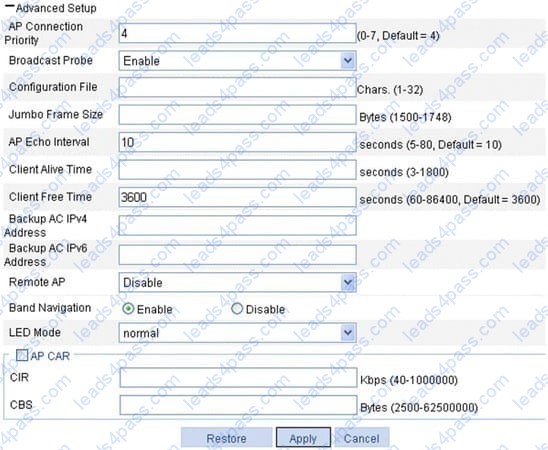
A. The access controller should send the access point (AP) an echo request every 10 seconds to ensure that the AP is still operational.
B. The access point should send the access controller an echo request every 10 seconds to ensure that the LWAPP tunnel is up.
C. The access point should transmit a beacon every 10 seconds.
D. The access point should send the client an echo request every 10 seconds to ensure that the client is still connected.
What is an advantage of the HP IMC Wireless Service Manager (WSM)?
A. An organization can centrally configure WLAN deployments of up to 10,000 FIT access points.
B. An organization can centrally manage WLAN deployments of up to 5,000 FIT access points.
C. An organization can configure switches, routers, and access controllers from a central location.
D. An organization can manage guest access through the command line interface.
A research company wants to deploy a high throughput 802.11n only wireless network. The network administrator selects the "client dot11n-only" option. Which other configuration option must the network administrator configure?
A. maximum MCS index
B. basic rate 6Mb/s
C. mandatory rates MCS0-MCS15
D. MCS15 data rate
The Wireless Intrusion Prevention System (WIPS) determines that a client has exceeded the maximum number of authentication requests that a client should make in the allowed period. What does the WIPS system do?
A. adds the client's MAC address to the static blacklist on the access controller
B. adds the client's MAC address to the static blacklist on the access point
C. adds the client's MAC address to the dynamic blacklist for the access point
D. removes the client's MAC address from the whitelist on the access controller
In 802.1XEAP-TLS, how can a network administrator control network access of corporate users?
A. by selecting which user groups are entitled to deploy a certificate on their endpoints
B. by selecting which endpoints are entitled to install a certificate
C. by defining corporate users as guests
D. by disabling or deleting the user's endpoint in User Access Manager
What is the maximum data rate that a 2x3 MIMO 802.11 n enabled device can transmit at?
A. 54Mb/s
B. 150 Mb/s
C. 300 Mb/s
D. 450 Mb/s
Which command allows an administrator to access the HP 830 switch CLI from the controller?
A. oap management-ip 192.168.0.101 module 1
B. oap connect slot 0
C. oap management-ip 192.168.0.101 slot 1
D. oap connect module 0
An HP BYOD solution is deployed on a wireless infrastructure. Which components actively participate in the RADIUS authentication process of a user endpoint? (Select two)
A. HP APs associated with an HP Unified Wireless controller in its default setup
B. HP Wireless Service Manager (WSM)
C. HP 830 Switch
D. HP User Access Manager
E. HP 830 Access Controller
Which components participate in the HP BYOD authentication process? (Select two.)
A. HTTP agent
B. Wireless Service Manager (WSM)
C. User Access Manager DHCP agent
D. User Access Manager
E. BYOD portal server





All rights are reserved by
leads4pass.com. Any changes, copy or trademarks abuse will be
regarded as infringement.
leads4pass.com will reserve the right to pursue accountability.
Copyright © 2004-
2026 leads4pass.com.