
HP0-Y50 Online Practice Questions and Answers
HOTSPOT
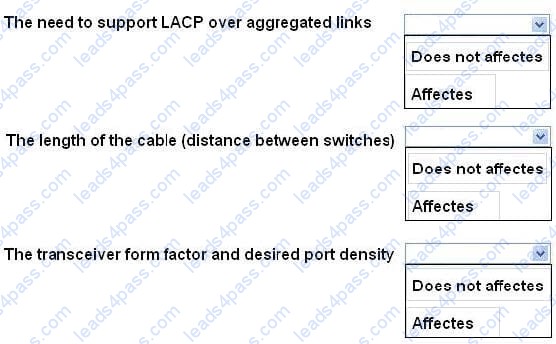
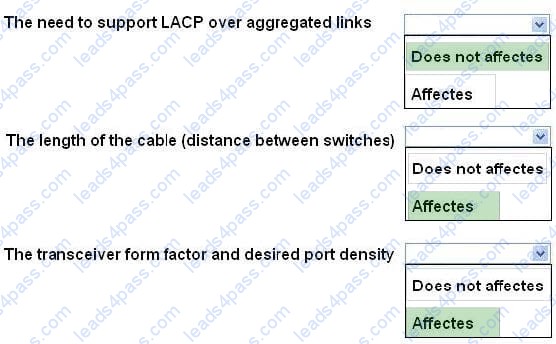
A network architect is choosing transceivers for switches-to-switches fiber links. Which factors affect the architect's choice?
Hot Area:
HOTSPOT
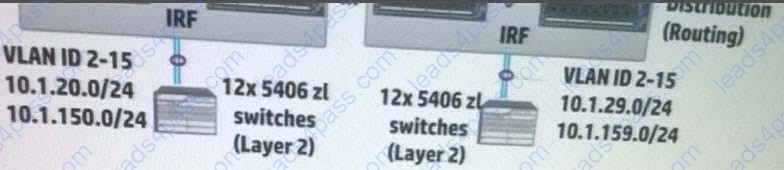
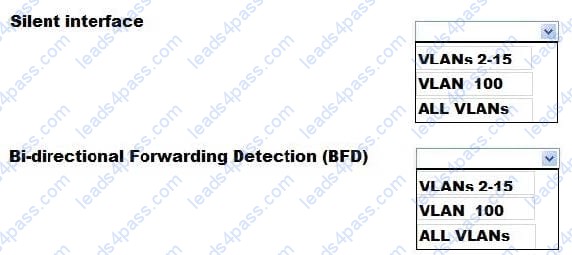
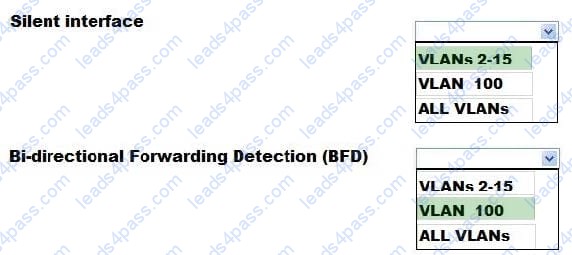
The network architect is designing an Open Shortest Path First (OSPF) solution and plans to run OSPF on each of the VLAN in switches. Based on the practices, which interface or interfaces should the network architect plan the features on?
Hot Area:
A network architect is planning a guest solution for a group of ports in a conference room. Guests should have access to the Internet only. The company wants a simple solution and prefers not to burden visitors with login requests. Which solution would best meet the company's requirements for a gust network?
A. Place the ports in a black-hole VLAN that is not carried on Switch-to-Switch links. Apply a dynamic VLAN for guests who pass web authentication to a server that allows MAC registration
B. Place the guest ports that is allowed access only to the internet. Optionally configure port isolation.
C. Apply MAC lockdown to the guest ports. Configure switches to place unknown MAC addresses in a VLAN with access only to the internet
D. Apply web authentication to the guest ports. Use the built-in guest accounts for HP switches to authenticate the users
An employer takes the company laptops offsite and connects it to an insecure network. A hacker is able to deploy a malware application to the laptop. The employer takes the laptop back to the office, where the malware uses the credentials of the employee to eavesdrop and to implement denial of service (DoS) attacks.
Which security solution would help prevent this type of attack?
A. MAC lockdown
B. A dynamic VPN (DVPN)
C. Port-based security with 802.1X
D. Endpoint integrity
What are information technology Service Management (ITSM) framework, such as the infrastructure Technology Infrastructure Library (ITILv3) and The Open Group Architecture Framework (TOGAF)?
A. They are Internet Engineering Task Force (IETF) standards that provide evolving guidelines and best practices for IT design and management
B. They are high-level approaches that provide recommendations and best practices for IT design management
C. They are industry-wide standards that provide guidelines for enterprise design and management
D. They are Internet Engineering Task Force (IETF) standards that define proper network design
Refer to the exhibit.
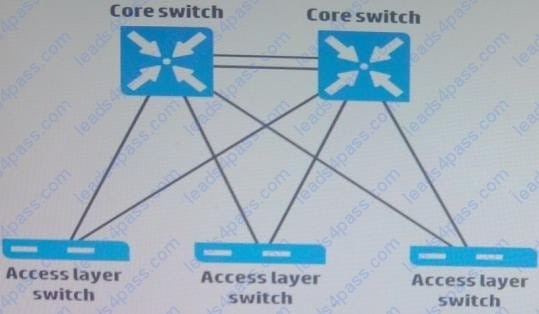
A customer has the solution in the exhibit, which includes more access layer switches than are shown. Members of the customer network team mention they are considering access layer routing for a new solution to eliminate Spanning Tree Protocol (STP) and Virtual Router Redundancy protocol (VRRP). However they are concerned about meaning the routing solution. The network architect proposes a solution that eliminates STP and VRRP without requiring routing at the access layer, although the solution can use access layer routing.
Which solution fits that description?
A. Two HP 10500 Series, using intelligent Resilient Framework (IRF) at the core, HP S400 zl Series switches at the access layer
B. Two HP 10500 Series switches, using Hot Standby Router Protocol (HSRP), at the core. HP 2600 Series switch at the access layer
C. Two HP 8200 zl Series switches, using distributed Trunking, at the core. HP 5400 zl Series switches at the access layer
D. Two HP zl Series switches, using backplane stacking, at the core. HP 5400 zl Series switches, using the backbone stacking at the access layer
When would a network architect recommend an HP HSR6800 Router for a campus LAN? (Select two)
A. The HP HSR6800 Router provides routing features at a more attractive price point than a routing switch
B. The company wants to implement a Dynamic Virtual Private Network (DVPN)
C. The HP HSR6800 Router Supports Border Gateway Protocol (BGP), which is unavailable on routing switches
D. The company needs a routing device that supports extremely large tables
E. The company requires a large number of 10G connections
The customer has a virtualized data center. The virtual hosts use virtual distributed switches with multiple redundant uplinks and these update control Protocol (LACP).
Which technology available in HP switches enhances high availability in this environment?
A. Fiber Channel over Ethernet (FCoE) allows the virtual host to send storage traffic over the server Ethernet uplinks if the FC connection.
B. Virtual Ethernet Port Aggregator (VEPA) combines redundant server talks into a single high-bandwidth trunk.
C. Intelligent Resilient Framework (IRF) allows redundant server links to connect to different physical switches.
D. Net Stream and sFlow technologies provide the built-in capability to optimize bandwidth flows dynamically.
A company is upgrading a data center network solution in phases. The first phase involves updating the top of rack (ToR) switches in one rack. Other switches will be updated in their phases.
What is one benefit of this approach?
A. It allows the through testing of the solution in real-world circumstances
B. It ensures that the network can be updated without any scheduled downtime
C. It removes the need to conduct connectivity and failover tests during the implementation
D. It removes the need for working with customer change management processes
A data center has a traditional three-tier network design with routing at the distribution layer. The customer is virtualizing its servers and adding technologies such as live migration of virtual machines (VMs). How well does the architecture (topology) meet the needs of the customer's changing environment?
A. This topology is not ideal in supporting the low-latency Layer 2 communications that this environment requires
B. This topology is ideal because it enforces consolidation of virtualized server domains
C. This topology is not ideal because it enforces consolidation of virtualized server domains
D. This topology is not ideal for supporting the Secure Virtualization Framework (SVF) required to protect the virtual servers





All rights are reserved by
leads4pass.com. Any changes, copy or trademarks abuse will be
regarded as infringement.
leads4pass.com will reserve the right to pursue accountability.
Copyright © 2004-
2026 leads4pass.com.