

 Printable PDF
Microsoft DP-420 Exam Preparation Materials
Vendor: Microsoft
Exam Code: DP-420
Exam Name: Designing and Implementing Cloud-Native Applications Using Microsoft Azure Cosmos DB
Certification: Microsoft Certifications
Total Questions: 176 Q&A
( View
Details)
Updated on: Jul 16, 2026
Note: Product instant download. Please sign in and click My account to download your product.



How Our Microsoft DP-420 Preparation Approach Works
Preparing for the Microsoft DP-420 Microsoft Certifications certification exam requires more than repetitive practice — it requires a clear preparation structure aligned with real exam objectives, question patterns, and learning efficiency.
At Leads4pass, our approach focuses on aligning preparation materials with current exam objectives, question patterns, and learning efficiency. Instead of overwhelming candidates with unfocused content, we organize practice around what truly matters in the Microsoft DP-420 exam, helping candidates build stable understanding and confident answering strategies.
Through structured practice, exam-style simulations, and clear explanations, candidates are guided to prepare with purpose, reduce uncertainty, and approach the Microsoft Certifications exam with confidence.
How We Structure Microsoft DP-420 Exam Preparation
Our preparation materials are not assembled randomly. They are structured around a clear methodology:
- Breaking down official exam objectives into focused learning modules
- Prioritizing high-impact and commonly misunderstood topics
- Using practice questions to validate understanding, not memorization
- Maintaining consistency between preparation and real exam expectations
This structure allows candidates to study efficiently while maintaining clarity and direction throughout the preparation process.
Maintaining Relevance Without Disrupting Learning Flow
To keep preparation aligned with current exam expectations, Microsoft DP-420 materials are maintained through a regular review and update cycle, ensuring alignment with evolving exam objectives while preserving a consistent learning experience.
Candidates can switch between PDF-based review and VCE-style practice depending on their study rhythm, allowing flexibility without unnecessary distractions. Throughout the process, learning remains focused, private, and uninterrupted.
How Candidates Typically Use This Page
- Candidates new to networking often begin with structured review and gradually move into exam-style practice
- Experienced professionals typically focus on targeted practice to refine weaker areas
- Candidates retaking the exam use focused simulations to rebuild confidence and answering consistency
Rather than enforcing a single study path, the materials adapt to the candidate’s experience level and preparation goals.
Avoiding Common Microsoft Certifications Preparation Pitfalls
- Practicing without understanding underlying concepts
- Studying outdated or misaligned content
- Preparing without exposure to real exam-style scenarios
- Lacking a structured review strategy
Our preparation framework is designed specifically to avoid these pitfalls and support efficient, focused learning.
What You Gain from Microsoft DP-420 Preparation
- A structured preparation framework aligned with exam objectives
- Practice that reinforces understanding, not memorization
- Flexible study formats that adapt to individual learning styles
- A focused, distraction-free preparation experience
- Greater clarity and confidence approaching exam day
If your goal is to prepare for the Microsoft Certifications exam with clarity and efficiency, you can begin a structured preparation process designed around real exam expectations.
- 99.5% pass rate
- 12 Years experience
- 7000+ IT Exam Q&As
- 70000+ satisfied customers
- 365 days Free Update
- 3 days of preparation before your test
- 100% Safe shopping experience
- 24/7 Support
Microsoft DP-420 Last Month Results
Free DP-420 Exam Questions in PDF Format
- File
- Size
- Microsoft_leads4pass_DP-420_by_Wannapass_101.pdf
- 227.98 KB
- Microsoft_leads4pass_DP-420_by_CITP1_106.pdf
- 298.27 KB
- Microsoft_leads4pass_DP-420_by_Murali_105.pdf
- 225.09 KB
- Microsoft_leads4pass_DP-420_by_cisco_world_100.pdf
- 334.94 KB
- Microsoft_leads4pass_DP-420_by_Anwar_Ahdab_95.pdf
- 231.26 KB
- Microsoft_leads4pass_DP-420_by_Ogechi_108.pdf
- 270.56 KB
DP-420 Online Practice Questions and Answers
DRAG DROP
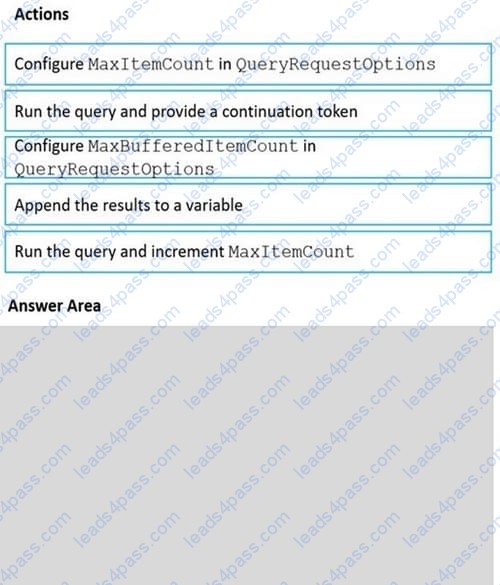
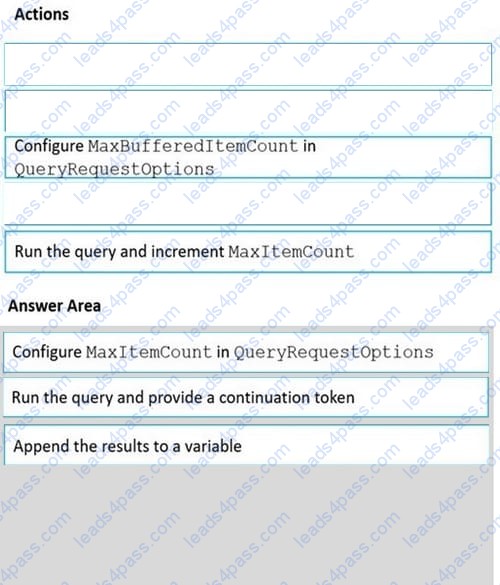
You have an app that stores data in an Azure Cosmos DB Core (SQL) API account The app performs queries that return large result sets.
You need to return a complete result set to the app by using pagination. Each page of results must return 80 items.
Which three actions should you perform in sequence? To answer, move the appropriate actions from the list of actions to the answer area and arrange them in the correct order.
Select and Place:
You have an Azure Cosmos DB Core (SQL) API account that is used by 10 web apps.
You need to analyze the data stored in the account by using Apache Spark to create machine learning models. The solution must NOT affect the performance of the web apps.
Which two actions should you perform? Each correct answer presents part of the solution.
NOTE: Each correct selection is worth one point.
A. In an Apache Spark pool in Azure Synapse, create a table that uses cosmos.olapas the data source.
B. Create a private endpoint connection to the account.
C. In an Azure Synapse Analytics serverless SQL pool, create a view that uses OPENROWSETand the CosmosDB provider.
D. Enable Azure Synapse Link for the account and Analytical store on the container.
E. In an Apache Spark pool in Azure Synapse, create a table that uses cosmos.oltpas the data source.
You have a container in an Azure Cosmos DB Core (SQL) API account. The container stores telemetry data from IoT devices. The container uses telemetryId as the partition key and has a throughput of 1,000 request units per second (RU/s).
Approximately 5,000 IoT devices submit data every five minutes by using the same telemetryId value.
You have an application that performs analytics on the data and frequently reads telemetry data for a single IoT device to perform trend analysis.
The following is a sample of a document in the container.
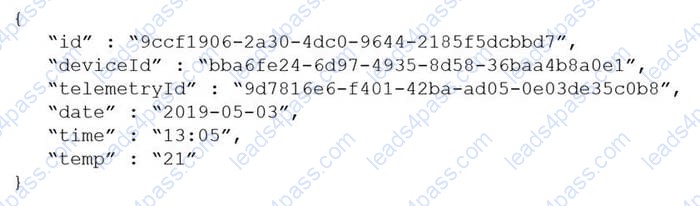
You need to reduce the amount of request units (RUs) consumed by the analytics application. What should you do?
A. Decrease the offerThroughputvalue for the container.
B. Increase the offerThroughputvalue for the container.
C. Move the data to a new container that has a partition key of deviceId.
D. Move the data to a new container that uses a partition key of date.
Leads4Pass Microsoft Certifications DP-420 Exam Solutions
The following table comprehensively analyzes the quality and value of Microsoft Certifications DP-420 exam materials.

100% safe shopping
100% real and effective
100% money back guarantee
Leads4Pass guarantee comes from more than 10 years of experience and reputation





All rights are reserved by
leads4pass.com. Any changes, copy or trademarks abuse will be
regarded as infringement.
leads4pass.com will reserve the right to pursue accountability.
Copyright © 2004-
2026 leads4pass.com.