
DATABRICKS-CERTIFIED-PROFESSIONAL-DATA-ENGINEER Online Practice Questions and Answers
Review the following error traceback:
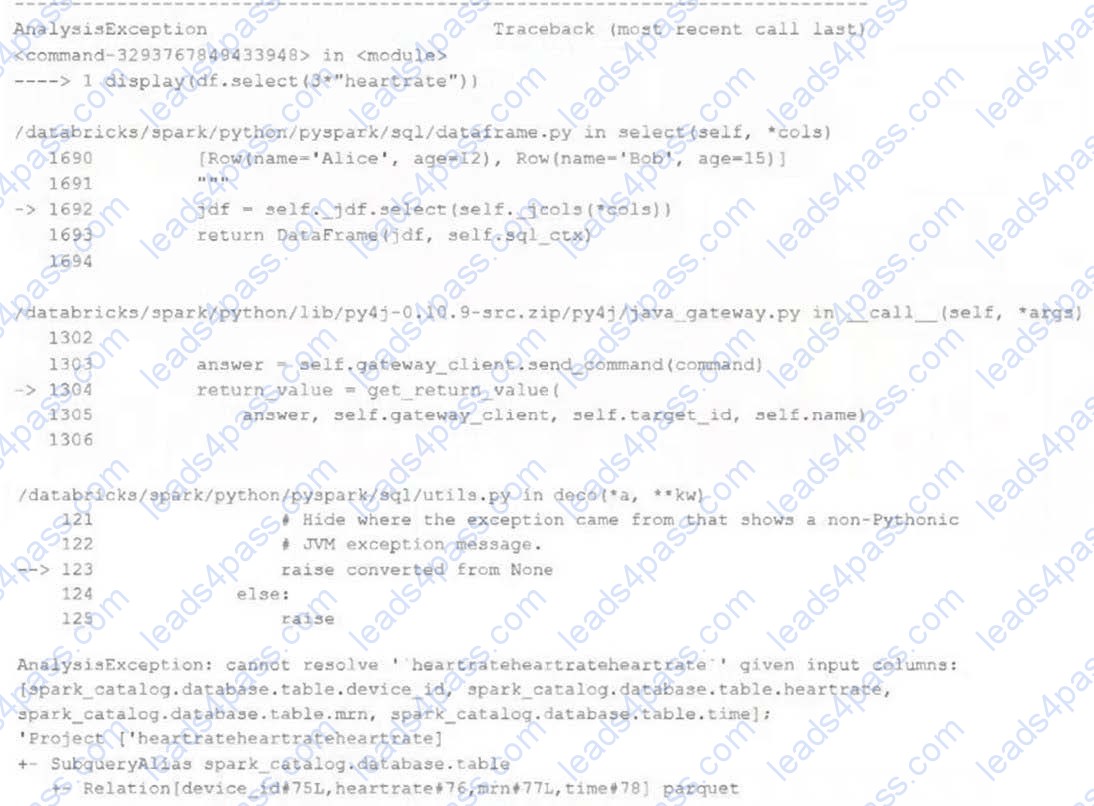
Which statement describes the error being raised?
A. The code executed was PvSoark but was executed in a Scala notebook.
B. There is no column in the table named heartrateheartrateheartrate
C. There is a type error because a column object cannot be multiplied.
D. There is a type error because a DataFrame object cannot be multiplied.
E. There is a syntax error because the heartrate column is not correctly identified as a column.
A junior data engineer is working to implement logic for a Lakehouse table named silver_device_recordings. The source data contains 100 unique fields in a highly nested JSON structure.
The silver_device_recordings table will be used downstream to power several production monitoring dashboards and a production model. At present, 45 of the 100 fields are being used in at least one of these applications.
The data engineer is trying to determine the best approach for dealing with schema declaration given the highly-nested structure of the data and the numerous fields.
Which of the following accurately presents information about Delta Lake and Databricks that may impact their decision-making process?
A. The Tungsten encoding used by Databricks is optimized for storing string data; newly-added native support for querying JSON strings means that string types are always most efficient.
B. Because Delta Lake uses Parquet for data storage, data types can be easily evolved by just modifying file footer information in place.
C. Human labor in writing code is the largest cost associated with data engineering workloads; as such, automating table declaration logic should be a priority in all migration workloads.
D. Because Databricks will infer schema using types that allow all observed data to be processed, setting types manually provides greater assurance of data quality enforcement.
E. Schema inference and evolution on .Databricks ensure that inferred types will always accurately match the data types used by downstream systems.
The business intelligence team has a dashboard configured to track various summary metrics for retail stories. This includes total sales for the previous day alongside totals and averages for a variety of time periods. The fields required to populate this dashboard have the following schema:
For Demand forecasting, the Lakehouse contains a validated table of all itemized sales updated incrementally in near real-time. This table named products_per_order, includes the following fields:
Because reporting on long-term sales trends is less volatile, analysts using the new dashboard only require data to be refreshed once daily. Because the dashboard will be queried interactively by many users throughout a normal business
day, it should return results quickly and reduce total compute associated with each materialization.
Which solution meets the expectations of the end users while controlling and limiting possible costs?
A. Use the Delta Cache to persists the products_per_order table in memory to quickly the dashboard with each query.
B. Populate the dashboard by configuring a nightly batch job to save the required to quickly update the dashboard with each query.
C. Use Structure Streaming to configure a live dashboard against the products_per_order table within a Databricks notebook.
D. Define a view against the products_per_order table and define the dashboard against this view.
A data engineer needs to capture pipeline settings from an existing in the workspace, and use them to create and version a JSON file to create a new pipeline.
Which command should the data engineer enter in a web terminal configured with the Databricks CLI?
A. Use the get command to capture the settings for the existing pipeline; remove the pipeline_id and rename the pipeline; use this in a create command
B. Stop the existing pipeline; use the returned settings in a reset command
C. Use the alone command to create a copy of an existing pipeline; use the get JSON command to get the pipeline definition; save this to git
D. Use list pipelines to get the specs for all pipelines; get the pipeline spec from the return results parse and use this to create a pipeline
A Delta Lake table in the Lakehouse named customer_parsams is used in churn prediction by the machine learning team. The table contains information about customers derived from a number of upstream sources. Currently, the data engineering team populates this table nightly by overwriting the table with the current valid values derived from upstream data sources.
Immediately after each update succeeds, the data engineer team would like to determine the difference between the new version and the previous of the table.
Given the current implementation, which method can be used?
A. Parse the Delta Lake transaction log to identify all newly written data files.
B. Execute DESCRIBE HISTORY customer_churn_params to obtain the full operation metrics for the update, including a log of all records that have been added or modified.
C. Execute a query to calculate the difference between the new version and the previous version using Delta Lake's built-in versioning and time travel functionality.
D. Parse the Spark event logs to identify those rows that were updated, inserted, or deleted.
The business reporting tem requires that data for their dashboards be updated every hour. The total processing time for the pipeline that extracts transforms and load the data for their pipeline runs in 10 minutes. Assuming normal operating conditions, which configuration will meet their service-level agreement requirements with the lowest cost?
A. Schedule a jo to execute the pipeline once and hour on a dedicated interactive cluster.
B. Schedule a Structured Streaming job with a trigger interval of 60 minutes.
C. Schedule a job to execute the pipeline once hour on a new job cluster.
D. Configure a job that executes every time new data lands in a given directory.
The data engineering team maintains a table of aggregate statistics through batch nightly updates. This includes total sales for the previous day alongside totals and averages for a variety of time periods including the 7 previous days, year-todate, and quarter-to-date. This table is named store_saies_summary and the schema is as follows:

The table daily_store_sales contains all the information needed to update store_sales_summary. The schema for this table is:
store_id INT, sales_date DATE, total_sales FLOAT
If daily_store_sales is implemented as a Type 1 table and the total_sales column might be adjusted after manual data auditing, which approach is the safest to generate accurate reports in the store_sales_summary table?
A. Implement the appropriate aggregate logic as a batch read against the daily_store_sales table and overwrite the store_sales_summary table with each Update.
B. Implement the appropriate aggregate logic as a batch read against the daily_store_sales table and append new rows nightly to the store_sales_summary table.
C. Implement the appropriate aggregate logic as a batch read against the daily_store_sales table and use upsert logic to update results in the store_sales_summary table.
D. Implement the appropriate aggregate logic as a Structured Streaming read against the daily_store_sales table and use upsert logic to update results in the store_sales_summary table.
E. Use Structured Streaming to subscribe to the change data feed for daily_store_sales and apply changes to the aggregates in the store_sales_summary table with each update.
A table named user_ltv is being used to create a view that will be used by data analysts on various teams. Users in the workspace are configured into groups, which are used for setting up data access using ACLs.
The user_ltv table has the following schema: email STRING, age INT, ltv INT
The following view definition is executed:
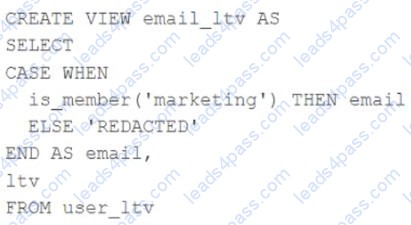
An analyst who is not a member of the marketing group executes the following query:
SELECT * FROM email_ltv
Which statement describes the results returned by this query?
A. Three columns will be returned, but one column will be named "redacted" and contain only null values.
B. Only the email and itv columns will be returned; the email column will contain all null values.
C. The email and ltv columns will be returned with the values in user itv.
D. The email, age. and ltv columns will be returned with the values in user ltv.
E. Only the email and ltv columns will be returned; the email column will contain the string "REDACTED" in each row.
Two of the most common data locations on Databricks are the DBFS root storage and external object storage mounted with dbutils.fs.mount().
Which of the following statements is correct?
A. DBFS is a file system protocol that allows users to interact with files stored in object storage using syntax and guarantees similar to Unix file systems.
B. By default, both the DBFS root and mounted data sources are only accessible to workspace administrators.
C. The DBFS root is the most secure location to store data, because mounted storage volumes must have full public read and write permissions.
D. Neither the DBFS root nor mounted storage can be accessed when using %sh in a Databricks notebook.
E. The DBFS root stores files in ephemeral block volumes attached to the driver, while mounted directories will always persist saved data to external storage between sessions.
Which of the following is true of Delta Lake and the Lakehouse?
A. Because Parquet compresses data row by row. strings will only be compressed when a character is repeated multiple times.
B. Delta Lake automatically collects statistics on the first 32 columns of each table which are leveraged in data skipping based on query filters.
C. Views in the Lakehouse maintain a valid cache of the most recent versions of source tables at all times.
D. Primary and foreign key constraints can be leveraged to ensure duplicate values are never entered into a dimension table.
E. Z-order can only be applied to numeric values stored in Delta Lake tables





All rights are reserved by
leads4pass.com. Any changes, copy or trademarks abuse will be
regarded as infringement.
leads4pass.com will reserve the right to pursue accountability.
Copyright © 2004-
2026 leads4pass.com.