
CBAF-001 Online Practice Questions and Answers
What does the M stand for in MoSCoW?
A. Mission.
B. Must have.
C. Management.
D. Mandatory.
Which of the following only includes explicit corporate knowledge?
A. Skills, values, communities of practice.
B. Job descriptions, tasks, targets.
C. Culture, norms, historicaldata.
D. Style guides, procedures, processes.
Which of the following investigation techniques involves following a user for one or two days in order to find out what a particular job entails?
A. Scenario analysis.
B. Protocol analysis.
C. Shadowing.
D. Activity sampling.
The requirements catalogue documents the business user or users who requested the requirement. Which heading in the requirements catalogue template would this information be recorded?
A. Owner.
B. Justification.
C. Author.
D. Source.
Which of the following is an advantage to the host organization of using an internal consultant to conduct a business analysis project?
A. They will have a broad business perspective.
B. They will be familiar with the host organization.
C. They will only be paid when they are needed.
D. They will have a dispassionate view of the host organization.
The entity relationship model below shows the relationship between Customer and Order. Which of the following business rules is correct?
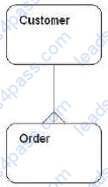
A. An order may be placed by many customers.
B. A customer may place many orders.
C. A customer may never place an order.
D. An order need not be placed by a customer.
Which of the following is a primary activity in the value chain?
A. Human Resources (HR).
B. Procurement.
C. Information Technology (IT).
D. Marketing and Sales.
Which stage of the Requirements Engineering process is concerned with tracking requirements from inception to implementation?
A. Requirements documentation.
B. Requirements management.
C. Requirements validation.
D. Requirements analysis.
Which of the following is an input to the 'Investigate the Situation' stage of the business analysis process model?
A. Stakeholder perspectives.
B. List of issues/problems.
C. Business case.
D. Terms of reference.
Who is the target of the value proposition?
A. The Supplier.
B. The Sponsor.
C. The Customer.
D. The Competitor.





All rights are reserved by
leads4pass.com. Any changes, copy or trademarks abuse will be
regarded as infringement.
leads4pass.com will reserve the right to pursue accountability.
Copyright © 2004-
2026 leads4pass.com.