
C2090-645 Online Practice Questions and Answers
In a crosstab, Campaign is in the rows area, Order method type is in the columns area, and Quantity is the measure. Campaign and Order method type are specified in the query. The report runs, displaying quantity valuesfor all years.
Why does this happen?
A. The dimension member from that dimension is implied.
B. The order method member from that dimension is implied.
C. The aggregate member from that dimension is implied.
D. The default member from that dimensionis implied.
The sales manager requires a crosstab report to display the top 3 sales people for the month. Considering that an OLAP data source is used, what will the report author use when creating this report?
A. A set expression
B. An axis title
C. A percent of base calculation
D. The hierarchize function
A report author can use a slicer to dowhat?
A. Make the report database smaller and efficient
B. Provide context to intersection values
C. Reduce the number of members on the edge of the crosstab.
D. Generate a zero suppression filter in the rows
A report author uses the following expression: lastPeriods(3,[2007/Mar]). What data will be returned when the report is run?
A. The last 3 months before 2007/Mar
B. 3 months, including 2007/Mar and the preceeding 2 months
C. The total of currentMeasure for 3 months including 2007/Mar and the preceeding 2 months
D. The month March of each of the 3 years 2005, 2006, and 2007
A report author creates an expression usingthe closingPeriod function to return the latest month found in the data source, and names the expression "Current Month".
What can the report author do with "Current Month"?
A. Use it to replace the lastPeriods(1,[Month]) expression currently in the report.
B. Add it to an expression to find the current member for the Month level.
C. Use it to determine the current quarter: parent([Current Month]).
D. Use it as a report expression to display the current month in the page header of the report.
Of the following prompt syntax expressions, which two are considered to be dimensional?
1)
2)
3)
4) set(
A. 1 and 4
B. 1 and 2
C. 2 and 3
D. 3 and 4
The report author creates a query where two items (TopThree and Retailer country) exist in the same member set. The expression for TopThree is: topCount([Retailer country],3,[Revenue]).
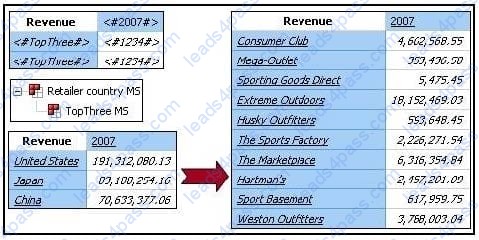
What drill behavior should the report author set in order to display the top three children instead of all children on drill down?
A. Configure TopThree to Change Expression, and configureRetailer country to Preserve.
B. Configure TopThree to Preserve, and configure Retailer country to Preserve.
C. Configure TopThree to Preserve, and configure Retailer country to Replace Expression.
D. Configure TopThree to Ancestor, and configure Retailercountry to Change Expression.
Why would a report author consider overriding the default drill behavior?
A. To maintain the behavior of a complex edge expression after drilling, such as one which returns the top 5 members of a set.
B. To replace all members within a hierarchy when drilling through to a report with more detail.
C. To drill down to the lowest level of the hierarchy and then drill down again to display only one member.
D. To drill down on a member and have its children display as details and have the member drilled on display as summary.
A report author creates a revenue report from an OLAP data source. On the rows, there are nested levels, each from different dimensions having a large number of members. The report author filters out empty rows using the expression "[Revenue] > 0".
When running this report, there is poor performance. What could cause this?
A. There are too many members or levels nested on the rowedge.
B. Filtering on measure values is incompatible with an OLAP data source.
C. Limiting the crosstab measures with a filter function.
D. A relational filter was applied.
A report runs, and is 433pages long, with 19,010 rows. Many of the rows are blank. The report author uses a filter function to filter nulls, and runs the report again. The result is 143 pages, with 6273 rows, and none of the rows are blank. What filtering style did the report author decide to use?
A. Conventional
B. Dimensional
C. Relational
D. Functional





All rights are reserved by
leads4pass.com. Any changes, copy or trademarks abuse will be
regarded as infringement.
leads4pass.com will reserve the right to pursue accountability.
Copyright © 2004-
2026 leads4pass.com.