
AZ-801 Online Practice Questions and Answers
HOTSPOT
You have two servers that have the Web Server (IIS) server role installed. The servers are configured as shown in the following table.

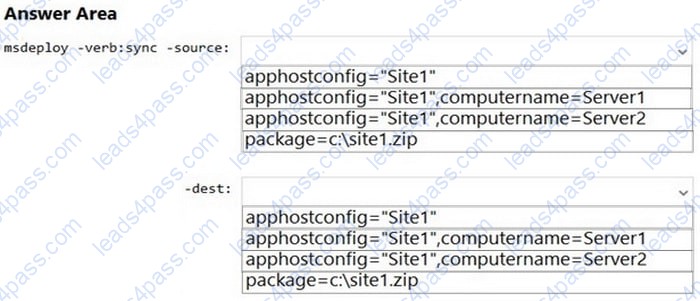
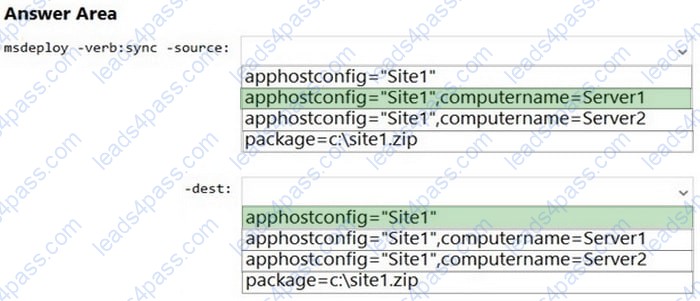
Both servers are configured to enable website deployment by using the Web Deployment Tool. Server1 hosts a website named Site1 that has Web Deploy Publishing configured.
You plan to migrate Site1 to Server2.
You need to perform a pull synchronization of Site1 by using the Web Deployment Agent Service.
How should you complete the command? To answer, select the appropriate options in the answer area.
NOTE: Each correct selection is worth one point.
Hot Area:
HOTSPOT
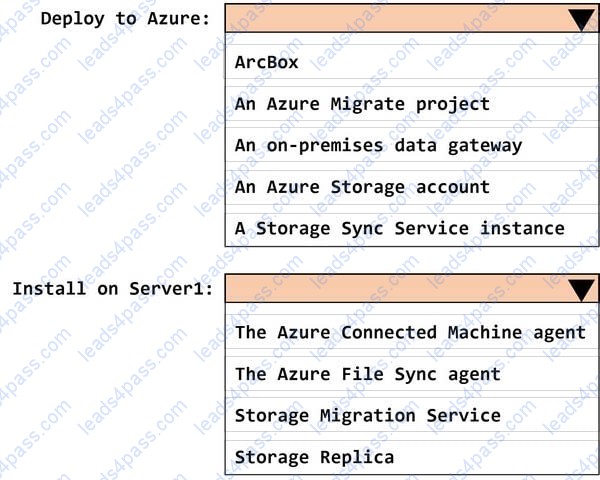
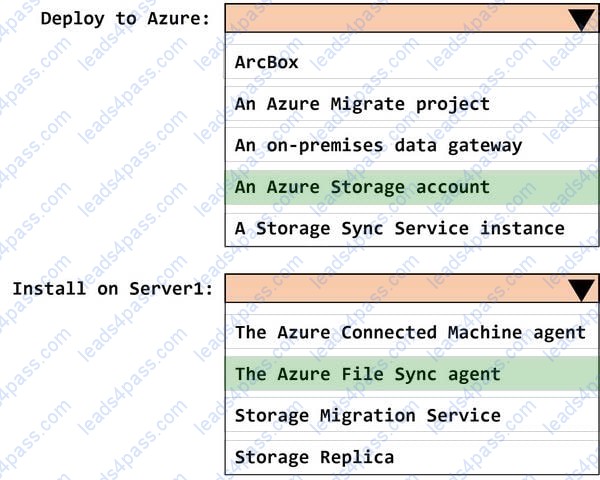
You have an on-premises server that runs Windows Server and contains a folder named Folder1. Folder1 contains 50 GB of files.
You have an Azure subscription that contains an Azure Files share named share1.
You need to migrate the data in Folder1 to share1.
What should you do? To answer, select the appropriate options in the answer area. NOTE: Each correct selection is worth one point.
Hot Area:
DRAG DROP
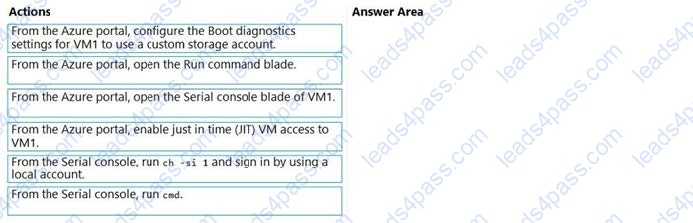
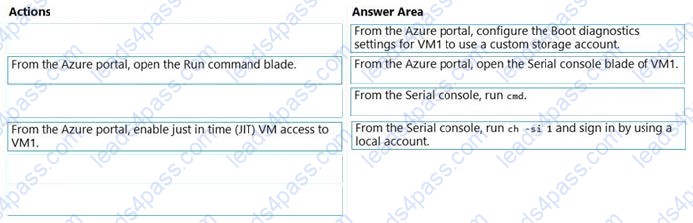
You have an Azure virtual machine named VM1 that runs Windows Server. VM1 has boot diagnostics configured to use a managed storage account.
You are troubleshooting connectivity issue on VM1.
You need to run a PowerShell cmdlet on VM1 by using the Azure Serial Console.
Which four actions should you perform in sequence? To answer, move the appropriate actions from the list of actions to the answer area and arrange them in the correct order.
Select and Place:
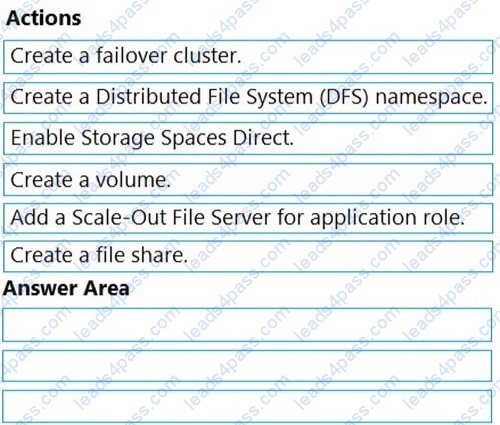
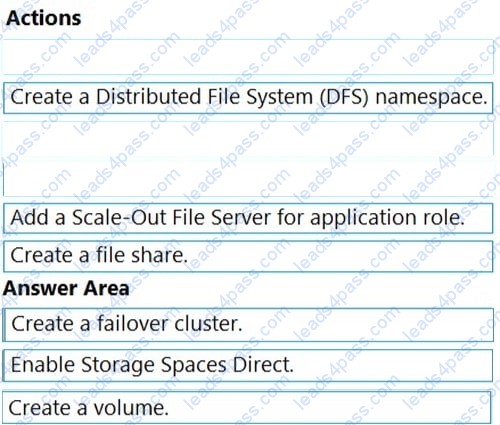
DRAG DROP You need to create a Hyper-V hyper-converged cluster that stores virtual machines by using Storage Spaces Owed Which three actions should you perform in sequence? To answer, move the appropriate anions from the list of actions to the answer area and arrange them in the correct order.
Select and Place:
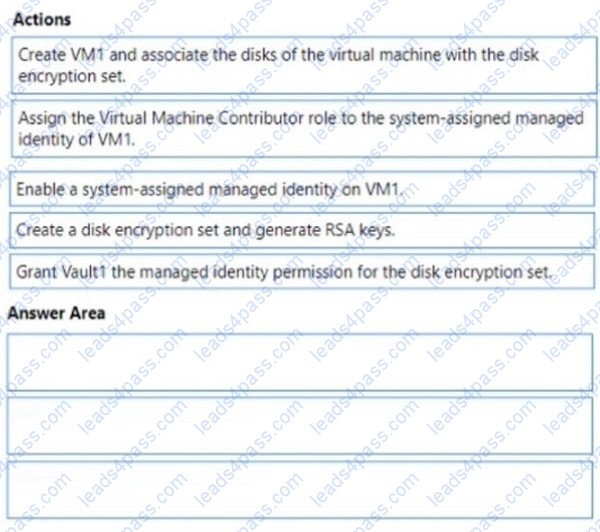
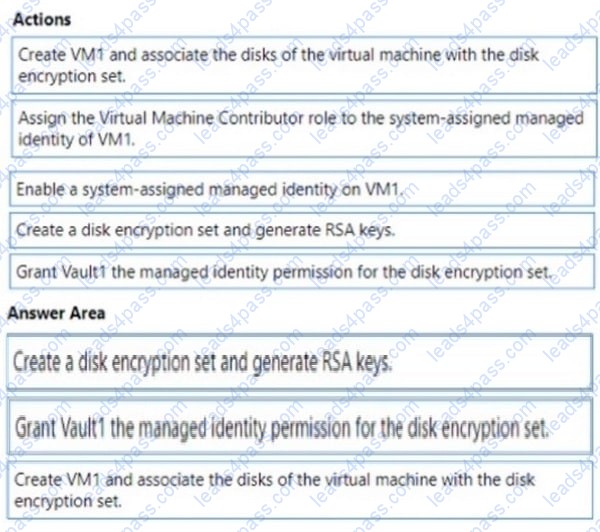
DRAG DROP
You have an Azure subscription that contains an Azure key vault named Vault1.
You plan to deploy a virtual machine named VM1 that will run Windows Server.
You need to enable encryption at host for VM1. The solution must use customer-managed keys.
Which three actions should you perform in sequence? To answer, move the appropriate actions from the list of actions to the answer area and arrange them in the correct order.
Select and Place:
You have three servers named Server 1. Servers and Server3 that run Windows Server. The servers have the Hyper-V server rote installed and are configured in a Storage Spaces Deed cluster named Cluster1.
Cluster1 hosts a virtual machine named VM1 that has Windows Admin Center Installed.
You manage all servers and clusters by using Windows Admin Center.
You purchase an Azure subscription.
You need to configure email alerts in Azure Monitor for the following:
1.
Disk Capacity Utilization Over 80% for 10 Minutes
2.
Any critical alert in the cluster system event log
3.
Memory Utilization over 95% for 10 minutes
4.
Heartbeat fewer than 5 beats for 5 Minutes.
5.
CPU Utilization over 85 % for 10 Minutes.
6.
Any hearth service faults for the cluster
The solution must use the minimum amount of administrative effort.
What should you do?
A. From Windows Admin Center, configure Azure Monitor and onboard Cluster1
B. From Azure portal, configure Azure Monitor and onboard Cluster1 by using Azure Arc.
C. Configure Azure Monitor and manually install the Microsoft Monitoring Agent on Server1, Server2 and Server3
You have a Site-to-Site VPN between an on-premises network and an Azure VPN gateway. BGP is disabled for the Site-to-Site VPN.
You have an Azure virtual network named Vnet1 that contains a subnet named Subnet1. Subnet1 contains a virtual machine named Server1.
You can connect to Server1 from the on-premises network.
You extend the address space of Vnet1. You add a subnet named Subnet2 to Vnet1. Subnet2 uses the extended address space. You deploy an Azure virtual machine named Server2 to Subnet2.
You cannot connect to Server2 from the on-premises network. Server1 can connect to Server2.
You need to ensure that you can connect to Subnet2 from the on-premises network.
What should you do?
A. Add an additional Site-to-Site VPN between the on-premises network and Vnetl.
B. Add a private endpoint to Subnet2.
C. To Subnet2. add a route table that contains a user-defined route.
D. Update the routing information on the on-premises routers.
You have 100 Azure virtual machines that run Windows Server. The virtual machines are onboarded to Microsoft Defender for Cloud.
You need to shut down a virtual machine automatically if Microsoft Defender for Cloud generates the "Antimalware disabled in the virtual machine" alert for the virtual machine.
What should you use in Microsoft Defender for Cloud?
A. a logic app
B. a workbook
C. a security policy
D. adaptive network hardening
You have an Azure virtual machine named VM1 that runs Windows Server.
The operating system on VM1 fails to fully initialize its network stack, and you cannot establish a network connection.
You need to establish an interactive shell session.
What should you use?
A. Azure Bastion
B. Serial console
C. just-in-time (JIT) VM access
Note: This question is part of a series of questions that present the same scenario. Each question in the series contains a unique solution that might meet the stated goals. Some question sets might have more than one correct solution, while
others might not have a correct solution.
After you answer a question in this section, you will NOT be able to return to it. As a result, these questions will not appear in the review screen.
You have an on-premises server named Server1 that runs Windows Server.
You have a Microsoft Sentinel instance.
You add the Windows Firewall data connector in Microsoft Sentinel.
You need to ensure that Microsoft Sentinel can collect Windows Firewall logs from Server1.
Solution: You install the Microsoft Integration Runtime on Server1.
Does this meet the goal?
A. Yes
B. No





All rights are reserved by
leads4pass.com. Any changes, copy or trademarks abuse will be
regarded as infringement.
leads4pass.com will reserve the right to pursue accountability.
Copyright © 2004-
2026 leads4pass.com.