
ASSOCIATE-CLOUD-ENGINEER Online Practice Questions and Answers
You have an App Engine application serving as your front-end. It's going to publish messages to Pub/Sub. The Pub/Sub API hasn't been enabled yet. What is the fastest way to enable the API?
A. Use a service account to auto-enable the API.
B. Enable the API in the Console.
C. Application's in App Engine don't require external APIs to be enabled.
D. The API will be enabled the first time the code attempts to access Pub/Sub.
Regarding audit logs, which of the following is a Google recommended best practice?
A. Export your audit logs to App Engine
B. Export your audit logs to Pub/Sub.
C. Flush your audit logs monthly so you can more easily notice security events.
D. Export your audit logs to Cloud Storage and store them for a long period of time.
You have sensitive data stored in three Cloud Storage buckets and have enabled data access logging. You want to verify activities for a particular user for these buckets, using the fewest possible steps. You need to verify the addition of metadata labels and which files have been viewed from those buckets. What should you do?
A. Using the GCP Console, filter the Activity log to view the information.
B. Using the GCP Console, filter the Stackdriver log to view the information.
C. View the bucket in the Storage section of the GCP Console.
D. Create a trace in Stackdriver to view the information.
You want to run a single caching HTTP reverse proxy on GCP for a latency-sensitive website. This specific reverse proxy consumes almost no CPU. You want to have a 30-GB in-memory cache, and need an additional 2 GB of memory for the rest of the processes. You want to minimize cost. How should you run this reverse proxy?
A. Create a Cloud Memorystore for Redis instance with 32-GB capacity.
B. Run it on Compute Engine, and choose a custom instance type with 6 vCPUs and 32 GB of memory.
C. Package it in a container image, and run it on Kubernetes Engine, using n1-standard-32 instances as nodes.
D. Run it on Compute Engine, choose the instance type n1-standard-1, and add an SSD persistent disk of 32 GB.
You want to deploy an application on Cloud Run that processes messages from a Cloud Pub/Sub topic. You want to follow Google-recommended practices. What should you do?
A. 1. Create a Cloud Function that uses a Cloud Pub/Sub trigger on that topic.
2. Call your application on Cloud Run from the Cloud Function for every message.
B. 1. Grant the Pub/Sub Subscriber role to the service account used by Cloud Run.
2.
Create a Cloud Pub/Sub subscription for that topic.
3.
Make your application pull messages from that subscription.
C. 1. Create a service account.
2.
Give the Cloud Run Invoker role to that service account for your Cloud Run application.
3.
Create a Cloud Pub/Sub subscription that uses that service account and uses your Cloud Run application as the push endpoint.
D. 1. Deploy your application on Cloud Run on GKE with the connectivity set to Internal.
2.
Create a Cloud Pub/Sub subscription for that topic.
3.
In the same Google Kubernetes Engine cluster as your application, deploy a container that takes the messages and sends them to your application.
You want to find out when users were added to Cloud Spanner Identity Access Management (IAM) roles on your Google Cloud Platform (GCP) project. What should you do in the GCP Console?
A. Open the Cloud Spanner console to review configurations.
B. Open the IAM and admin console to review IAM policies for Cloud Spanner roles.
C. Go to the Stackdriver Monitoring console and review information for Cloud Spanner.
D. Go to the Stackdriver Logging console, review admin activity logs, and filter them for Cloud Spanner IAM roles.
Your customer has implemented a solution that uses Cloud Spanner and notices some read latency-related performance issues on one table. This table is accessed only by their users using a primary key. The table schema is shown below.
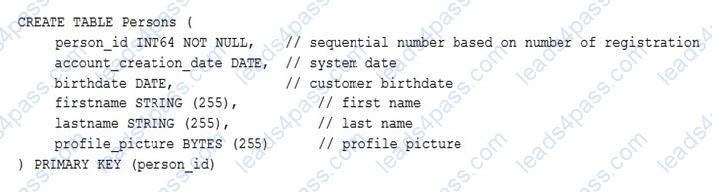
You want to resolve the issue. What should you do?
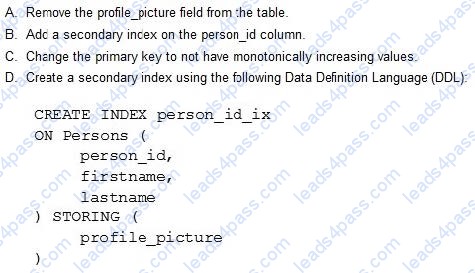
A. Option A
B. Option B
C. Option C
D. Option D
You are in charge of provisioning access for all Google Cloud users in your organization. Your company recently acquired a startup company that has their own Google Cloud organization. You need to ensure that your Site Reliability Engineers (SREs) have the same project permissions in the startup company's organization as in your own organization. What should you do?
A. In the Google Cloud console for your organization, select Create role from selection, and choose destination as the startup company's organization
B. In the Google Cloud console for the startup company, select Create role from selection and choose source as the startup company's Google Cloud organization.
C. Use the gcloud iam roles copy command, and provide the Organization ID of the startup company's Google Cloud Organization as the destination.
D. Use the gcloud iam roles copy command, and provide the project IDs of all projects in the startup company s organization as the destination.
You have deployed an application on a Compute Engine instance. An external consultant needs to access the Linux-based instance. The consultant is connected to your corporate network through a VPN connection, but the consultant has no Google account.
What should you do?
A. Instruct the external consultant to use the gcloud compute ssh command line tool by using Identity- Aware Proxy to access the instance.
B. Instruct the external consultant to use the gcloud compute ssh command line tool by using the public IP address of the instance to access it.
C. Instruct the external consultant to generate an SSH key pair, and request the public key from the consultant. Add the public key to the instance yourself, and have the consultant access the instance through SSH with their private key.
D. Instruct the external consultant to generate an SSH key pair, and request the private key from the consultant. Add the private key to the instance yourself, and have the consultant access the instance through SSH with their public key.
You are deploying a web application using Compute Engine. You created a managed instance group (MIG) to host the application. You want to follow Google-recommended practices to implement a secure and highly available solution. What should you do?
A. Use SSL proxy load balancing for the MIG and an A record in your DNS private zone with the load balancer's IP address.
B. Use SSL proxy load balancing for the MIG and a CNAME record in your DNS public zone with the load balancer's IP address.
C. Use HTTP(S) load balancing for the MIG and a CNAME record in your DNS private zone with the load balancer's IP address.
D. Use HTTP(S) load balancing for the MIG and an A record in your DNS public zone with the load balancer's IP address.





All rights are reserved by
leads4pass.com. Any changes, copy or trademarks abuse will be
regarded as infringement.
leads4pass.com will reserve the right to pursue accountability.
Copyright © 2004-
2026 leads4pass.com.