
ASSOCIATE-ANDROID-DEVELOPER Online Practice Questions and Answers
DRAG DROP
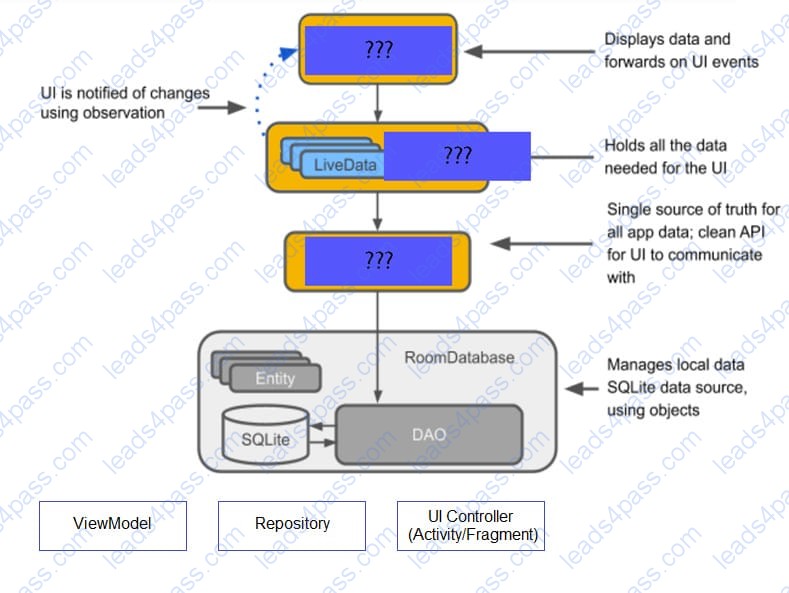
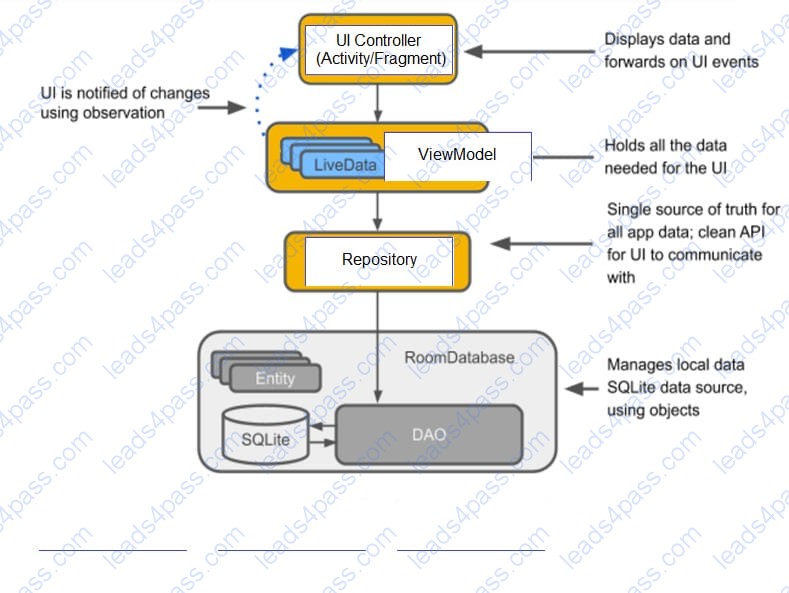
The diagram below shows a basic form of the recommended architecture for apps that use Architecture Components. The architecture consists of a UI controller, a ViewModel that serves LiveData, a Repository, and a Room database. Drag modules to correct places.
Select and Place:
DRAG DROP
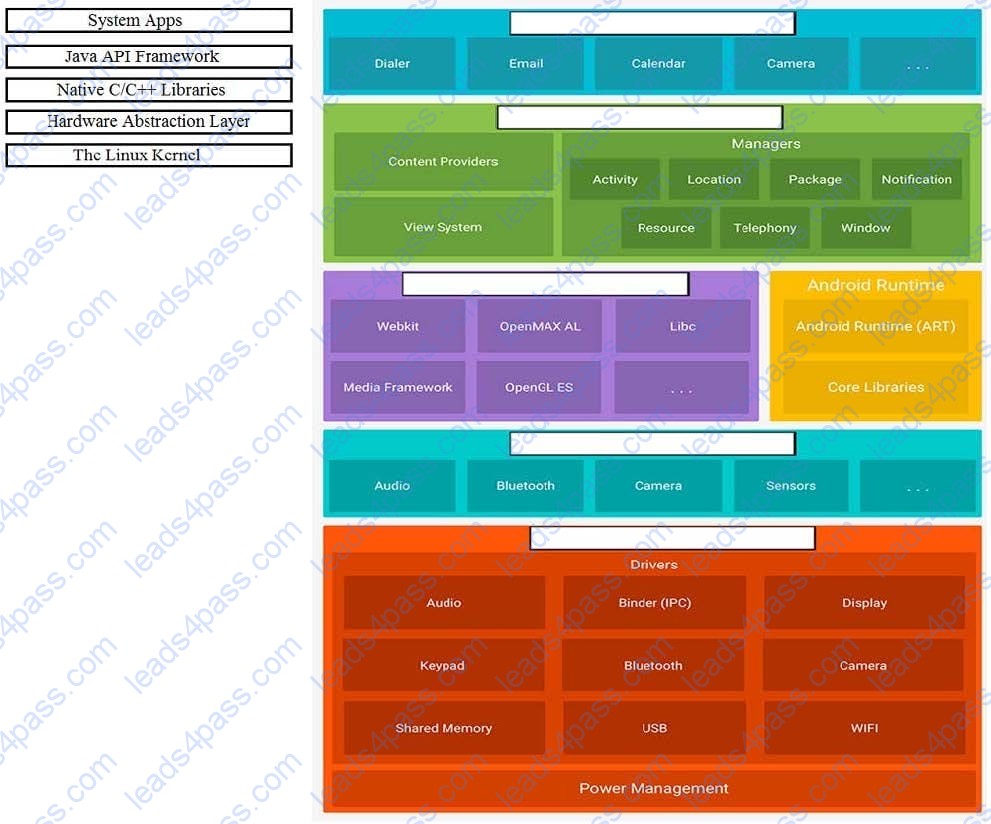
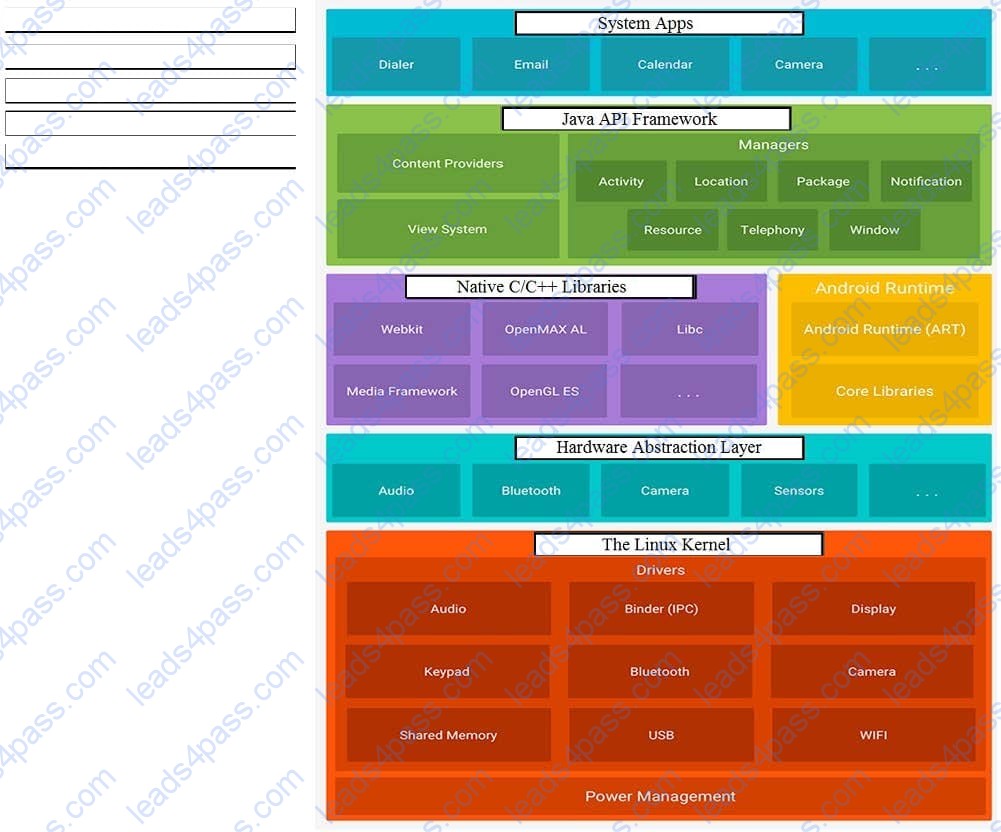
Move the major components of the Android platform to correct places in diagram.
Select and Place:
What is a correct part of an Implicit Intent for sharing data implementation?
A. val sendIntent = Intent(this, UploadService::class.java).apply { putExtra(Intent.EXTRA_TEXT, textMessage) ...
B. val sendIntent = Intent().apply { type = Intent.ACTION_SEND; ...
C. val sendIntent = Intent(this, UploadService::class.java).apply { data = Uri.parse(fileUrl) ...
D. val sendIntent = Intent().apply { action = Intent.ACTION_SEND ...
In our TeaViewModel class, that extends ViewModel, we have such prorerty: val tea: LiveData
An observer in our Activity (type of mViewModel variable in example is TeaViewModel) is set in this way:
mViewModel!!.tea.observe(this, Observer { tea: Tea? -> displayTea(tea) })
What will be a correct displayTea method definition?
A. private fun displayTea()
B. private fun displayTea(tea: Tea?)
C. private fun displayTea(tea: LiveData?
D. private fun displayTea(tea: LiveData?
Each time your test invokes onView(), Espresso waits to perform the corresponding UI action or assertion until the following synchronization conditions are met: (Choose three.)
A. The message queue is empty.
B. The message queue is not empty.
C. There are some instances of AsyncTask currently executing a task.
D. There are no instances of AsyncTask currently executing a task.
E. Some developer-defined idling resources are not idle.
F. All developer-defined idling res
Filter logcat messages. If in the filter menu, a filter option "Show only selected application"? means:
A. Display the messages produced by the app code only (the default). Logcat filters the log messages using the PID of the active app.
B. Apply no filters. Logcat displays all log messages from the device, regardless of which process you selected.
C. Create or modify a custom filter. For example, you could create a filter to view log messages from two apps at the same time.
What statements about InputStreamReader (java.io.InputStreamReader) are correct? (Choose two.)
A. An InputStreamReader is a bridge from byte streams to character streams: It reads bytes and decodes them into characters using a specified charset. The charset that it uses may be specified by name or may be given explicitly, or the platform's default charset may be accepted.
B. An InputStreamReader is a bridge from character streams to byte streams: It reads characters using a specified charset and encodes them into bytes. The charset that it uses may be specified by name or may be given explicitly, or the platform's default charset may be accepted.
C. Each invocation of one of an InputStreamReader's read() methods may cause one or more bytes to be read from the underlying byte-input stream. To enable the efficient conversion of bytes to characters, more bytes may be read ahead from the underlying stream than are necessary to satisfy the current read operation.
D. No any invocation of one of an InputStreamReader's read() methods can cause some bytes to be read from the underlying byte-input stream.
By executing an allowMainThreadQueries() method to the room database builder RoomDatabase.Builder, we can:
A. set the database factory
B. handle database first time creation
C. handle database opening
D. disable the main thread query check for Room
LiveData.postValue() and LiveData.setValue() methods have some differences. So if you have a following code executed in the main thread:
liveData.postValue("a"); liveData.setValue("b");
What will be the correct statement?
A. The value "b" would be set at first and later the main thread would override it with the value "a".
B. The value "a" would be set at first and later the main thread would override it with the value "b".
C. The value "b" would be set at first and would not be overridden with the value "a".
D. The value "a" would be set at first and would not be overridden with the value "b".
Choose the most correct statement.
A. Android is a closed source, Linux-based software stack created for a wide array of devices and form factors.
B. Android is a closed source, Windows-based software stack created for a wide array of devices and form factors.
C. Android is an open source, Linux-based software stack created for a wide array of devices and form factors.
D. Android is an open source software stack created for a highly limited array of devices and form factors.





All rights are reserved by
leads4pass.com. Any changes, copy or trademarks abuse will be
regarded as infringement.
leads4pass.com will reserve the right to pursue accountability.
Copyright © 2004-
2026 leads4pass.com.