
ACP-100 Online Practice Questions and Answers
The configuration details of an SMTP Mail Server of a Jira instance are shown below. The configuration hasn't been changed in the last 24 months.
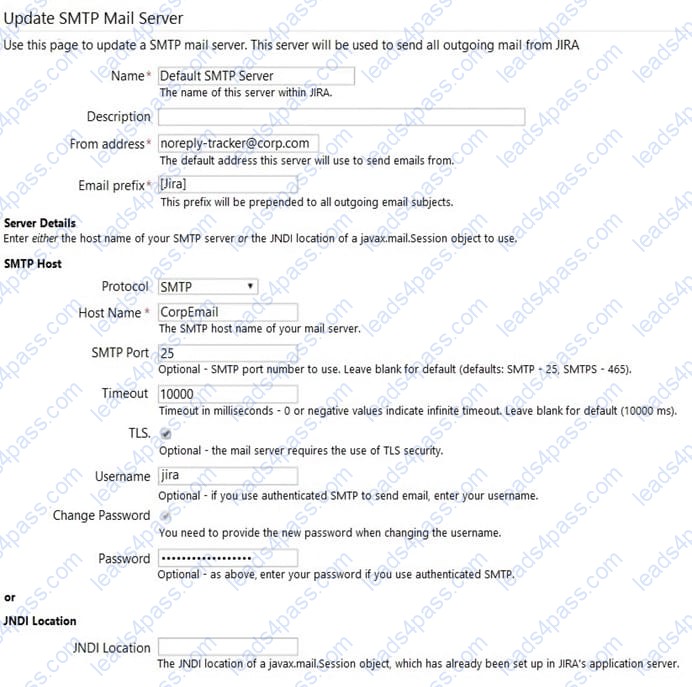
Currently emails are no longer being sent and the failed notifications can be seen in the Mail Error Queue.
What is the likely cause of the failure?
A. Email volume has increased and the Timeout is too low.
B. The SMTP password has expired.
C. The user jira has no valid Jira license.
D. The database and/or server disk is full.
E. The Jira license has expired.
You have planned, tested, and performed a Jira upgrade.
The upgrade appeared to be a success; however, after several hours of use, your users are reporting
significant problems and you decide to roll back.
Which two effects do you expect to see after the rollback? (Choose two.)
A. Emails will automatically be sent out to tell people about the rollback.
B. New issues entered between upgrade and rollback will be lost.
C. The color scheme will be set back to default to indicate there was a rollback.
D. Jira will go back to the same schemes as before the upgrade.
E. Jira will need to be reconnected to other systems it was integrated with.
Beehive Bank wants to implement Jira with the following requirements:
Enforce the strictest possible security measures for user logins.
Allow external users to create their own user logins.
Use the Jira Internal Directory.
Which two login security options can you offer them? (Choose two.)
A. Set Login Mode to Secure.
B. Require character variety for the user name.
C. Require that a password is not too similar to another user's password.
D. Require a certain length for passwords.
E. Require that a password is not too similar to the user name or email address.
You install a new Jira instance using only the default configurations. A team approaches you to set up a
project with the following specifications:
There are four standard issue types and three sub-task issue types.
The first sub-task will need a new screen for the Edit operation.
The second sub-task will need new screens for both the Create and Edit operations.
Everything else should use the default configurations.
How many new Screen Schemes do you need to create?
A. 7
B. 4
C. 1
D. 3
E. 2
A project has hundreds of old completed issues which are cluttering up the reports, searches, and dashboards.
The project administrator has the following requirements:
1.
He wants to hide the old issues.
2.
He wants to unhide issues, if needed.
3.
He wants to control whether he himself sees the hidden issues, so they do not clutter his own daily work. Which three configurations, when combined, will meet these requirements? (Choose three.)
A. security level
B. project permission
C. workflow condition
D. project role
E. global permission
F. group
A medical clinic has decided to use Jira. Their project will allow patients to file medical complaints.
The requirements for the project are as follows:
Members of the group (jira-patients) must be able to see only their own complaints. Members of the group (medical-board) must be able to see all complaints.
Based only on these two requirements, which two configurations used together will satisfy them? (Choose two.)
A. Implement an issue security scheme with three levels: (#1) Group (jira-patients), (#2) Reporter, and (#3) Group (medical-board).
B. Implement an issue security scheme with two levels: (#1) Reporter and (#2) Group (medical-board).
C. In the permission scheme, add Reporter and Group (anonymous) to Browse Projects and Create Issues.
D. In the permission scheme, add Group (jira-patients) and Group (medical-board) to Browse Projects and Create Issues permissions.
E. Implement an issue security scheme with one level: Reporter and Group (medical-board).
You needed to replace the legacy Jira group all-staff-europe with a newly created all-staff-global group.
You created the new group and you migrated all users to the new group.
Then you deleted the legacy group.
Which four problems might users report after the change? (Choose four.)
A. Filter subscriptions send out errors instead of issues statistics.
B. Workflow transitions are hidden from certain users.
C. Users are not able to perform bulk change operations.
D. Users are not able to log in to Jira anymore.
E. Comments that were restricted to the legacy group are lost.
F. Filter results return an incorrect number of issues.
You need to make the following changes to an existing workflow:
1.
A transition should only be available if code has been committed against the issue.
2.
Only users in a specific project role can see a transition
3.
Issues must not be commented on in a specific status.
4.
The resolution should be set automatically.
5.
A transition should send out a specific notification email.
Which workflow elements will you use to implement the desired changes?
A. 1 condition, 1 validator, 2 post functions, 1 property
B. 2 conditions, 2 validators, 1 property
C. 1 condition, 1 validator, 1 post function, 2 properties
D. 2 validators, 2 post functions, 1 property
E. 2 conditions, 2 post functions, 1 property
A user says she can see the Ready for Testing transition but cannot successfully execute it.
Why can't the user execute this transition?
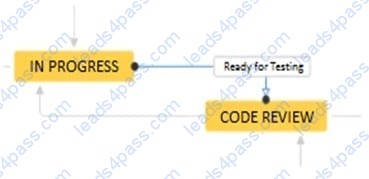
A. The status property of Code Review prevents the Developer role from executing the transition.
B. A Condition on the transition requires the user to be in the Developer role.
C. A Validator on the workflow transition requires the user to be in the Developer role.
D. The status property of In Progress prevents the Developer role from executing the transition.
Your marketing group is using Jira to track media print advertisements. They would like to track TV and radio commercials as well.
The same team handles all three formats, but each format requires a unique workflow. The team would like to keep everything on the same dashboard, and they will also be using the same permissions, notifications and screens.
Without using third-party apps, how should you configure Jira to meet these requirements?
A. Clone the existing project and key for TV and Radio.
B. Copy the existing permissions and notification schemes, and associate them with new projects for TV and Radio.
C. Create a sub-component hierarchy.
D. Create two new projects for TV and Radio.
E. Add TV and Radio into the existing project as components.
F. Use issue types of Print, Radio and TV in the existing project.





All rights are reserved by
leads4pass.com. Any changes, copy or trademarks abuse will be
regarded as infringement.
leads4pass.com will reserve the right to pursue accountability.
Copyright © 2004-
2026 leads4pass.com.