
ACLS Online Practice Questions and Answers
You have been unsuccessful in the first two attempts to defibrillate an adult. The energy for the third defibrillation attempt is
A. 50 J
B. 100 J
C. 200–300 J
D. 360 J
A patient has the following rhythm refractory to adenosine IV and verapamil IV. Before treatment, the heart rate was 200 beats/min and his blood pressure was 110/70 mm Hg. After treatment, the heart rate remains at 200 beats/minute and the blood pressure is 60 mm Hg systolic. What should the immediate treatment be?

A. atropine 0.5 mg IV
B. dopamine drip IV
C. synchronized cardioversion at 50–100 J
D. verapamil 10 mg IV over 1–2 minutes
T/F: Sodium bicarbonate is recommended early in cardiac arrest management.
A. False
B. True
Which of the following patients require intubation? (Choose two.)
A. conscious with a suspected stroke
B. unconscious with no gag reflex
C. normotensive with third degree heart block
D. cardiac arrest after three unsuccessful countershocks
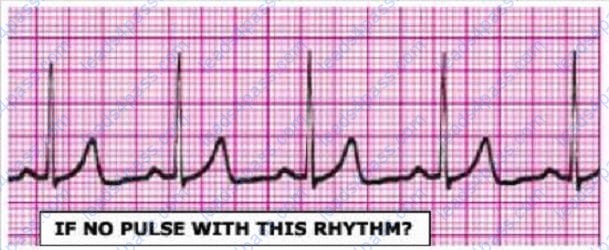
Identify the rhythm by selecting the best single answer:
A. Normal sinus rhythm
B. Sinus tachycardia
C. Sinus bradycardia D. Reentry supraventricular tachycardia
E. First-degree AV Block
F. Second-degree AV Block (Mobitz 1 Wenckebach)
G. Second-degree AV Block (Mobitz II Block)
H. Third-degree AV Block
I. Atrial fibrillation
J. Atrial flutter
K. Monomorphic ventricular tachycardia
L. Polymorphic ventricular tachycardia
M. Coarse ventricular fibrillation
N. Fine ventricular fibrillation
O. Agonal rhythm/asystole
P. Pulseless electrical activity
FILL BLANK
During cardiac arrest from pulseless electrical activity, the exam reveals distended neck veins. How should cardiac tamponade be ruled out?
A. Pericardiocentesis
SIMULATION
Describe the major function of the aorta.
A. The aorta is the major artery originating from the heart and lying in front of the spine in the thoracic and abdominal cavities. This provides blood flow to the rest of the vascular system in the body.
SIMULATION
Describe the skin of a patient suffering from hypothermia.
A. A patient suffering from hypothermia may exhibit skin that is both red in the early stages of hypothermia and, as hypothermia progresses; the skin will become pale, even cyanotic. Its texture may also become stiff and hard.
SIMULATION
What local issues may affect consent for treating children and mentally incompetent adults?
A. Emancipation issues and state regulations regarding the age of minors.
FILL BLANK
How often should you repeat ventilations on a child?
A. Every 3 seconds





All rights are reserved by
leads4pass.com. Any changes, copy or trademarks abuse will be
regarded as infringement.
leads4pass.com will reserve the right to pursue accountability.
Copyright © 2004-
2026 leads4pass.com.