
A00-212 Online Practice Questions and Answers
Given the SAS data sets ONE and TWO:
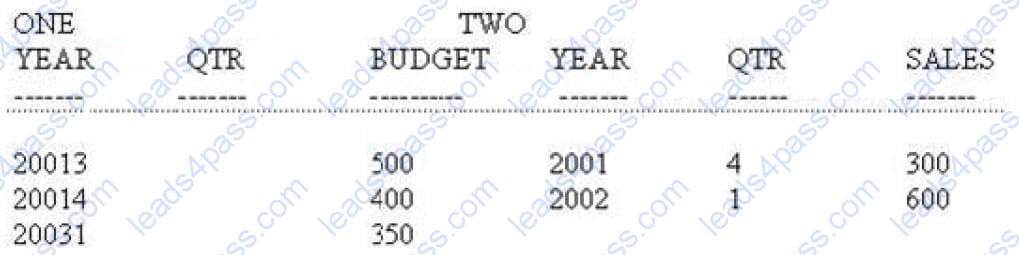
The following SAS program is submitted:
Proc sql;
Select two.*,budget from one
Quit;
The following output is desired:
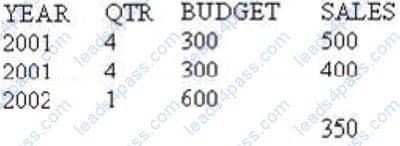
Which JOIN operator completes the program and generates the desired output?
A. FULL JOIN
B. INNER JOIN
C. LEFT JOIN
D. RIGHT JOIN
Which SQL procedure program deletes rows from the data set CLASS?
A. proc sql; Select * from class Where age<(select stop_age from threshold); Quit;
B. proc sql; Modify table class Delete where age<(select stop_age from threshold); Quit
C. proc sql; Delete from class Where age<(select stop_age from threshold); Quit;
D. proc sql; Alter from class Delete where age<(select stop_age from threshold); Quit;
Given the following scenario:
The SAS libraries LIBRARY and MYLIB are successfully defined in your current SAS session.
There is a SAS Data Set named WORK.GENDERS with a column called MF containing single character values.
The SAS program on the left is submitted and the desired output is shown in the right.
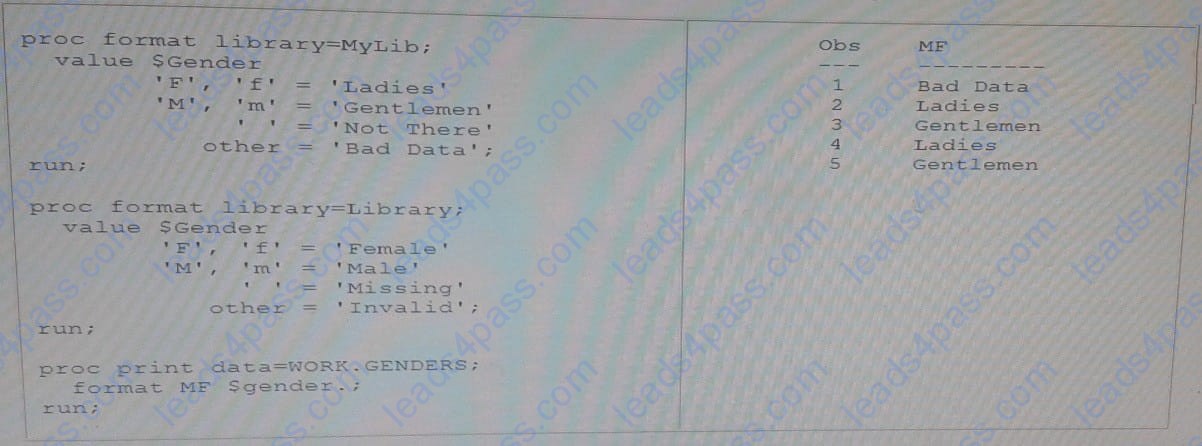
Which statement is true?
A. The statement OPTIONS FMTSEARCH = (Mylib Library); is required before the PRINT procedure to attain the resulting output
B. The statement OPTIONS FMSEARCH = (Library Mylib); is required before the PRINT procedure to attain the resulting output
C. No OPTIONS FMSEARCH ( ) statement is needed to attain resulting output
D. The statement OPTIONS FMSEARCH = (Mylib); is required before the print procedure to attain the resulting output
Given the data set SASHELP.CLASS SASHELP.CLASS NAME AGE Mary 15 Philip 16 Robert 12 Ronald 15 The following SAS program is submitted %let value = Philip; proc print data =sashelp.class;
A. Where upcase(name)="upcase(andvalue)";
B. Where upcase(name)="%upcase(andvalue)";
C. Where upcase(name)=upcase(andvalue);
D. Where upcase(name)=%upcase(andvalue);
Given the following SAS data set ONE:
ONE
DIVISION SALES
A 1234
A 3654
B 5678
The following SAS program is submitted:
data _null_;
set one;
by division;
if first.division then
call symput('mfirst',sales);
if last.division then
call symput('mlast',sales);
run;
Which one of the following is the value of the macro variable MFIRST when the above program finishes execution?
A. null
B. 1234
C. 3654
D. 5678
Given the following SAS data sets ONE and TWO:
ONE TWO
NUM CHAR1 NUM CHAR2
1 A1 2 X1
1 A2 2 X2
2 B1 3 Y
2 B2 5 V
4 D
The following SAS program is submitted creating the output table THREE:
proc sql; create table three as
select one.num, char1, char2
from one, two
where one.num = two.num;
quit;
THREE
NUM CHAR1 CHAR2
2 B1 X1
2 B1 X2
2 B2 X1
2 B2 X2
Which one of the following DATA step programs creates an equivalent SAS data set THREE?
A. data three; merge one two; by num; run;
B. data three; set one; set two; by num; run; merge one two; by num; run;
C. data three; set one; set two; by num; run; by num; run;
D. data three; set one; do i = 1 to numobs; set two(rename = (num = num2)) point = i nobs = numobs; if num2 = num then output; end; drop num2; run;
The following SAS program is submitted:
date view=sauser.ranch;
describe;
run;
What is the result?
A. The program creates a DATA step view called SASUSER.RANCH and places the program cod in the current editor window
B. The program retrieves the SAS source code that creates the view and places it in the output window
C. The program creates a DATA step view called SASUSER.RANCH and places it in the SAS log
D. the program retrieves the SAS source code that creates the view and places it in the SAS log
Given the following SAS statement: %let idcode = Prod567;
Which one of the following statements stores the value 567 in the macro variable CODENUM?
A. %let codenum = substr(andidcode,length(andidcode)-2);
B. %let codenum = substr(andidcode,length(andidcode)-3);
C. %let codenum = %substr(andidcode,%length(andidcode)-2);
D. %let codenum = %substr(andidcode,%length(andidcode)-3);
The following SAS program is submitted:
%macro test(var);
%let jobs = BLACKSMITH WORDSMITH SWORDSMITH;
%let type = %index(andjobs,andvar);
%mend;
%test(SMITH)
Which one of the following is the resulting value of the macro variable TYPE?
A. 0
B. 3
C. 6
D. null
Given the following SAS data set ONE: ONE JOB LEVEL SALARY ACC 2 300 SEC 1 100 SEC 2 200 MGR 3 700 ACC 1 . ACC 3 . MGR 2 400 The following SAS data set TWO is created: TWO JOB LEVEL BONUS ACC 2 30 MGR 3 70 MGR 2 40 Which one of the following SAS programs creates data set TWO?
A. proc sql; create table two as select job, level, salary * 0.1 as bonus from one where bonus > 20; quit;
B. proc sql; create table two as select job, level, salary * 0.1 as bonus from one where salary > 20; quit;
C. proc sql; create table two as select job, level, salary * 0.1 as bonus from one where calculated salary * 0.1 > 20; quit;
D. proc sql;D.proc sql; create table two as select job, level, salary * 0.1 as bonus from one where calculated bonus > 20; quit;





All rights are reserved by
leads4pass.com. Any changes, copy or trademarks abuse will be
regarded as infringement.
leads4pass.com will reserve the right to pursue accountability.
Copyright © 2004-
2026 leads4pass.com.