
70-762 Online Practice Questions and Answers
Note: This question is part of a series of questions that use the same scenario. For your convenience, the scenario is repeated in each question. Each question presents a different goal and answer choices, but the text of the scenario is exactly the same in each question in this series.
You have a database named DB1 that contains the following tables: Customer, CustomerToAccountBridge, and CustomerDetails. The three tables are part of the Sales schema. The database also contains a schema named Website. You create the Customer table by running the following Transact-SQL statement: The value of the CustomerStatus column is equal to one for active customers. The value of the Account1Status and Account2Status columns are equal to one for active accounts. The following table displays selected columns and rows from the Customer table.
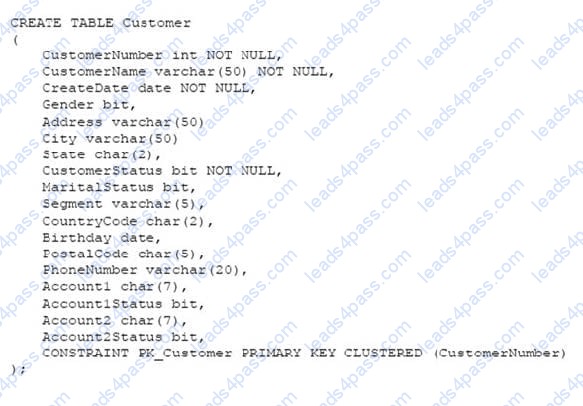

You plan to create a view named Website.Customer and a view named Sales.FemaleCustomers.
Website.Customer must meet the following requirements:
Allow users access to the CustomerName and CustomerNumber columns for active customers.
Allow changes to the columns that the view references. Modified data must be visible through the view.
Prevent the view from being published as part of Microsoft SQL Server replication.
Sales.Female.Customers must meet the following requirements:
Allow users access to the CustomerName, Address, City, State and PostalCode columns.
Prevent changes to the columns that the view references.
Only allow updates through the views that adhere to the view filter.
You have the following stored procedures: spDeleteCustAcctRelationship and spUpdateCustomerSummary. The spUpdateCustomerSummary stored procedure was created by running the following Transacr-SQL statement:
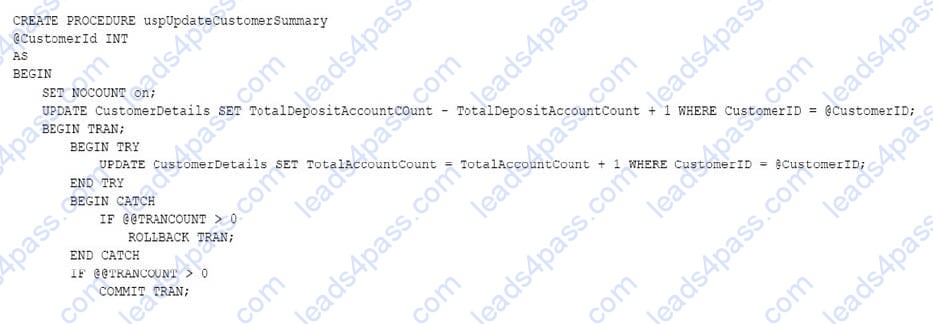
You run the uspUpdateCustomerSummary stored procedure to make changes to customer account summaries. Other stored procedures call the spDeleteCustAcctRelationship to delete records from the CustomerToAccountBridge table.
When you start uspUpdateCustomerSummary, there are no active transactions. The procedure fails at the second update statement due to a CHECK constraint violation on the TotalDepositAccountCount column.
What is the impact of the stored procedure on the CustomerDetails table?
A. A. The value of the TotalAccountCount column decreased.
B. The value of the TotalDepositAccountCount column is not changed.
C. The statement that modifies TotalDepositAccountCount is excluded from the transaction.
D. The value of the TotalAccountCount column is not changed.
E. The value of the TotalDepositAccountCount column is increased.
F. The statement that modifies TotalAccountCount column is excluded from the transaction.
G. The value of the TotalDepositAcountCount column is decreased.
Note: This question is part of a series of questions that use the same answer choices. An answer choice may be correct for more than one question on the series. Each question is independent of the other questions in this series. Information
and details provided in a question apply only to that question.
You work on an OLTP database that has no memory-optimized file group defined.
You have a table names tblTransaction that is persisted on disk and contains the information described in the following table:
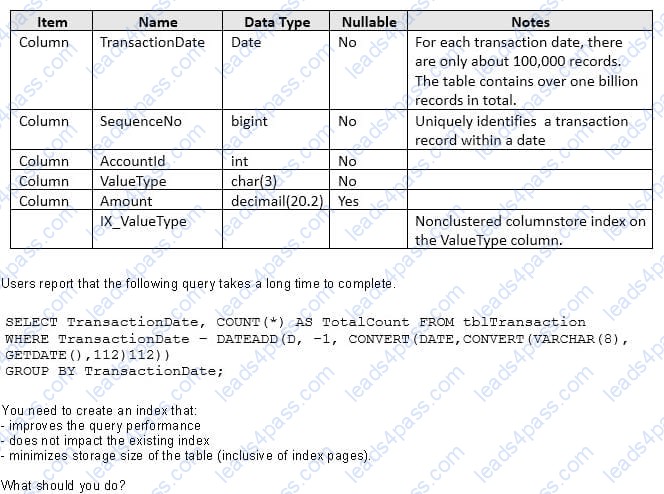
Users report that the following query takes a long time to complete.

You need to create an index that:
-improves the query performance
-does not impact the existing index
- minimizes storage size of the table (inclusive of index pages).
What should you do?
A. Create aclustered index on the table.
B. Create a nonclustered index on the table.
C. Create a nonclustered filtered index on the table.
D. Create a clustered columnstore index on the table.
E. Create a nonclustered columnstore index on the table.
F. Create a hashindex on the table.
Note: This question is part of a series of questions that use the same or similar answer choices. An answer choice may be correct for more than one question in the series. Each question os independent of the other questions in this series. Information and details provided in a question apply only to that question.
You have a database named DB1. There is no memory-optimized filegroup in the database. You run the following query:
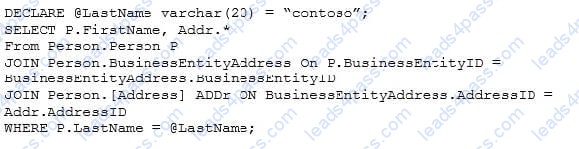
The following image displays the execution plan the query optimizer generates for this query:
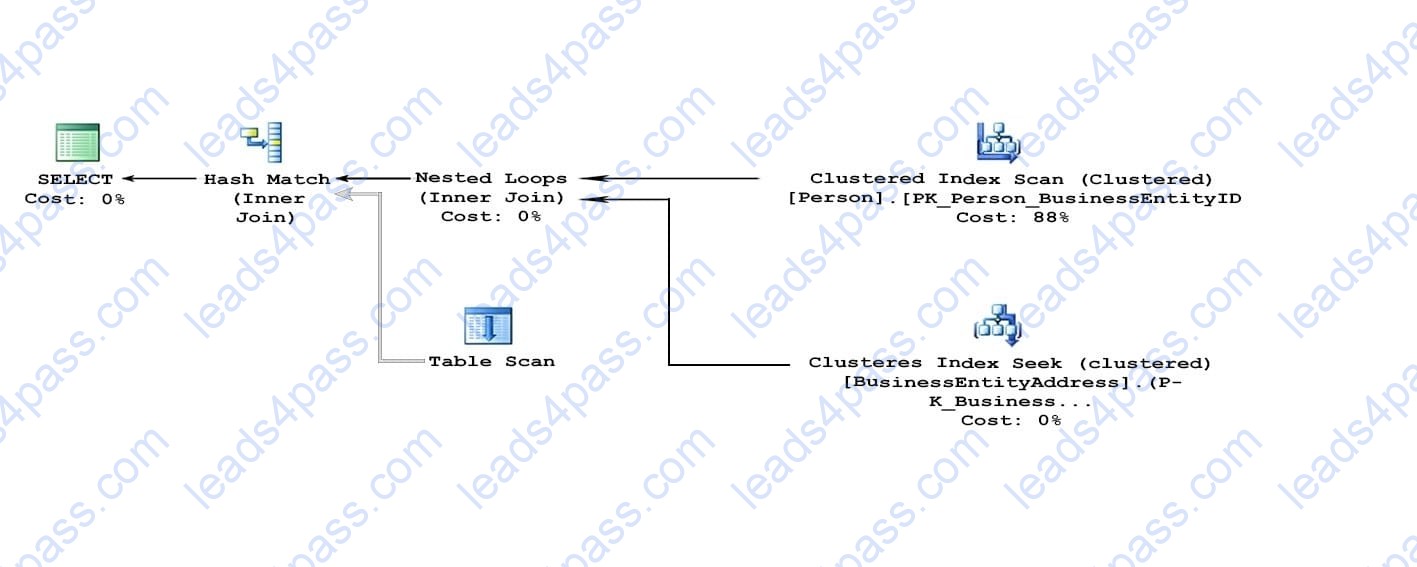
Users frequently run the same query with different values for the local variable @lastName. The table named Person is persisted on disk. You need to create an index on the Person.Person table that meets the following requirements:
1.
All users must be able to benefit from the index.
2.
FirstName must be added to the index as an included column.
What should you do?
A. Create a clustered index on the table.
B. Create a nonclustered index on the table.
C. Create a nonclustered filtered index on the table.
D. Create a clustered columnstore index on the table.
E. Create a nonclustered columnstore index on the table.
F. Create a hash index on the table.
Note: This question is part of a series of questions that use the same or similar answer choices. An Answer choice may be correct for more than one question in the series. Each question independent of the other questions in this series.
Information and details provided in a question apply only to that question.
You are a database developer for a company. The company has a server that has multiple physical disks. The disks are not part of a RAID array. The server hosts three Microsoft SQL Server instances. There are many SQL jobs that run
during off-peak hours.
You must monitor the SQL Server instances in real time and optimize the server to maximize throughput, response time, and overall SQL performance.
What should you do?
A. A. Create asys.dm_os_waiting_tasks query.
B. Create a sys.dm_exec_sessions query.
C. Create a Performance Monitor Data Collector Set.
D. Create a sys.dm_os_memory_objects query.
E. Create a sp_configure `max server memory' query.
F. Create a SQL Profiler trace.
G. Create a sys.dm_os_wait_stats query.
H. Create an Extended Event.
Note: This question is part of a series of questions that present the same scenario. Each question in the series contains a unique solution. Determine whether the solution meets the stated goals.
You have a database that contains a table named Employees. The table stored information about the employees of your company. You need to implement the following auditing rules for the Employees table:
- Record any changes that are made to the data in the Employees table.
-
Customize the data recorded by the audit operations.
Solution: You implement a check constraint on the Employees table.
Does the solution meet the goal?
A.
Yes
B.
No
Note: This question is part of a series of questions that present the same scenario. Each question in the series contains a unique solution. Determine whether the solution meets the stated goals.
You have a database that contains a table named Employees. The table stores information about the employees of your company.
You need to implement and enforce the following business rules:
Limit the values that are accepted by the Salary column.
Prevent salaries less than $15,000 and greater than $300,000 from being entered.
Determine valid values by using logical expressions.
Do not validate data integrity when running DELETE statements.
Solution: You implement a FOR UPDATE trigger on the table.
Does the solution meet the goal?
A. Yes
B. No
Background
You have a database named HR1 that includes a table named Employee.
You have several read-only, historical reports that contain regularly changing totals. The reports use multiple queries to estimate payroll expenses. The queries run concurrently. Users report that the payroll estimate reports do not always run. You must monitor the database to identify issues that prevent the reports from running.
You plan to deploy the application to a database server that supports other applications. You must minimize the amount of storage that the database requires.
Employee Table
You use the following Transact-SQL statements to create, configure, and populate the Employee table:
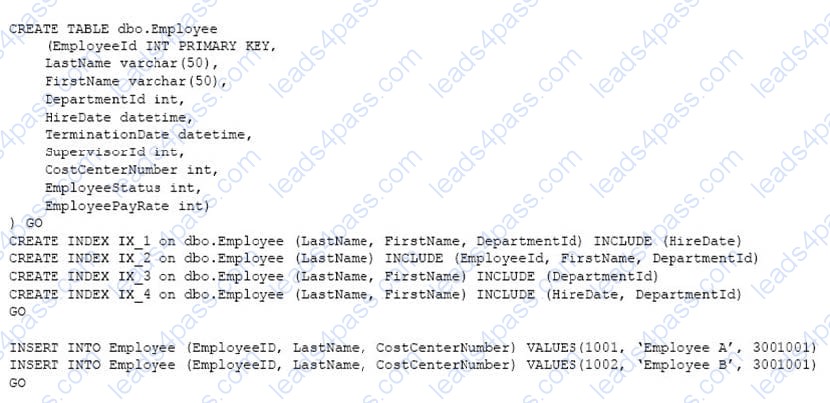
Application
You have an application that updates the Employees table. The application calls the following stored procedures simultaneously and asynchronously:
UspA: This stored procedure updates only the EmployeeStatus column.
UspB: This stored procedure updates only the EmployeePayRate column.
The application uses views to control access to data. Views must meet the following requirements:
Allow user access to all columns in the tables that the view accesses.
Restrict updates to only the rows that the view returns.
Exhibit
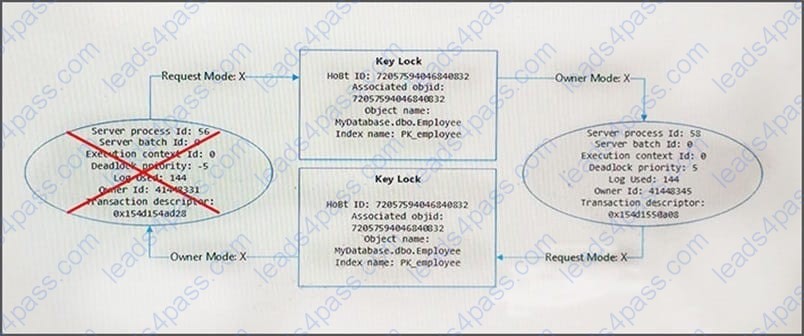
You are analyzing the performance of the database environment. You discover that locks that are held for a long period of time as the reports are generated.
You need to generate the reports more quickly. The database must not use additional resources.
What should you do?
A. Update all FROM clauses of the DML statements to use the IGNORE_CONSTRAINTS table hint.
B. Modify the report queries to use the UNION statement to combine the results of two or more queries.
C. Apply a nonclustered index to all tables used in the report queries.
D. Update the transaction level of the report query session to READ UNCOMMITTED.
You have a relational data warehouse that contains 1 TB of data.
You have a stored procedure named usp_sp1 that generated an HTML fragment. The HTML fragment contains color and font style.
You need to return the HTML fragment.
What should you do?
A. Use the NOLOCK option.
B. Execute the DBCC UPDATEUSAGE statement.
C. Use the max worker threads option.
D. Use a table-valued parameter.
E. Set SET ALLOW_SNAPSHOT_ISOLATION to ON.
F. Set SET XACT_ABORT to ON.
G. Execute the ALTER TABLE T1 SET (LOCK_ESCALATION = AUTO); statement.
H. Use the OUTPUT parameters.
Note: This question is part of a series of questions that present the same scenario. Each question in the series contains a unique solution. Determine whether the solution meets the stated goals.
You need to create a stored procedure that updates the Customer, CustomerInfo, OrderHeader, and OrderDetail tables in order.
You need to ensure that the stored procedure:
Runs within a single transaction.
Commits updates to the Customer and CustomerInfo tables regardless of the status of updates to the OrderHeader and OrderDetail tables.
Commits changes to all four tables when updates to all four tables are successful.
Solution: You create a stored procedure that includes the following Transact-SQL code:
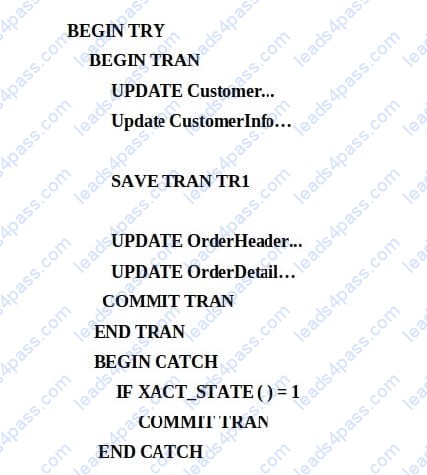
Does the solution meet the goal?
A. Yes
B. No
Note: This question is part of a series of questions that present the same scenario. Each question in the series contains a unique solution. Determine whether the solution meets the stated goals.
You have a database that contains a table named Employees. The table stores information about the employees of your company.
You need to implement and enforce the following business rules:
Limit the values that are accepted by the Salary column.
Prevent salaries less than $15,000 and greater than $300,000 from being entered.
Determine valid values by using logical expressions.
Do not validate data integrity when running DELETE statements.
Solution: You implement a foreign key on the table.
Does the solution meet the goal?
A. Yes
B. No





All rights are reserved by
leads4pass.com. Any changes, copy or trademarks abuse will be
regarded as infringement.
leads4pass.com will reserve the right to pursue accountability.
Copyright © 2004-
2026 leads4pass.com.