
5V0-21.19 Online Practice Questions and Answers
Refer to the exhibit.
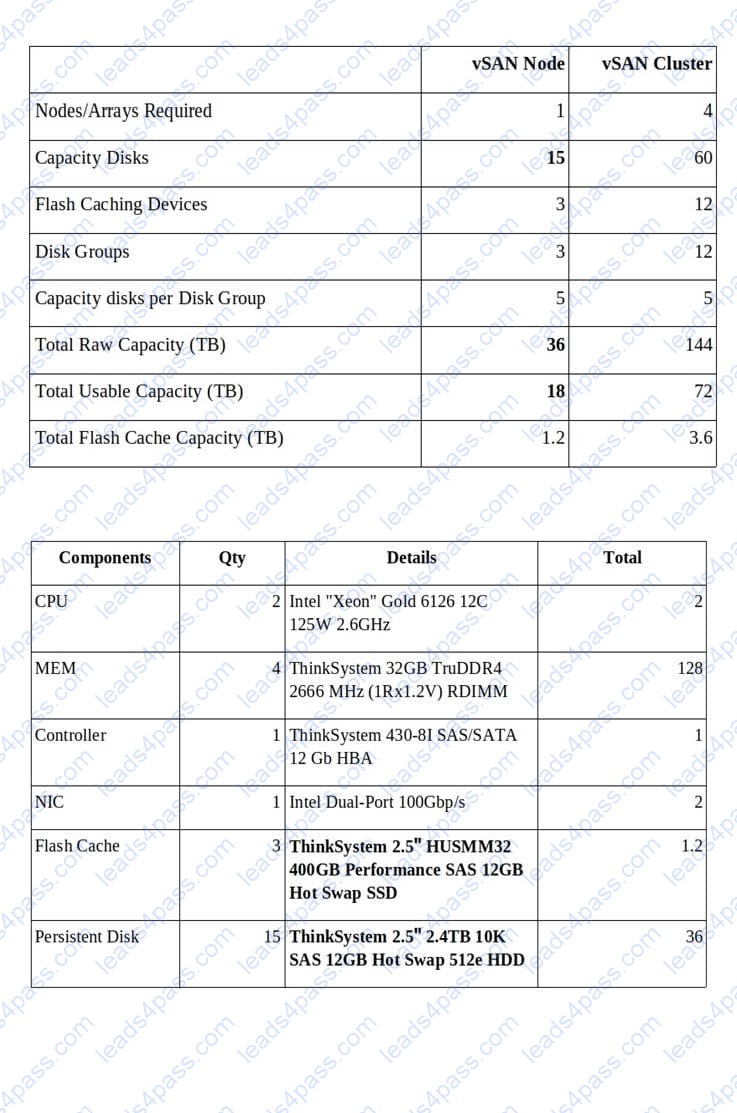
A solution architect is setting up a highly resilient vSAN hybrid cluster. Why is the cache incorrectly sized in this configuration?
A. Cache disk needs to meet vSAN Compatibility Guide
B. Cache-to-capacity ratio needs to be sized lower
C. Cache-to-capacity ratio needs to be sized higher
D. Number of cache disks in disk group is insufficient.
A company implements a vSAN environment with linked clone virtual desktops and homogeneous desktop
operating systems. During the last three months, users have experienced intermittent high latency,
degraded performance, and lockout from desktops.
Which two methods should an administrator use to monitor and respond to the issues? (Choose two.)
A. vRealize Log Insight
B. vRealize Automation
C. Live Optics
D. HCIBench
E. vRealize Operations Manager
An administrator has discovered that space utilized by VMs does not decrease after deleting files and
folders within the VMs. The administrator needs to be able to reclaim this space.
Which action could the administrator perform to accomplish this task?
A. Enable Storage I/O Control.
B. Enable TRIM/UNMAP for the vSAN cluster.
C. Reboot the VM to recreate the swap file.
D. Assign a storage policy with thin provisioning.
The vSAN host memory needs to be replaced and the entire operation is expected to take 90-120 minutes. Which vSAN advanced setting can be adjusted to avoid rebuild operations during the host hardware maintenance?
A. Site Read Locality
B. Forced Provisioning
C. Object Repair Timer
D. Thin Swap
A vSAN administrator is building a new vSAN cluster and each host only has two physical uplinks
configured in a team.
What can the administrator use to ensure vSAN receives the necessary bandwidth while maintaining high
availability?
A. Route based on IP hash
B. A dedicated uplink for vSAN traffic
C. Shared uplinks for all traffic
D. Network I/O control
Refer to the exhibit.
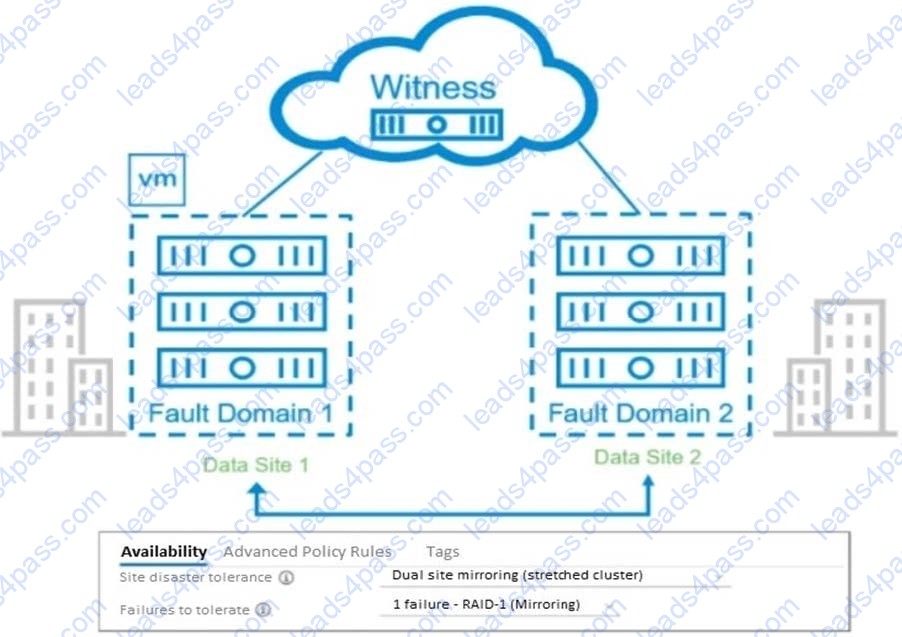
A storage administrator is designing a vSAN stretched cluster with production workload running on a
preferred site. A VM has been deployed on the preferred site.
How does the VM read I/O?
A. 50 percent from preferred site and 50 percent from non-preferred site
B. 70 percent from preferred site and 30 percent from non-preferred site
C. 100 percent from preferred site
D. 100 percent from non-preferred site
Which resource provides information about vSAN compatibility with other VMware products?
A. VMware Product Interoperability Matrices
B. vSAN Sizing Guide
C. vSAN Ready Node Configurator
D. vSAN Compatibility Guide
Refer to the red question mark in the exhibit.
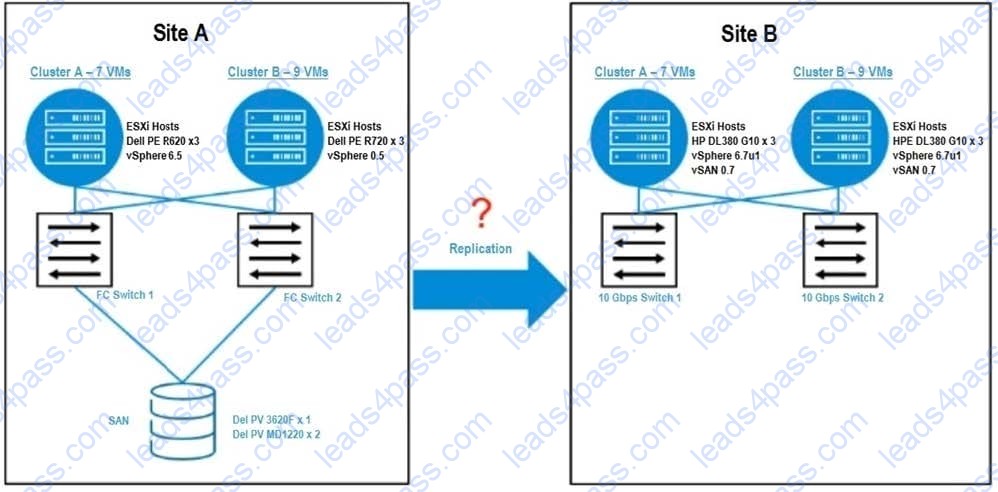
Which VMware solution provides automated interoperability to failover and re-protect VMs from Site A to Site B, and Site B to Site A?
A. vSphere Integrated Containers
B. NSX SD-WAN by VeloCloud
C. vRealize Operations
D. Site Recovery Manager
A vSAN all-flash environment with these host specifications has reported high network latency, write
latency, and faces degraded performance:
One 1Gbps (vSAN, vMotion Traffic)
One 1Gbps (Management, Fault Tolerance traffic)
Based on the specifications of each host, what is recommended to resolve the issue?
A. collapse all traffic into one 1Gbps NIC
B. collapse all traffic shared under two 10Gbps NICs
C. change stripe width to 12
D. change MTU to 9000
Refer to the exhibit.

What is the minimum number of data nodes across all sites in a vSAN stretched cluster configuration with the above storage policy?
A. 4
B. 6
C. 8
D. 9





All rights are reserved by
leads4pass.com. Any changes, copy or trademarks abuse will be
regarded as infringement.
leads4pass.com will reserve the right to pursue accountability.
Copyright © 2004-
2026 leads4pass.com.