
4A0-110 Online Practice Questions and Answers
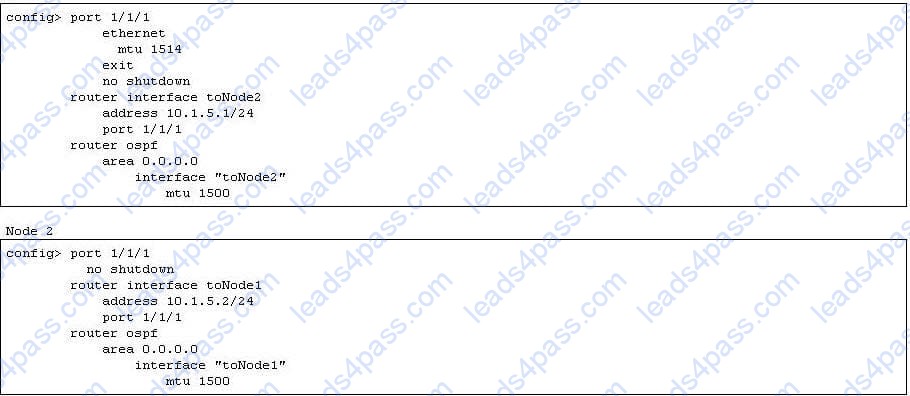
Two routers are physically connected to each other over Ethernet port 1/1/1. Review the configuration information below. What state should the OSPF neighbor be in?
A. INIT
B. EXCHANGE
C. EXSTART
D. FULL
E. No OSPF neighbor
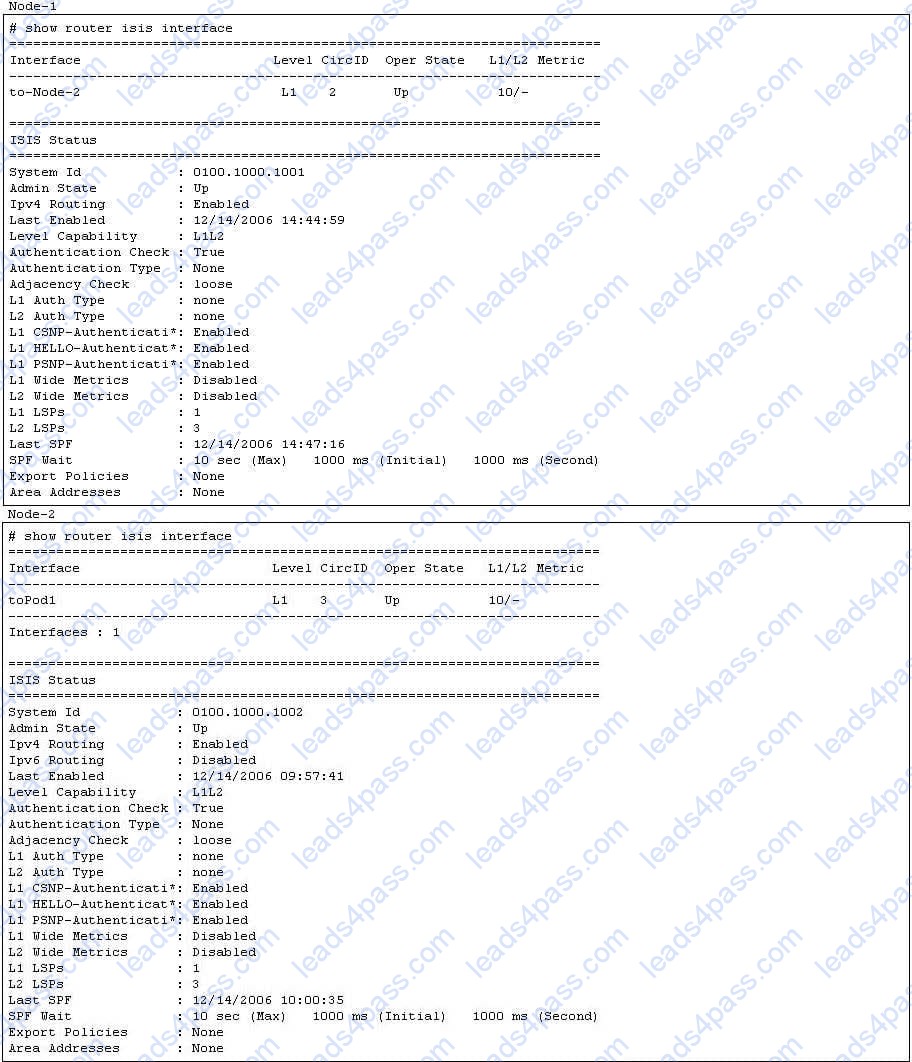
Two routers are physically connected to each other with ISIS configured. No ISIS adjacency can be found on both routers. Ping works fine on the local and the remote interface addresses on both routers. Review the confguration information shown below. Which of the following statements best describe the cause of the problem? Select one answer only.
A. The ISIS interface level configured does not match the ISIS level capability supported on the routers
B. The ISIS authentication check is enabled but there is no authentication type and password configured
C. ISIS Area addresses are not configured on both routers
D. L1 wide Metrics are disabled on the routers
E. ISIS Circuit id does not match on Node-1 and Node-2
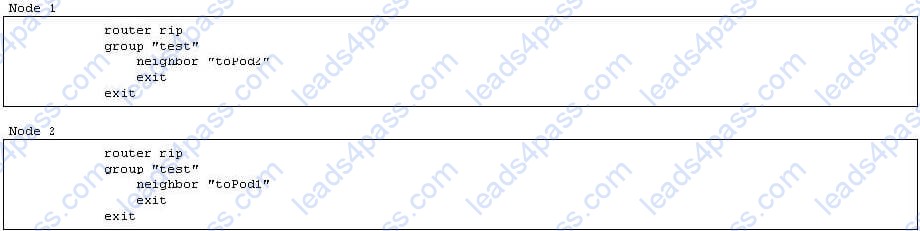
Two direct connected routers are running RIPv2, neighbors are up but there is no route in the RIP database. Review the configuration information below. What is the potential problem?
A. System interface is not added to the RIP protocol
B. No import policy is configured
C. No export policy is configured
D. Split-horizon has to be disabled in RIP
E. Message-size has to be configured with a non-zero value
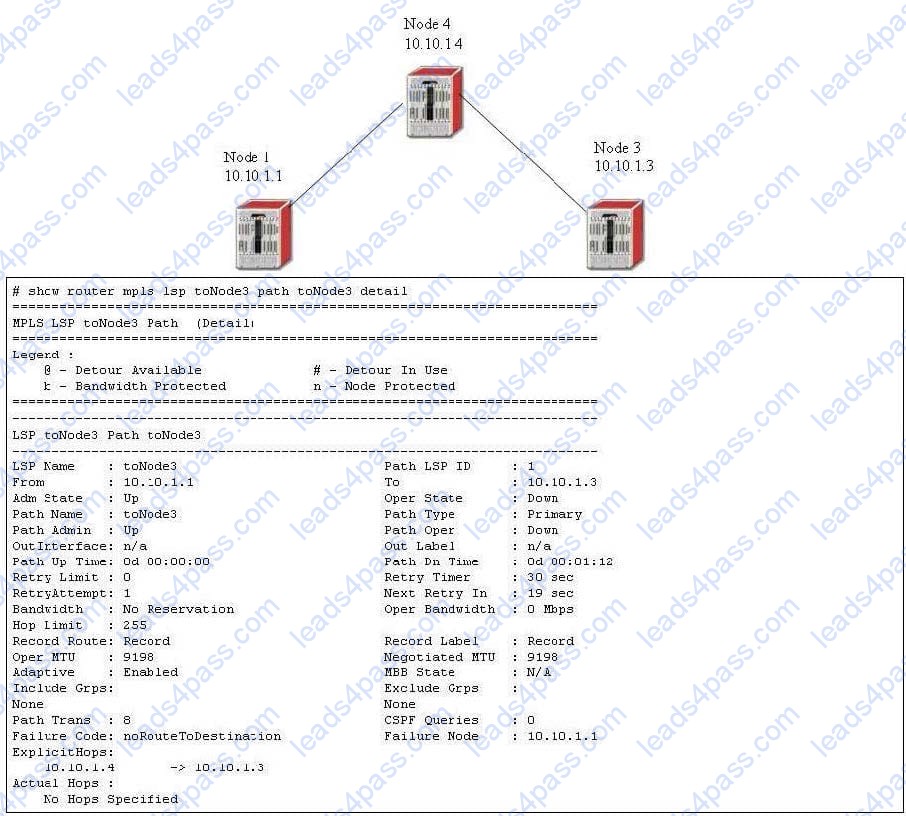
Based on the show display below, what should be done to further trouble the LSP problem? Choose all valid actions.
A. Check all the interface filters to make sure no LDP protocol is blocked
B. Check all management filters to make sure no RSVP-TE protocol is blocked
C. Verify all explicit hops are reachable via IGP
D. Make sure MPLS is enabled on all appropriate interfaces
E. Make sure LDP is enabled on all appropriate interfaces
Based on the following CLI Output, why is the path toPod3-loose down?
A. Path toPod3-loose is down because it is secondary path with no standby configured
B. Path toPod3-loose is down because there is no explicit hop specified
C. Path toPod3-loose is down because CSPF is not enabled
D. Path toPod3-loose is down because the destination address 0.10.1.3 is not reachable
E. Path toPod3-loose is not down because the failure code is oError
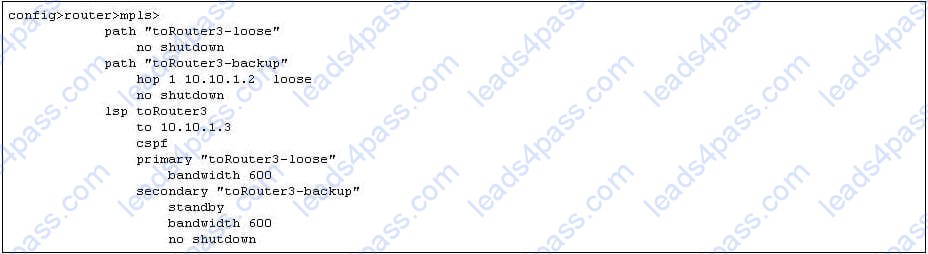
A LSP is configured with one primary path and one secondary path as below. What configuration is required to make the LSP non-revertive. Choose the best answer.
A. Turn off CSPF and remove all the bandwidth reservations
B. Remove the primary path and configure both paths as secondary
C. Under asp toRouter3? configure on-revertive
D. It is not possible to configure the LSP as non-revertive
E. MPLS fast re-route has to be enabled to make it non-revertive
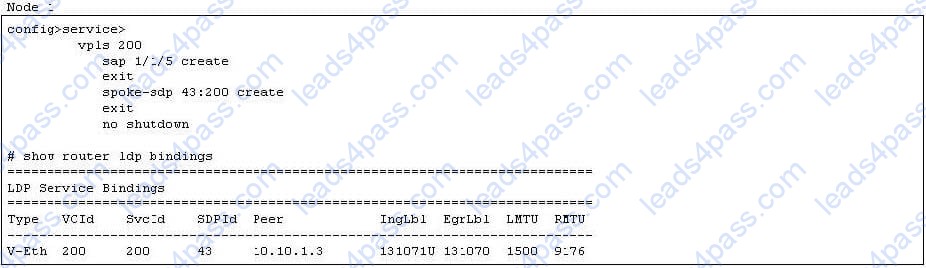
The mesh-sdp binding for a VPLS configured on Node 1 is down with an error serviceMTUMismatch. One sap is configured in the VPLS and it is up with default mtu 1514. The LDP binding display on Node 1 shows that there is a mismatch on the MTU value. What are the required configurations on Node 1 to bring the VPLS up?
A. Set the sap port mtu to 9176
B. Set the service-mtu to 9176
C. Set the service-mtu to 9190
D. Set the sap port mtu to 9190
E. Set the service-mtu to 1514
Node 1 receives some VPRN routes from Node 2, but Node 2 is not receiveing any VPRN routes from Node 1. Routes in VPRN 400 route table are found on Node 1 as follows: Based on the configuration below, why is Node 2 not receiving BGP VPN routes from Node 1?

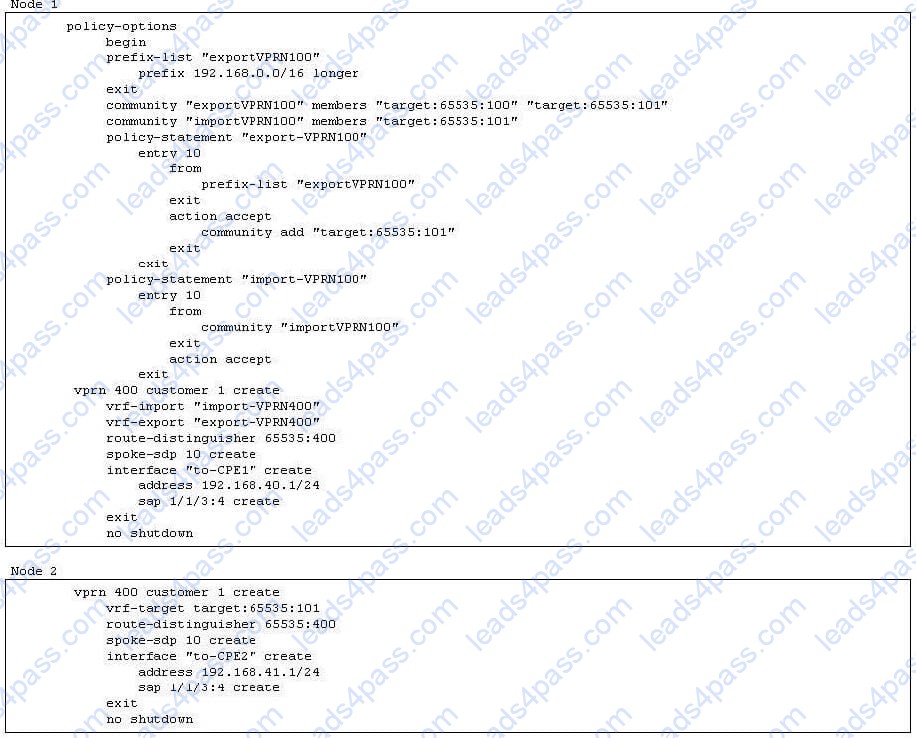
A. VRF import and export policies defined on Node 1 do not match with vrf-target defined on Node 2
B. Prefix-list exportVPRN100 is applied on Node 1 but not on Node 2
C. More than one import route targets are defined on Node 1 and only one defined on Node 2
D. VRF target has to be defined on Node 1 as well
E. Community target:65535:101 is not defined on Node 1
VPRN 300 is configured between Node 3 and Node 4. Node 4 receives VPN routes from Node 3 and imports them into the VRF. The entire route-table is displayed below for VPRN 300 on Node
4. When attempting a ping from VPRN 300 on Node 4 to 30.1.1.1 the ping fails. A ping from Node 3 within VPRN 300 to 30.1.1.1 is successful. What is the cause of the problem?
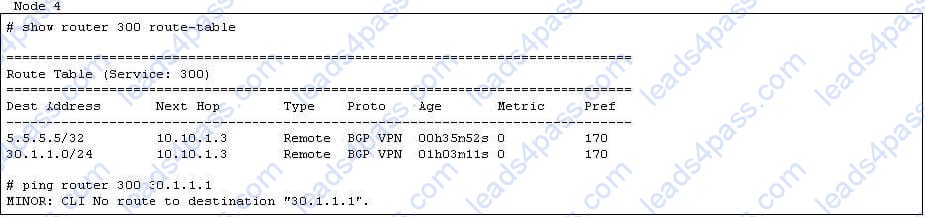
A. No local interface existed in VPRN 300 route-table on Node 4
B. Syntax problem in the ping command
C. Prefix 30.1.1.1 does not exist on the far-end
D. Source address has to be specified in the ping command
E. Next-hop address has to be specified in the ping command
Refer to the diagram below, what encapsulation type and VLAN tag are required at point X for the PC to ping the IES interface?

A. qinq sap 1/1/1:6.0
B. qinq sap 1/1/1:6.*
C. dot1q sap 1/1/1:6
D. null sap 1/1/1
E. There is no way to make ping works in this case





All rights are reserved by
leads4pass.com. Any changes, copy or trademarks abuse will be
regarded as infringement.
leads4pass.com will reserve the right to pursue accountability.
Copyright © 2004-
2026 leads4pass.com.