
4A0-107 Online Practice Questions and Answers
Click the exhibit button below. A service provider has applied the SAP-ingress policy configuration below on his customer's SAP. The service provider notices that all of the customer's traffic is being dropped at the SAP-ingress. Which of the following actions can resolve the problem, if applied on its own? (Choose three)
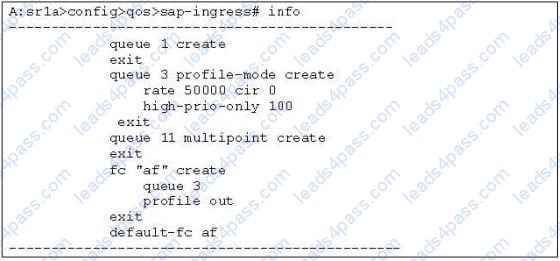
A. Set the CIR of queue 3 to a non-zero value corresponding to the customer's expected bandwidth requirements.
B. Set queue 3 to use priority mode.
C. Set the traffic classification of packets to in-profile.
D. Set the high-priority-only value to 0.
E. Map AF traffic to queue 1
Which of the following statements describe the primary objectives of the policing of traffic flows on the Nokia 7750 SR? (Choose two)
A. Ensure that traffic flows conform to their traffic profile.
B. Log violations of metered traffic flows exceeding the CIR value set on the entity across which the traffic is moving.
C. Provide fairness between traffic flows, so that conforming (in-profile) traffic flows are not starved of bandwidth and/or buffer space by non-conforming (out-of-profile) flows.
D. Minimize packet loss and reduce end to end latency.
E. Ensure that variable latencies do not cluster short bursts of originally conforming packets and render them nonconforming.
Which of the following statements are TRUE? (Choose two)
A. The primary contributors to latency are distance, scheduling, and congestion.
B. The weighted round robin scheduling algorithm will result in more delay for high priority traffic than the regular round robin algorithm.
C. The round robin scheduling algorithm will result in less jitter for low priority traffic than a strict priority scheduler.
D. Packet loss can be reduced by decreasing the amount of buffer space available to a queue.
E. Latency can be reduced by increasing the amount of buffer space available to a queue.
Click the exhibit button below. A network operator has configured the SAP-ingress policy below. Ping traffic is expected in queue 3. However, the network operator notices that all traffic is placed in queue 1. What is the most probable reason for this?
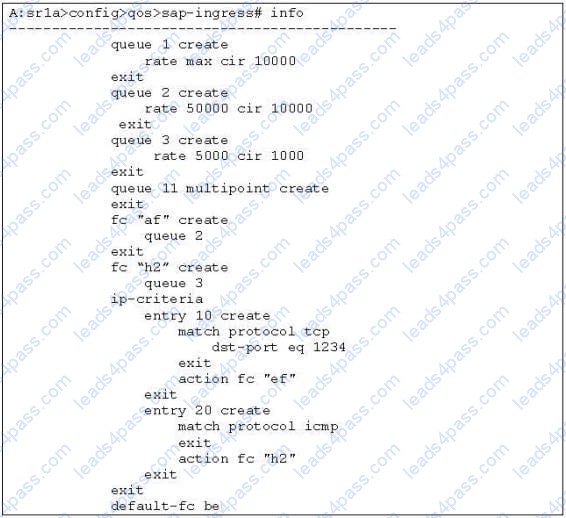
A. The default forwarding class for all traffic, including ICMP, is BE, which is placed in queue 1.
B. The SAP has been shut down.
C. The IP-match criteria has been misconfigured for ICMP traffic.
D. Queue 3 has no rate or CIR configured and thus cannot hold any packets.
E. The SAP-ingress policy has not been applied to the SAP.
Which of the following statements is considered best practice when changing a network policy that has been associated with an interface?
A. The policy should be placed in a "shutdown" state before changes are made.
B. A new network policy should be created and applied to the interface, overwriting the previous policy.
C. The policy must first be removed from the interface, then modified and re-applied to the interface.
D. Before the policy can be changed, it must be deleted with the no network qos
E. Before any changes are made to the policy, all network interfaces where the policy is applied have to be shut down.
Which of the following statements regarding the default scheduler in the Nokia 7750 SR are TRUE? (Choose two)
A. There are a maximum of 8 levels of priority serviced using a round-robin algorithm.
B. The default scheduler will spend an equal amount of time in each queue, as long as there is traffic present
C. The H1 internal forwarding class will receive its CIR before AF traffic.
D. Orphaned queues will be scheduled out of the BE queue.
E. A queue servicing EF and AF traffic will require explicit configuration to set the queue to expedited.
Which of the following policies does NOT exist by default on a network port?
A. A network policy for every network interface configured on the port.
B. A slope policy for the port on ingress.
C. A network queue policy for the corresponding MDA on ingress.
D. A network queue policy for the port on egress.
Which of the following statements is a characteristic of a CFHP arbiter?
A. An arbiter can adjust the CIR of its child policers.
B. An arbiter rate-limits the collective output of several policers towards each egress FFPC.
C. An arbiter can adjust the bandwidth assigned to its child arbiters and child policers.
D. An arbiter does not need to honor the configurations of its child policers.
According to the SAP-egress policy configured and applied, which queue will forwarding class AF's traffic use?
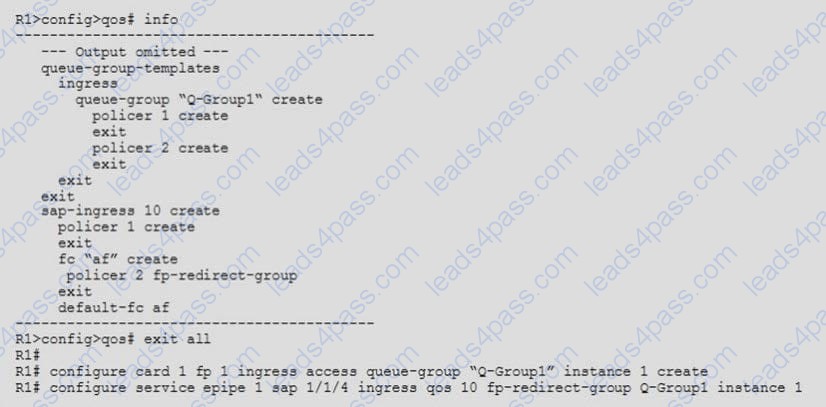
A. Policer 2 on the queue-group Q-Group1 instance 1.
B. Policer 1 on the queue-group Q-Group1 instance 1.
C. The default policer 1.
D. AF traffic is dropped.
Which of the following statements about the token buckets of a policer is TRUE?
A. When a packet arrives, the PIR bucket depth is checked and the packet is discarded if this bucket is full.
B. The CIR bucket of a policer is the reserved portion of its PIR bucket.
C. The CIR bucket of a policer has two thresholds: CBS and HPO.
D. Packets processed by the PIR bucket at an average rate above PIR will be forwarded as out-of-profile.





All rights are reserved by
leads4pass.com. Any changes, copy or trademarks abuse will be
regarded as infringement.
leads4pass.com will reserve the right to pursue accountability.
Copyright © 2004-
2026 leads4pass.com.