
4A0-106 Online Practice Questions and Answers
What are the two primary problems the service provider must consider when providing traditional Layer 3 VPN services using only a single common routing table in the provider core? (Choose two)
A. Memory exhaustion in the provider core
B. Route leaking between the customer networks
C. CPU utilization for route processing
D. Unwanted packet forwarding between customer networks
How was standard BGP modified to allow it to carry routing information for VPRNs?
A. By using the MED attribute to carry the OSPF metric.
B. By defining Extended Communities for use as the Route Target
C. By using the Cluster List attribute to carry the network prefix
D. By defining support for the VPN-IPv4 address family
E. By adding an additional field to the BGP Update to carry the VPRN label
After configuring OSPF as the PE to CE routing protocol for a VPRN service you get the following output from an Alcatel-Lucent 7750 SR: What is most likely wrong with the configuration?
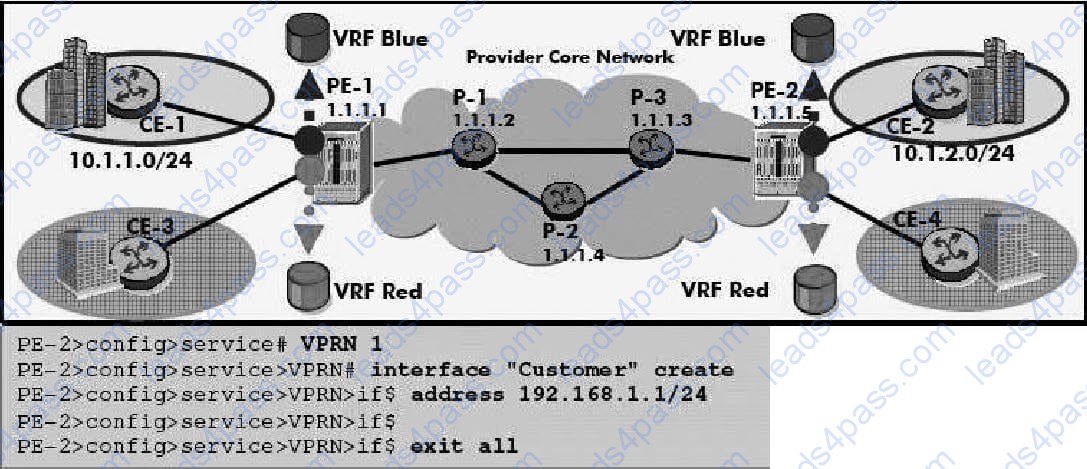
A. OSPF is not configured on the CE router
B. There is a problem with OSPF authentication
C. The operational MTU does not match
D. The PE and CE router have different OSPF interface types configured
E. None of the above
Which of the following protocols does the Alcatel-Lucent 7750 SR support to signal VPRN service labels?
A. Targeted-LDP
B. BGP
C. MP-BGP
D. RSVP-TE
Which of the following VPRN label allocation methods are supported by the Alcatel-Lucent 7750 SR?
A. One label per VRF per route
B. One label per VRF per next-hop
C. One label per VRF
D. All of the above
E. A and C
F. B and C
Click the exhibit.
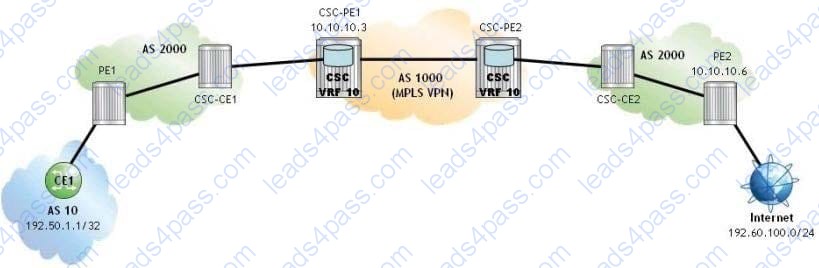
A Carrier Supporting Carrier (CSC) VPRN is configured for a customer carrier who is an Internet Service Provider (ISP). Which route is NOT present in PE1's global routing table?
A. 192.60.100.0
B. 10.10.10.6
C. 10.10.10.3
D. 192.50.1.1
For a Carrier Supporting Carrier (CSC) VPRN where the customer carrier is a BGP/MPLS VPN Service Provider (SP), which of the following is FALSE?
A. The customer carrier network can be a pure IP network.
B. The customer carrier provides Layer 2 and Layer 3 services to its end-customers.
C. A single CSC VPRN is configured on the network provider to support all services offered by the customer carrier.
D. In the case where the customer carrier offers VPRN services, the model is referred to as hierarchical VPRN.
VPN-IPv4 addressing is made unique by defining an address structure consisting of:
A. A 64-bit Route Target followed by a 32-bit IPv4 address.
B. A 64-bit Route Distinguisher followed by a 32-bit IPv4 address.
C. A 32-bit Route Distinguisher followed by a 32-bit IPv4 address.
D. A 32-bit Route Target followed by a 32-bit IPv4 address.
Click the exhibit.
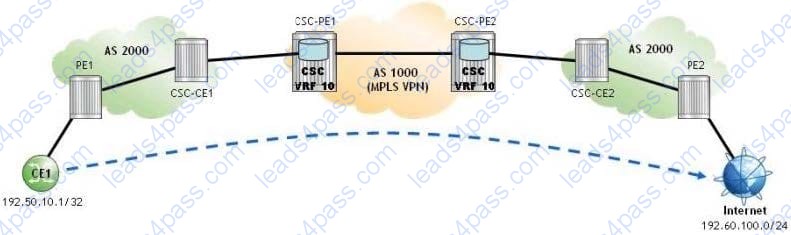
A Carrier Supporting Carrier (CSC) VPRN is configured for a customer carrier who is an Internet Service Provider (ISP). If CE1 sends an IP packet to 192.60.100.1, which of the following is FALSE?
A. PE1 pushes an LDP transport label.
B. CSC-PE1 pops the BGP label and pushes two labels: a VPN label and an MPLS transport label.
C. CSC-PE2 pops the MPLS transport label and pushes a BGP label.
D. CSC-CE2 pops the BGP label and pushes an LDP transport label.
Which of the following about Carrier Supporting Carrier (CSC) VPRN is FALSE?
A. CSC does not allow a customer carrier to offer Layer 2 services to its end customers.
B. A CSC VPRN is configured on the network provider's CSC-PE routers.
C. CSC eliminates the need for customer carriers to build and maintain their own MPLS backbone.
D. The network provider provides an MPLS VPN backbone to the customer carrier.





All rights are reserved by
leads4pass.com. Any changes, copy or trademarks abuse will be
regarded as infringement.
leads4pass.com will reserve the right to pursue accountability.
Copyright © 2004-
2026 leads4pass.com.