
3V0-624 Online Practice Questions and Answers
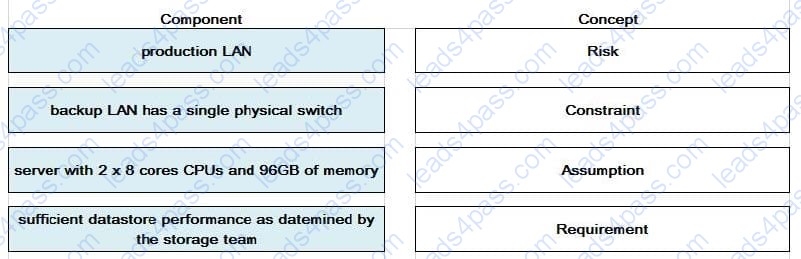
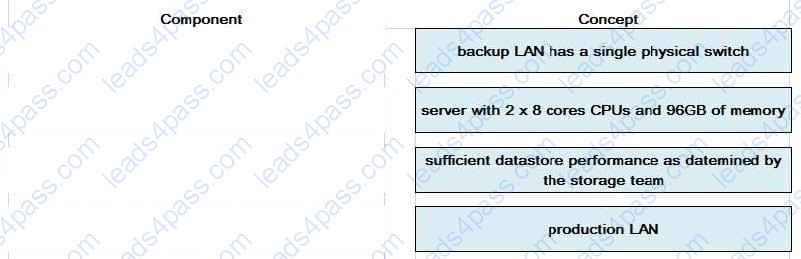
A company would like to utilize its current infrastructure but wants to adopt virtualization to consolidate its environment. Currently, the infrastructure contains:
1.
server with 2 x 8 cores CPUs and 96G8 of memory
2.
backup LAN with a single physical switch
3.
production LAN
4.
sufficient datastore performance as determined by the storage team
Match the existing infrastructure component to its appropriate concept.
Select and Place:
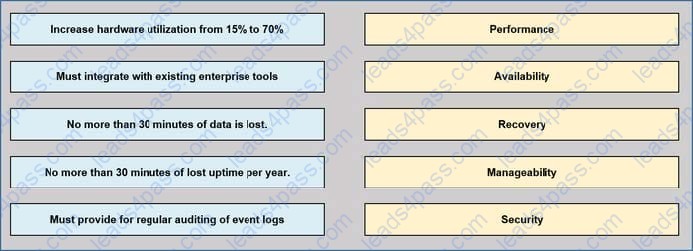
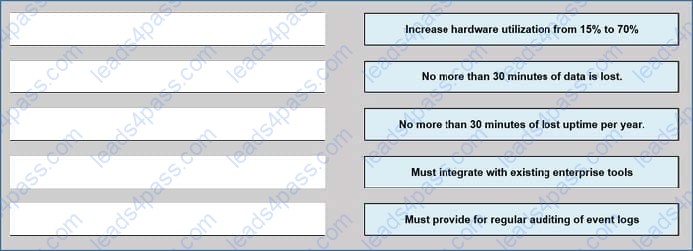
Match the business requirement to the appropriate design concept.
Select and Place:
DRAG DROP
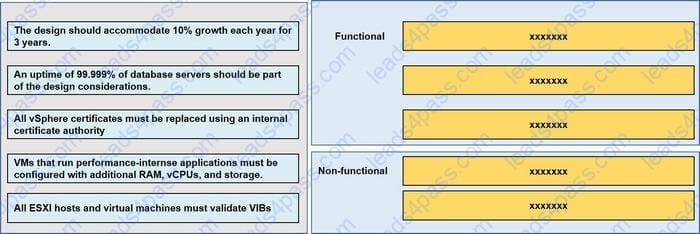
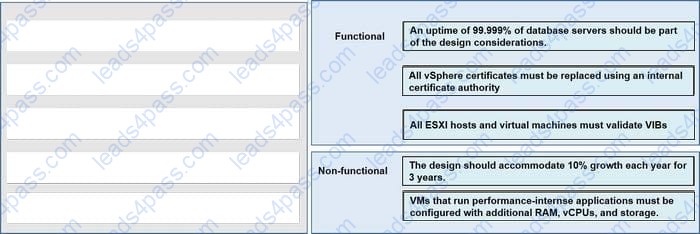
Determine which statements are functional or non-functional requirements, and place in the correct location.
Select and Place:
A university is going through an IT transformation project and is re-evaluating how to use technology to provide a better academic experience for its 15,000 students. The university is a current VMware customer and has a single data center.
1.
Within that data center, they are using blade servers backed by a Fibre Channel array for its business critical applications, and two iSCSI arrays (one for the development environment and one for the non-critical production environment).
2.
Its VMware environment consists of three clusters. The first cluster contains all development virtual machines, the second cluster is dedicated to DMZ virtual machines (VMs), and the final cluster contains production VMs.
3.
The university requires the ability to perform hardware maintenance without a service interruption, and can sustain only 4 minutes of downtime per month.
From the list below, which two are non-functional requirements? (Choose two.)
A. Projected growth has been calculated by reviewing the last five years of actual growth.
B. Provide for N+1 redundancy to support the environment during the maintenance window.
C. There is sufficient power and cooling in the current data center.
D. 99.99% uptime for the environment.
E. The WAN provider meets their SLA.
The system administrator team is planning to upgrade its vCenter Server 5.5 environments to version 6.5.
1.
Each vCenter 5.5 is pointing to a Single Sign On (SSO) server that has a dedicated virtual machine.
2.
The SSO servers are currently in independent SSO domains.
3.
During the upgrade process, the administrators would like to combine their two SSO domains into a single one.
View the exhibit.
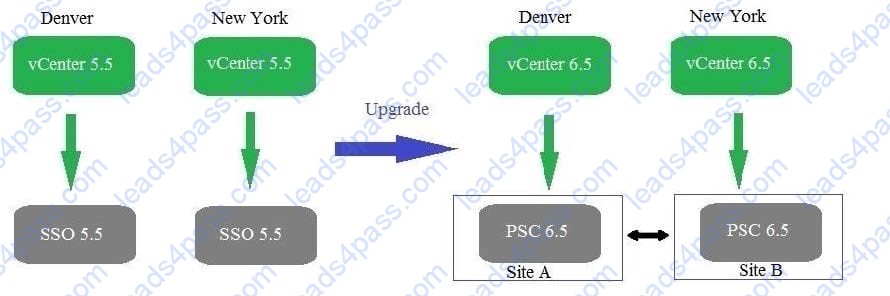
Referring to the exhibit, which upgrade scenario would accomplish this?
A. 1. Upgrade the Denver SSO server to a 6.5 PSC.
2.
Upgrade the Denver vCenter Server 5.5 to version 6.5.
3.
Use the migration utility to upgrade the New York vCenter Server to 6.5.
4.
Choose to join it to the Denver PSC.
B. 1. Upgrade the Denver SSO server to a 6.5 PSC.
2.
Use the migration utility to upgrade the New York SSO server.
3.
Choose to join the existing SSO domain during the second upgrade.
4.
Upgrade both of the vCenter Servers to 6.5.
C. 1. Upgrade both of the SSO servers to 6.5 PSCs.
2.
Upgrade both of the vCenter Servers to 6.5.
3.
Install a new 6.5 PSC in the same SSO domain as the Denver 6.5 PSC.
4.
Repoint the New York vCenter Server to the newly-installed PSC.
D. 1. Install a new New York SSO 5.5 server in the same SSO domain as the Denver SSO server.
2.
Repoint the New York vCenter Server to the newly-installed SSO server.
3.
Upgrade both SSO servers to 6.5 PSCs.
4.
Upgrade both vCenter Servers to 6.5.
The ability to live-migrate all virtual machines between two clusters is a requirement in the customer's design.
Which two clusters and EVC configurations will accomplish this? (Choose two)
A. Cluster 1
1.
ESXi 6.0
2.
Intel Skylake CPUs
3.
EVC Enabled: AMD OpteronTM";Steamrolle"; Generation
Cluster 2
1.
ESXi 6.5
2.
AMD Steamroller CPUs
3.
EVC Enabled: AMD OpteronTM "Steamrolle"; Generation
B. Cluster 1
1.
ESXi 5.6
2.
Intel?Broadwell CPUs
3.
EVC Disabled
Cluster 2
1.
ESXi 6.5
2.
Intel?Broadwell CPUs
3.
EVC Disabled
C. Cluster 1
1.
ESXi 5.5
2.
AMD Piledriver CPUs
3.
EVC Enabled: AMD OpteronTM";Piledrive"; Generation
Cluster 2
1.
ESXi 6.5
2.
AMD Steamroller CPUs
3.
EVC Enabled: AMD OpteronTM "Piledrive"; Generation
D. Cluster 1
1.
ESXi 6.5
2.
Intel Broadwell CPUs
3.
EVC Enabled: Intel?"Broadwe"t; Generation
Cluster 2
1.
ESXi 6.5
2.
Intel Sandy Bridge CPUs
3.
EVC Enabled: Intel?"Sandy Brid"t; Generation
A company has a database server that requires intensive random write performance on its traditional iSCSI storage running in RAID LUNs.
1.
Currently, it is running on a physical server.
2.
The customer would like to consolidate its existing environment by virtualizing.
When architects a vSphere 6.5 design, which three components would ensure storage performance and availability? (Choose three.)
A. RAID 5 on storage
B. 10Gb uplink for iSCSI network
C. RAID 10 on storage
D. VMXNET3 for the VM network
E. VMware Paravirtual SCSI adapter
In the review of the current state of a business application, which three statements are true? (Choose three.)
A. A virtual machine can be scaled up more quickly than a bare metal server.
B. Application outages caused by known issues in the software do NOT count against the 99.9% SLA.
C. Average latency should be monitored to ensure that application transactions never exceed 5 milliseconds.
D. A weekly full backup and incremental every 2 hours meets an RPO of 2 hours.
E. Separation of duties can be implemented using Role Based Access Controls (RBAC).
Recommend in order to allow multicast snooping to enhance multicast performance in vSphere 6.5?
A. Change multicast filtering mode in distributed switch from basic to igmp/mld
B. Change multicast filtering mode in distributed switch from igmp/mld to basic
C. Edit query time interval for multicast snooping to 300 secs
D. Multicast is not supported.
A customer uses servers without internal storage and asks a systems architect to design a solution with a Fiber Channel array and blade servers as options. The customer requires:
1.
Easier server replacement
2.
Booting through HBA or FCoE
3.
Less wasted space
4.
Improved management
5.
Batter reliability
6.
Inexpensive servers
7.
Easier backup processes
Which design element will follow VMware recommended best practices and also meet customer requirements?
A. VMware Virtual SAN
B. Auto Deploy
C. PXE boot
D. Boot from SAN





All rights are reserved by
leads4pass.com. Any changes, copy or trademarks abuse will be
regarded as infringement.
leads4pass.com will reserve the right to pursue accountability.
Copyright © 2004-
2026 leads4pass.com.