
3V0-42.20 Online Practice Questions and Answers
An architect is helping an organization with the Logical Design of an NSX-T Data Center solution.
This information was gathered during the Assessment Phase:
Customer currently has a single 10 host vSphere cluster.
Customer wants to improve network security and automation.
Current cluster utilization and business policies prevent changing the existing vSphere deployment.
High-availability is important to the customer.
Which three selections should the architect include in their design? (Choose three.)
A. Apply vSphere DRS VM-Host anti-affinity rules to the virtual machines of the NSX-T Edge cluster.
B. Deploy at least two NSX-T Edge virtual machines in the vSphere cluster.
C. Deploy the NSX Controllers in the management cluster.
D. Apply vSphere Distributed Resource Scheduler (vSphere DRS) VM-Host anti-affinity rules to NSX Managers.
E. Remove 2 hosts from the cluster and create a new edge cluster.
F. Remove vSphere DRS VM-Host affinity rules to the NSX-T Controller VMs.
An architect is helping an organization with the Physical Design of an NSX-T Data Center solution.
This information was gathered during a workshop:
Any proposed solution must provide low latency. Any proposed solution must provide high throughput. Customer is running stock trading applications.
Which two selections should the architect recommend to meet high-performance workload requirements? (Choose two.)
A. Leverage ESXi as the compute host.
B. Use LACP for all uplink profiles.
C. Leverage KVM as the compute host.
D. Enable enhanced data path mode on the N-VDS.
E. Enable latency sensitivity mode on the N-VDS.
Which selection is associated with the Review Task of the Engagement Lifecycle? (Choose the best answer.)
A. Gather and document requirements, assumptions, and constraints.
B. Build, deploy, implement, and test the design.
C. Measure performance against customer's objective.
D. Create and document the logical and physical design.
An architect is helping an organization with the Physical Design of an NSX-T Data Center solution.
This information was gathered during a workshop:
Migrating existing data center to KVM hosts.
Redundancy and high availability are required.
No component can be a single point of failure.
Which selection should the architect recommend? (Choose the best answer.)
A. Linux Bridge redundancy with Active/Active Mode and multiple pNICs with necessary binding
B. Linux Bridge redundancy with Active/Active Mode and single pNIC with static binding
C. vSS/vDS in Active/Standby Mode with necessary binding
D. vSS/vDS in Active/Active Mode with necessary pNICS and required binding modes
A customer has a requirement to implement a next generation firewall (NGFW) to improve security network introspection. The customer wants to apply the NGFW to all workloads exposed both internally and externally. The customer wants the NGFW to work seamlessly with NSX-T Data Center and vSphere.
Which solution should be recommended to the customer? (Choose the best answer.)
A. Use network introspection only on the external workloads and use NSX DFW for internal workloads.
B. Apply the NGFW on bare metal hosts which will offer better performance of inline network introspection.
C. Apply the NGFW to internal and external workloads for increased protection and use NSX-T Data Center with Federation to set network policies.
D. Use NSX-T Data Center leveraged with NSX Intelligence to protect all workloads at the network inspection level.
An NSX-T architect is working with a customer who wants to improve performance and future-proof their
workloads with a multi-site architecture.
A current-state analysis captured this information:
Latency between sites is 160ms.
Bandwidth is 2Gbps.
The MTU is 1600.
What two VMware design recommendations should the architect recommend to the organization to
achieve future-proofing? (Choose two.)
A. MTU is recommended to be 9000.
B. MTU must be at least 1700.
C. Bandwidth must be at least 10Gbps.
D. Latency RTT is acceptable.
E. Latency must be less than 150ms.
An NSX-T Architect is working in a brownfield environment with 4 ESXi hosts. These constraints were documented:
new servers cannot be purchased North/South bandwidth must be guaranteed Top-of-Rack switches have additional uplinks
Which three recommendations should the architect implement? (Choose three.)
A. Remove one of the ESXi hosts and install a bare-metal Edge.
B. Use a resource pool for production workloads.
C. Use a resource pool to deploy the Edge nodes on.
D. Recommend obtaining 2 new physical NICs for the servers.
E. Install Edge nodes on a separate cluster.
Refer to the exhibits. Design Option1:
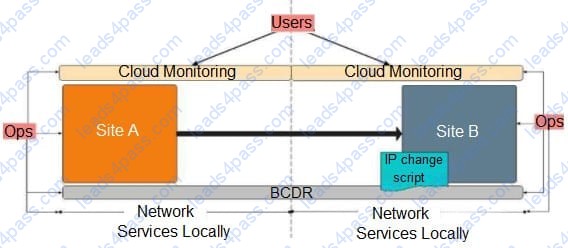
Design Option 2:
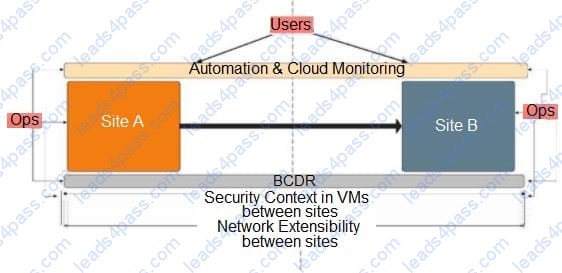
Design Option 3:
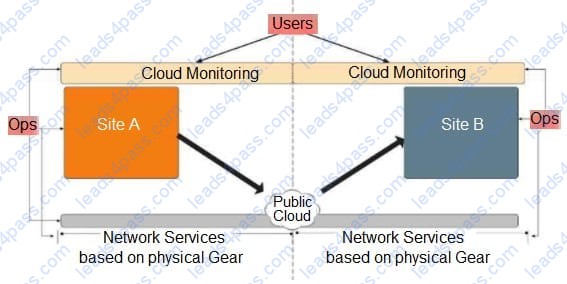
Design Option 4:
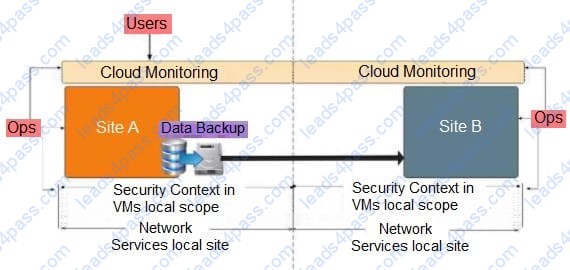
An architect is helping an organization with the Conceptual Design of an NSX-T Data Center solution.
The conceptual design includes these requirements, assumptions, constraints, and risks:
Critical applications must run across sites without changing IP address.
Business continuity and disaster recovery (BCDR) plans will leverage a second site running vSphere.
RTO/RPO must be reduced for recovery of applications on secondary site.
IT Teams require automation tools for configuration.
Which Conceptual Design would the architect recommend to the customer? (Choose the best answer.)
A. Design Option 4
B. Design Option 2
C. Design Option 1
D. Design Option 3
Which three assessment findings are part of a Conceptual Design? (Choose three.)
A. risks
B. host names
C. justifications
D. constraints
E. assumptions
F. vendor model
An architect is helping an organization with the Logical Design of an NSX-T Data Center solution.
This information was gathered during the Assessment Phase:
Customer is concerned with NSX Manager availability.
3 cabinets/racks are available in the data center.
No integration with 3rd party solution is required.
There is no budget for physical equipment acquisition.
The 3 cabinets/racks do not share the same L2 domain.
Which three selections should the architect include in their design to address the customer's concern with
NSX Manager availability? (Choose three.)
A. Deploy 2 cold standby NSX Manager appliances in rack 2/3.
B. Use separate IP per NSX Manager appliance per rack.
C. Use another NSX Manager IP in case an appliance fails.
D. Deploy a single active NSX Manager appliance in rack 1.
E. Deploy an NSX Manager Appliance per rack and cluster them.
F. Use a physical/internal load-balancer with the cluster.





All rights are reserved by
leads4pass.com. Any changes, copy or trademarks abuse will be
regarded as infringement.
leads4pass.com will reserve the right to pursue accountability.
Copyright © 2004-
2026 leads4pass.com.